photos/Kiki Garfield
It appears we’ve stumbled upon that rarest piece of real estate: the immortal dump. It cannot be demolished. It cannot be sold. It cannot be fixed and it cannot be moved. Its destiny is to continue to deteriorate as the elemental forces of nature and vandalism take their achingly slow toll.
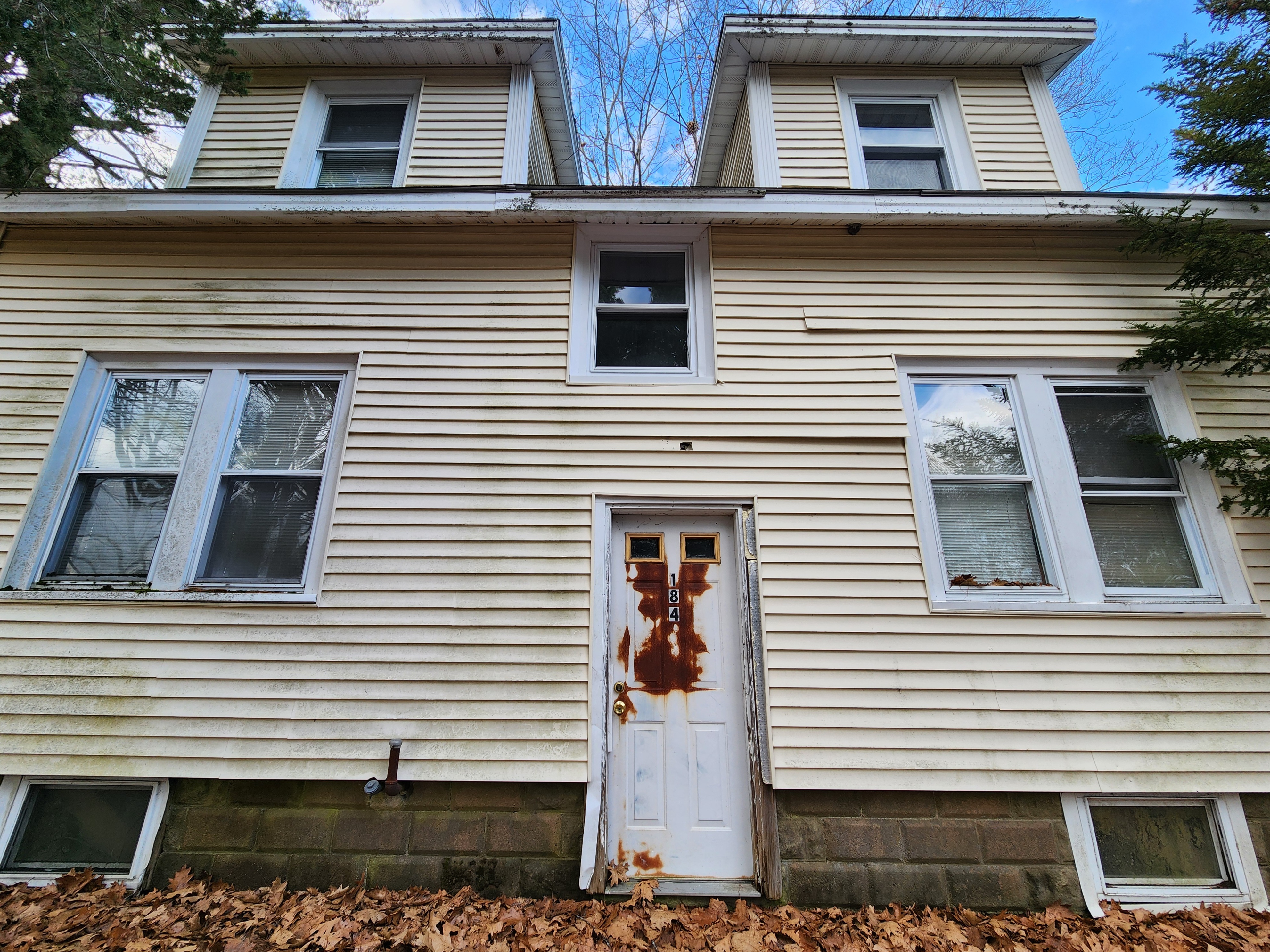
Perched on a steep cliff overlooking the Fore River, this four-bedroom, one-and-a-half story house at 184 Osgood St. is owned by Waynflete, the prestigious private school in Portland’s West End. It sits right next to the entrance to Waynflete’s athletic fields, in a hidden, sparsely developed neighborhood off outer Congress Street, but is visible to all the players and parents who frequent the facility.
Waynflete is not in the habit of allowing its properties to fall to ruin in plain sight. They have a reputation to uphold. So I was mystified to see the condition of this home: broken and boarded-up windows, unclimbable wooden entry stairs, rusty doors and moldy cream-colored siding falling off in spots. And then there’s the existential horror of it all — how, in the midst of a crushing housing crisis, a seemingly habitable home with gorgeous river views in a secluded neighborhood has been vacant for two decades.
What gives?
Well, it seems this property is stuck between a non-profit educational institution and the City of Portland, two entities whose guiding principles and laws are irreconcilably at odds.
Built in 1900 in the “old style,” this house was last the abode of Mr. and Mrs. William Merrill (that’s how Anna, William’s wife, signed her name on a 1990 home inspection form). City tax records indicate that William was a veteran of World War II. I found it odd that this bit of biography follows his name on the tax rolls, but perhaps it granted him a special property-tax break.
More puzzling was the price valuation listed on city tax records when the property changed hands on the second-to-last day of 2005: $400,000. Currently assessed at about half that sum, this modest home and the tiny, angular, treacherously pitched plot of land it sits upon were never worth 400 large.

Portlander commercial real estate developer Ted West — whose Atlantic National Trust built several high-profile properties along Marginal Way in Bayside (including the InterMed and AAA buildings) — bought it in 2000 for $90,000 and pledged that year to give it to the school. According to Waynflete’s communications director, Rand Ardell, West formally gifted the property to Waynflete at the end of 2005, so no money changed hands, and it was “transferred legally … based on a valuation of $90K at the time it was pledged,” Ardell wrote in response to The Bollard’s questions.
County property records back that up, and we’re talking about data entered two decades ago by someone in the city’s Assessor’s Office, so that curious figure is presently unexplainable. Perhaps a cat walked across the keyboard…
Anyway, back to Ardell. The prep school’s spokesperson said there were tenants living there when Waynflete took possession of the property in ’05, and the school continued to rent to them “for a brief period.” After its occupants “departed,” the school had the property inspected and discovered “a number of serious issues,” Ardell wrote, “including: no septic system or connection to municipal sewage; significant asbestos in the siding, wrapped plumbing, and heating pipes; lead paint throughout; major issues with the foundation; and earth banking stabilization concerns.”
Addressing those problems to make the place habitable was “not cost-effective,” according to Ardell, who noted that, “as a nonprofit educational institution, Waynflete is primarily concerned with funding its academic and financial aid programs.” The property’s proximity to the river and the state Department of Environmental Protection “compliance requirements” that entails would have further added to the cost, Ardell wrote.
So, I guess we’ll condition one of our earlier statements: this place can be fixed up and inhabited, but Waynflete’s not in the residential real estate business and its mission precludes spending money on a project unrelated to its educational aims.
Why not just knock it down?
“The City of Portland would not permit us to demolish the structure as it would have reduced the city’s housing stock,” Ardell responded. “Doing so would have resulted in significant penalties — again, as a nonprofit educational institution, this was not an investment we wanted to make.”
So another condition is in order: it can be demolished, but Waynflete is loathe to pay the fines for doing so, because … again, the kids come first.
The fun continues. Ardell again: “Waynflete attempted to sell the house for $1.00 and have it moved to a nearby buyer’s property at their expense. The potential buyer backed out of the transaction, informing us that the City had proposed significant and costly road improvement requirements to move the structure to its new location. We contacted neighbors and local real estate agencies to see if there were other interested parties. No interest was expressed.”
OK, fine — it could also be moved, but again, that’s a pricy proposition involving a maddening mess of municipal red tape. So this former veteran’s home sits and sags while the river flows gently by, used to store a few traffic barrels and a pile of little classroom seat-desks. “The structure has unfortunately been subjected to occasional vandalism,” Ardell noted, and said the school has no plans at present to do anything with 184 Osgood.
Unmentioned by Ardell, but potentially relevant, is the fact Waynflete is in the midst of a major renovation project in the West End: a $15 million “Wellness and Athletics Center” to replace its old gym. That project is also a feat of bureaucratic finesse, as it’s in a designated historic district and the neighbors there are … well, persnickety is a word.
Still, I had to press Ardell a bit more about Waynflete’s dump. “Does the years-long neglect of this property and careless use of it not reflect poorly on Waynflete, given your school’s professed values?” I asked via e-mail.
“For the many reasons noted above, this structure is uninhabitable,” Ardell responded. “We encourage any parties who may be interested in purchasing the structure and moving it to a suitable location within the City of Portland to contact the school.”
The response closed on a polite note: “Thank you for your interest in Waynflete.”
Waynflete is welcome.