A Mainer who fled violence in Africa reflects on his abduction by ICE
Paul is an asylum seeker who lives and works in Maine. His name is not Paul, but he wants to tell us his story, to warn us about what he’s experienced. Paul fears for his safety — here in Maine and, were he to be deported, in his home country — so his name and other identifying details, such as his nation of origin, have been omitted from this article.
“Let’s just use Africa,” Paul suggested when I met him last fall, not long after he’d been arrested by Immigration and Customs Enforcement (ICE) agents; driven in chains to an ICE field office outside Boston, where he was detained in inhumane conditions; and incarcerated for over a month before being released on bond.
“Despite being jailed by ICE, I still believe it is safer [in Maine] than in my country,” Paul said. “I cannot go back.”
The day of his arrest, Paul was driving to work a double shift at a residential care facility. “I had everything I needed for that day, because I was going to be [on the job] for sixteen hours with two residents,” he recalled.
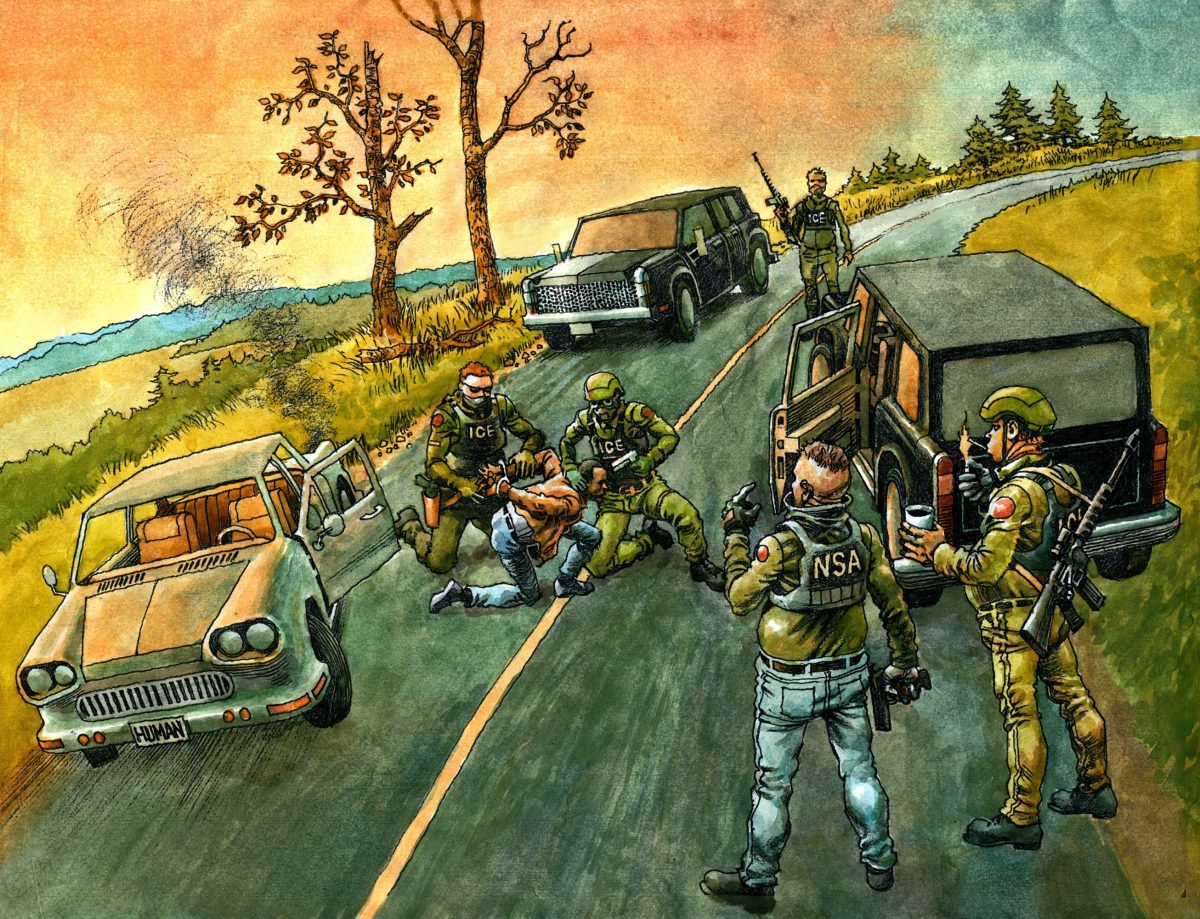
When Paul heard a siren over the country music on his car stereo, he glanced up to see flashing lights in the rearview mirror. “I saw probably they want me, so I immediately pulled over,” he said. With a clean criminal record and his immigration paperwork in order, Paul expected to have a polite conversation with the two burly guys in black flak jackets who approached his car.
“I asked them, ‘Do you want me?’ And they said yes,” Paul recalled. “They were really, really aggressive. It was their tone, and the way they looked at me. … I said to myself, This is not usual, because professionally, U.S. people are amazing.”
Paul was comfortable around local law enforcement and appreciated the police who’d show up at his workplace when he had to call 911 for help with a violent or suicidal client. The cops’ calm deescalation skills had impressed Paul. “They were exceptional,” he said of those officers.
“But these two people, they were something else,” Paul said. “I will never forget them. … Immediately, they said, ‘You are arrested. Are you willing to accept the handcuffs?’ I said, ‘No problem, I accept.’”
Paul didn’t invoke his right to remain silent or ask to see the arrest warrant. “Personally, I was raised in a place where rights is a privilege,” he explained. “Our authorities back in our countries, they don’t promote rights to people, you know? So it’s rare to see people claiming rights.”
Instead, Paul said, “I was humble, very humble.”
Paul was handcuffed and locked in a cruiser. He said one of the officers identified himself as a federal agent, cited Paul’s country of origin and the date he arrived in the U.S., and told Paul he’d overstayed. Paul’s car remained parked on the roadside, empty and unlocked, with his work bag, containing his wallet, on the passenger seat.
“When they said they are federal, what comes to my mind is that probably they are ICE,” Paul told me. “And I said I didn’t overstay, because I immediately filed my asylum application, so I didn’t overstay. The officer said, ‘No, you are arrested. Applying for asylum doesn’t give you legal status to stay in the U.S.’”
The language of immigration law is confusing. It can also be used to intentionally confuse. For example, refugees, asylees and lawful permanent residents all have what’s termed “legal status,” but living here without legal status is not, in itself, a crime. As an asylum seeker who’d filed his paperwork with U.S. Citizenship and Immigration Services (USCIS) and had attended his scheduled check-ins, Paul was considered to be “lawfully present” in the U.S. at the time of his arrest. He was also legally employed while waiting to be assigned a date for his asylum hearing.
Paul provided me a copy of the form ICE had used to justify his arrest — a document he obtained only after he was released. ICE has been given authority to print and sign these administrative I-200 forms from the U.S. Department of Homeland Security (DHS), which labels them a “Warrant for Arrest of Alien.”
Nearly 400,000 people have been arrested by ICE during President Trump’s first year back in power. Trump has characterized the mass purge as an effort to deport the “worst of the worst” — convicted murderers, rapists and violent gang members living here illegally.
Last month, CBS News reported that less than 14 percent of those arrested by ICE during this period had a violent crime on their record, according to an internal DHS document obtained by the network. Almost 40 percent “did not have any criminal record at all,” according to CBS, “and were only accused of civil immigration offenses, such as living in the U.S. illegally or overstaying their permission to be in the country.”
Critics accuse ICE of using overly aggressive tactics — like “roving patrols” and SWAT-like raids conducted by masked gunmen in unmarked vehicles — to police paperwork violations. In the cases of asylum seekers like Paul, the alleged infractions are typically the result of USCIS’ hopelessly backlogged application-processing system. It takes over four years, on average, for applicants to get a decision, and hundreds of thousands of people who fled violence overseas have been waiting for over a decade.
Paul said that before he was arrested, “I wasn’t concerned about ICE, because I thought, I’m not a criminal. Because, you know, I believed the U.S. would not do those kinds of activities or operate in that way.”
“This type of arrest has been done for so long in my home country,” Paul added, referring to militarized policing. “We have so many people who have disappeared. You see [an African police] car behind you, and you are scared they are trying to kidnap you.”
Paul struggled to understand all the orders the ICE agent barked at him, and this also reminded him of Africa. “They don’t give you time to explain, they are rushing,” he said of authorities in his home country. “They are too fast and they want the operation to be done in a short time.”
“Then he drove me without [my] knowing where we are going,” said Paul, “and it was to Scarborough.”
The ICE field office at 40 Manson Libby Road is inside a nondescript, one-story cinderblock building in a commercial-industrial zone. There’s a parking area adjoining the building hidden behind brown-paneled fencing and topped with razor wire. An electric gate opens to allow agents to drive in and out.
Paul was uncuffed and placed in a windowless cell inside the field office. There was a seatless steel toilet in a corner and a steel bench protruding from one wall. A peephole in the door gave him a partial view of a block of cells.
“I stayed there in that tiny room thinking too much about what was happening,” Paul told me. “I was really hurt mentally.”
A guard opened the door and offered Paul some mac and cheese, but he couldn’t stomach anything. A few hours later, hunger kicked in and Paul rapped on the cell door to take the guard up on his offer. This guard was more polite than the arresting officers, Paul remembered, “but at that moment I didn’t think anyone was good.”
The guard returned that afternoon. “He told me, ‘You’re gonna do an initial statement before we get you to the jail.’ He asked me if I was ready. I said, ‘No, I’m not ready.’ He tried to convince me that I should do it. I said, ‘No, I’m not ready because I don’t have a lawyer. How will I do that stuff?’”
Paul said the guard offered him a list of attorneys willing to work pro bono, but he declined it. “I believe you should live through your own sweat — I don’t like free stuff,” Paul told me. “But the big reason is that in my home country, they have a list of lawyers, and those lawyers are manipulated.” Paul told the guard, “Give me time and I will pay for my own lawyer.”
The guard asked Paul to confirm his nationality and date of entry into the U.S., and he did so. But Paul said the guard then pressed him to admit he’d committed immigration violations that he hadn’t committed, so he stopped answering questions.
The guard wrote on the form: “refused to sign.”
Paul said this guard was “probably a good guy,” because in addition to the mac and cheese, he allowed Paul to make two calls on the cell phone they’d confiscated from him. Paul used both calls to get his work shifts covered.
The guard also advised Paul to write down a few key contacts’ numbers on a scrap of paper before they took his phone away again. “He said it’s not a good idea to go without some numbers,” Paul recalled. “That was really, really something helpful, because once in [jail], those numbers really helped so much. That’s why I still believe that guy was good.” A few other Maine immigrants Paul met in jail had also dealt with this guard, and “they thought he was good, too.”

Two different ICE agents, a man and a woman this time, chained Paul for transit again. First handcuffs, then, to his dismay, ankle shackles. “It was like I was considered a serial killer,” said Paul. “I don’t like even to remember that image of myself. It’s the worst image I can remember.”
Paul’s immobilized body was hoisted into a prison transit van. When we met, Paul showed me how he sat during the long drive to Massachusetts. “You just need to stay like this,” he said, bending forward in his chair at the waist, almost crouching. “Otherwise, you would feel pain.”
Paul didn’t ask to have the restraints adjusted. “I remember, because of the initial treatment [during the arrest], my belief was they are aggressive, so I wouldn’t ask them any questions,” he said. “But they knew” he was in discomfort.
“The idea of shackles being too tight, I hear that a lot … especially in those African countries that folks are coming from,” said Wyatt Kilburn, student co-leader of the Tufts Asylum Project, which works with the University of Maine School of Law and others to conduct forensic evaluations for asylum seekers.
ICE’s law enforcement tactics resemble those of African dictatorships. “Government soldiers or government police officers get involved, either track them down or capture them at a political event,” Kilburn said. African forces “rough them up in any number of ways, whether that’s kicking or beating with batons or nightsticks or whatever they might have — gun butts, that sort of thing. Usually they are roughly being either handcuffed or bound with zip ties, roughly handled into some sort of military jeep or official vehicle, and then being incarcerated in unsanitary conditions.”
Paul said the trauma he experienced in ICE custody wasn’t due to physical abuse. It was the devastating sense that the repressive state system he’d escaped in Africa had somehow managed to grab him in Maine, the new home he’d considered a haven.
“I think people like me suffer the most because it was, you know, not expected to have that in the U.S.,” Paul said of African asylees. “Mentally, they’re not prepared to have those scenarios.”
At ICE’s Boston field office in the town of Burlington, Mass., the guards unchained Paul in a crowded cell among about 40 other men, more than half of whom he identified as Latin American.
“There were some horrible images,” he said. Some of the men, apparently arrested or jailed by force, were still bloody and unbandaged.
“And because it was cold, I saw people laying down on the floor without something to cover themselves,” Paul recalled. “They would use those papers we use in the kitchen [that] are between paper and metal” — aluminum space blankets used during emergencies. The cell had only one toilet, in open view and monitored by security cameras.
Last month, the Lewiston Sun Journal reported that attorneys for people caged inside the Burlington office are raising alarm about conditions there, including overcrowding and lack of access to medical care, medicine and showers. Some detainees are being held inside the office for 10 days or longer in “inhumane” conditions, Massachusetts attorney Robin Nice told the newspaper.
“They’re trapped in this little confinement cell, a dark cell with no sunlight, with multiple people,” Shaan Chatterjee, an attorney with New England Immigration Law, told the Sun Journal. “They’re basically torturing people into signing off on their own deportation.”
Paul said it seemed he was the only one in the holding cell who didn’t have what everyone called “paperwork” pertaining to their arrest. “They didn’t give me anything,” he told me. “I tried to ask the guards in Massachusetts, ‘Where is mine?’ They would say, ‘We don’t know.’”

Paul said a man he identified as a European was among the crowd in the cell. It seemed he’d been jailed by ICE before, Paul said.
The European cracked jokes, interpreted for detainees, and pestered the guards with demands for things the others were unaware they were entitled to receive. Paul said the man taught him to say, “I need my call, it’s my right,” and insisted everyone should be transferred out of the holding cell without undue delay. “It was fun being around [the European], despite our awful moments,” Paul said.
Before nightfall, Paul was cuffed and shackled again and loaded into a van bound for a jail elsewhere in New England. This time, he was among about a dozen other prisoners. Once again, the restraints were too tight, “but when you are in a group, you share the pain,” Paul said. “It was better in a group.”
“We were warmly received at the jail,” Paul told me. “It’s not managed by ICE.” The jail guards gave him hot spaghetti, milk and juice, fresh socks and underwear, and, to his grateful surprise, soap. “But it also reminds me I was in a jail, because they got those uniforms for prisoners,” Paul said: scrubs.
Paul was locked inside a cell in a wing of the jail reserved for immigrants. His four cellmates talked among themselves, but Paul didn’t know their language, “so I was alone,” he said. The thin mat he was given to sleep on hurt his back. He tried to focus on positive thoughts.
“In Africa, I went through different tough situations, like passing nights in the bush — like a banana plantation — because of fear of being killed,” Paul told me. “So if you give me a tiny mattress, I feel even comfortable,” he said with a chuckle.
Paul described the daily routine in the jail: “Get up at five a.m., get breakfast, go back in the room. And at nine a.m., you get out — an open space with a TV screen, a basketball court with only one bucket. And then eleven-thirty lunch, four-thirty dinner.” Prisoners could also order cookies or ramen. “You know Maruchan?” Paul asked me.
In the common area, Paul met a few Africans from his region and a handful of Latinos who knew enough English to communicate with him. “Now I know how things are in Brazil, Guatemala, El Salvador,” Paul said. “Because people would talk about the different cultures, or how they believe, how they live.” Everyone intermingled, trading haircuts and commissary snacks, shooting hoops and watching soccer.
But depression and other mental illnesses were also on display. “I saw people who were traumatized, [who] would wake up and cry during the night … shouting loudly, ‘I’m not a criminal! Why am I here?’” Some prayed for hours at a time, but didn’t seek any legal help.
“Immigrants are being mentally killed, and many of them will not cure,” said Paul. “Even after release, we’re still traumatized.”
Paul found it strange that a law enforcement campaign undertaken to improve public safety would do this to people. “Many will stay, and everyone will have to live with people already killed mentally, who will choose to stay in the U.S. despite the climate of fear,” he said. “So it’s really confusing when we see people from the government treating people this way.”
“Why don’t they just mail us the court summons in the first place?” Paul wondered aloud. Asylum seekers here are, by definition, eager to engage with our immigration system. “We would go independently,” Paul said.
•••
To gain release from ICE custody requires self-advocacy, social connections, and lots of money. Paul taught a new African inmate the jail skills he’d learned during his weeks there in exchange for a reference to the man’s lawyer, who worked for a Boston-based firm.
Due to high demand for its services, the firm was only taking cases it was confident it could win. They agreed to represent Paul, but he couldn’t pay the $4,500 retainer fee because his wallet was still in his work bag in his car, and he had no idea where his car was. The law firm tracked it down to a lot operated by a towing company in southern Maine, but Paul’s friends were afraid to retrieve the vehicle for fear of being arrested by ICE.
“I tried to call my people in Maine to see if they can do something for me, if they can help,” Paul said. “But they thought I wouldn’t be released. And to my surprise, some started to imagine that I did some crime.”
Paul eventually coaxed two friends to get the bag, but his car remained in the impound lot for several more days, racking up storage fees while his lawyer drew up a legal release authorizing Paul’s friends to drive it off the property.
The manager of the towing company told me his business has a contract with DHS to impound detainees’ vehicles. He recommends that immigrants going to scheduled check-ins at an ICE office have someone drive them to the appointment, in case they don’t come out.
If the towing company doesn’t hear from the owner within a few days, they’ll apply to take title of the vehicle, the manager said. The state will send notice to the owner that they have 21 days to claim their property. If the owner fails to respond in time — because, for example, they’re in jail in another state — the tow company acquires the vehicle and either junks it or fixes it up to sell.
Paul spent several more days making calls to gather letters of support from U.S. citizens he knows in an attempt to demonstrate to a judge that he was not a flight risk. The outpouring of support he received buoyed his faith in this country.
“I got recommendations from my neighbors, from my employer,” Paul told me, glowing with pride. “I have a friend in the U.S. military, and my landlord — he’s amazing. I was supported by everyone.”
Paul attended his bond hearing via video from the jail. The hearing ended before he could present his case — the docket was lengthy — but Paul learned that the judge authorized his release based on his filing alone, including those letters of support. Paul was cuffed and shackled again and driven back to Burlington, where he was finally freed and given a copy of the administrative warrant ICE had used to snatch him up.
“Everything back home was disturbed,” Paul said. His credit score was shot and he still owed legal expenses, back rent, and payments to the family who’d paid his bond. Paul had already depleted his savings on vehicle impound fees and the first few payments to his lawyer. It cost him over $14,000 to regain his freedom, and legal expenses continue to mount as he and his attorney try to build an asylum case that will allow Paul to stay in Maine.
“It was a big burden, because it’s not easy to live in the U.S.,” said Paul. “When you come and work for years to take the shape of your life, that is something that puts us behind. … I am ready to get on with my life.”
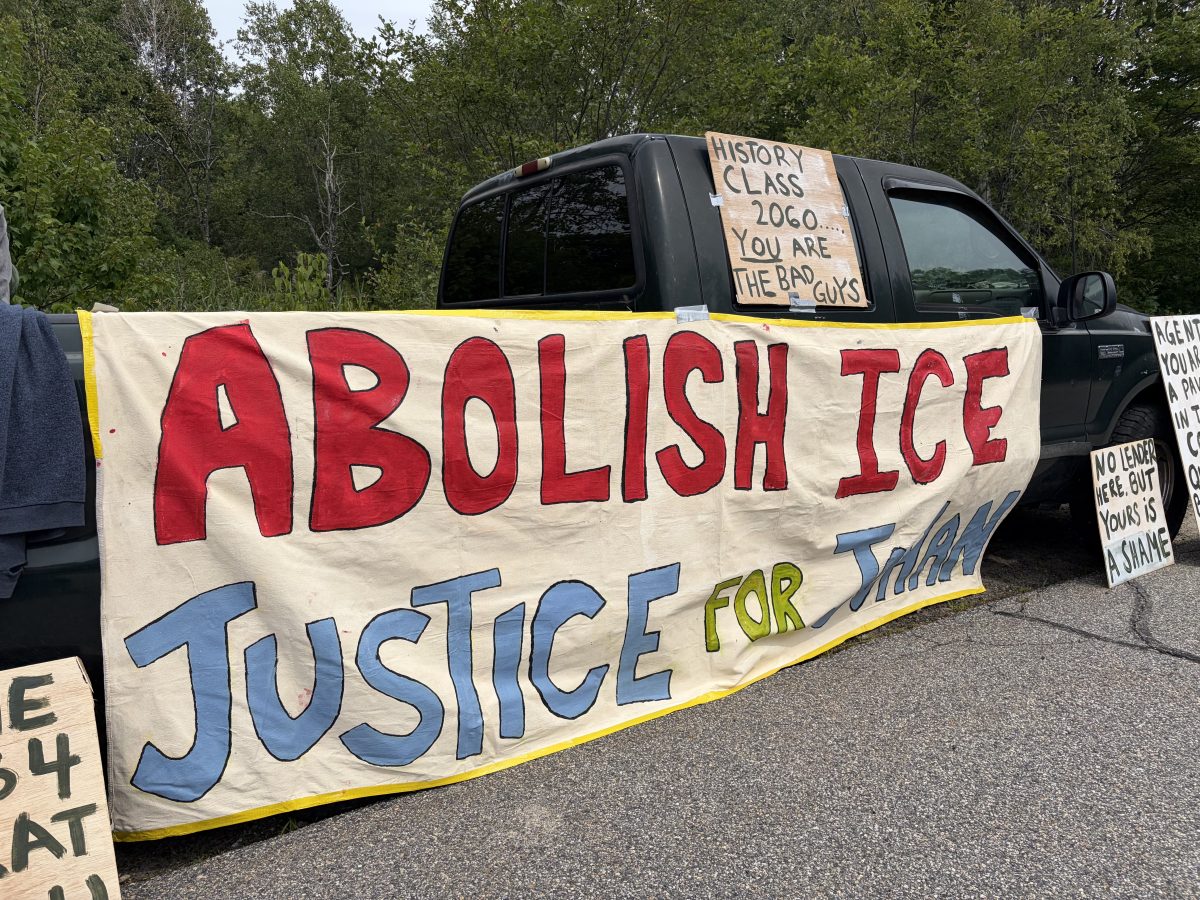
Paul had another experience that gives him hope. As he was being driven away from the Burlington ICE office by the family who’d paid his bond, “to my surprise, I saw people demonstrating outside,” he said. “I remember an old man sitting in front of the ICE facility with a flag telling, ‘ICE should not arrest immigrants.’ That was a positive feeling.”
The bigger picture Paul sees, however, is dark.
In Africa, Paul saw how militarized policing operations quickly expand to impact people outside the initial target group. “It’s really, really surprising to see that situation happening in the U.S.,” Paul told me. “It is really unbelievable. Because from my experience, if someone is victimizing people — today he is victimizing me, but tomorrow he is victimizing you. If someone comes and destroys the house of your neighbor, probably the next day he destroys yours too,” he said with another rueful chuckle.
ICE’s campaign has rapidly expanded in the past year to sweep up immigrants without criminal records, Black and Latino U.S. citizens, Native Americans, and foreigners “legally present” in this country. Citizens protesting or observing ICE have been arrested, beaten and, in the high-profile cases of Renée Good and Alex Pretti, shot to death by immigration officers.
In Maine, civilians report being intimidated by ICE agents who’ve accosted them, threatened arrest, showed up at their homes and filmed their faces and license plates. An ICE officer in Maine “told a woman she was now in an internal database and considered a ‘domestic terrorist,’” The Maine Monitor reported in late January, echoing similar encounters reported nationwide. And DHS has been seeking the personal information of social-media users critical of ICE, the New York Times revealed last month.
Businesses owned by immigrants or employing a substantial number of foreign-born workers have been targeted by ICE, and fearing raids, many were forced to close during the enforcement “surge” in Maine cities earlier this year. Scores of non-immigrant businesses that closed for a day in January to protest ICE were targeted with negative online reviews.
In all these ways, ICE’s targets have grown to include millions of people who assumed their U.S. citizenship or legal status would shield them from persecution.
Still, there are slivers of light.
I asked Paul how he reconciled the small acts of kindness by the guard in Scarborough with the hostility he encountered from other officers in Maine and Massachusetts. “Actually, I respect what they are doing,” Paul said of ICE. It’s “the way they are doing it” that worries him.
“But there are kind people everywhere,” Paul continued. “Some people are just there because it’s their job, you know what I mean? Maybe they think this should not happen, but it’s happening, and suddenly they’re the one doing this.
“That’s why sometimes we cry, because you think maybe one of them is hearing me, maybe they will accept my feelings,” Paul added. “Maybe even though he’s doing this, maybe he’s not convinced he should be, you know? Even in my jail, I saw some of the security who would take their lunch or dinner and come back with some bananas in their pockets and give it to the prisoners. So I think it’s a good thing to have those ICE who are good.”
Paul paused, considering something, then laughed for real. “I think if I was eligible, I would go to ICE too, so that I could do that kind of work with kindness.”
•••
In January, a few days into the ICE surge in Maine, I met with Paul again at a Thai restaurant. He fit me in between his overnight shift and his day shift. Bundled up against the snow and cold, Paul visibly flinched when I ordered him a Thai iced coffee. “I think hot coffee is good in winter,” he said, but gratefully drank it anyway. We went over my transcript of our talks and Paul asked me to add two things.
One regards a doctor’s note he showed me on his phone. It said his daughter had begun having seizures after his arrest, and they had not abated in the months since his sudden disappearance. The physician attributed the recurrence and increasing severity of her epileptic symptoms to several possible factors. One is trauma.
“Make sure that you put that the consequences of ICE detention are beyond description,” Paul said to me. African families tend to be deeply interconnected, so the trauma of one member radiates outward to hurt everyone. “The consequences of arresting people in this way are beyond description,” Paul repeated.
The second thing he wanted me to add was this: “The good thing about America is that people still believe in their justice. That’s a very positive thing. Because in my country, when you are arrested, you don’t need to go see a lawyer; you need to see powerful people. Sometimes lawyers come to you, but they do nothing. So actually, if we are in America, we do have something great.”
Editor’s note: The name of this article’s author has also been made anonymous to protect Paul’s identity. The Maine Solidarity Fund, an initiative of the People’s Coalition for Safety & Justice, supports local immigrants detained by ICE, as well as their families, with money to cover legal fees, rent, the cost of groceries and other expenses. Their website is mainesolidarity.org.