RISE OF THE LOCALS
The Holy Donut’s workers want a livable wage, safety and respect. Ownership wants to them to shut up
By all outward appearances, The Holy Donut on Park Avenue in Portland checks every box for an acceptable eatery in a liberal East Coast town that the New York Times recently named one of the nation’s 10 “Best Small Cities for Big Careers.”
Formerly charmless cinderblock building remodeled into a hip bakery? Check. Bright, candy-colored mural depicting angelic doughnuts hovering around an iconic Maine lighthouse? Check. Original pine-and-star state flag complete with Pride-colored fringe flapping by the front door? Check. Poster prominently displayed in the window declaring the donut shop off limits to immigration cops? Check.
These elements assure customers who drop $52 for a dozen Holy Donuts that their hard-earned money is supporting a local family business that truly values its community and employees. “Spreading positive vibes” is the company’s oft-stated mission.
But looks, like vibrations, can be deceiving.
Last month, The Holy Donut’s owners and managers began showing their true colors. When all eight employees at the Park Ave. shop who are eligible to unionize signed union cards and asked the bosses to recognize their union, ownership refused. Some of these workers qualify for SNAP food assistance and MaineCare, the state’s health insurance program for the poor and indigent, even after years of employment with the company.
In a series of Facebook posts explaining their opposition to the union, Holy Donut CEO Jeff Buckwalter’s unidentified “ownership team” also cried poor. They cited “several million dollars” of outstanding personal loans that have “put all their personal assets at risk,” and claimed 2025 was the first year since COVID-19 that the business — which currently operates four shops and a production bakery in Southern Maine — made a profit, “albeit a very small profit,” they added.
“Our ownership team willingly cut their own salaries significantly back in March of 2020 so that they would not have to reduce benefits and [could] continue to pay all of our teammates at or above market rate,” they wrote in the March 12 post. The operating owners’ salaries remain “well below market rates,” they added, without offering figures, because, “Our ownership group firmly believes that leaders eat least.”
These days, among those dining on The Holy Donut’s dime are high-priced corporate attorneys and out-of-state consultants who specialize in busting unions. And they’re eating very well, with the consultants alone costing the company at least $500 a day, organizers estimate.
“We don’t want the business to fail,” said union co-lead organizer Justin Gross, who makes $17.50 an hour at the Park Avenue location. He’s worked there for five years.
“We have asked Jeff to stop spending useless money and just talk to us,” Gross said. “We’ve literally asked him multiple times, but he ignores our e-mails. He’s fighting us tooth and nail and he’s just dumping money.”

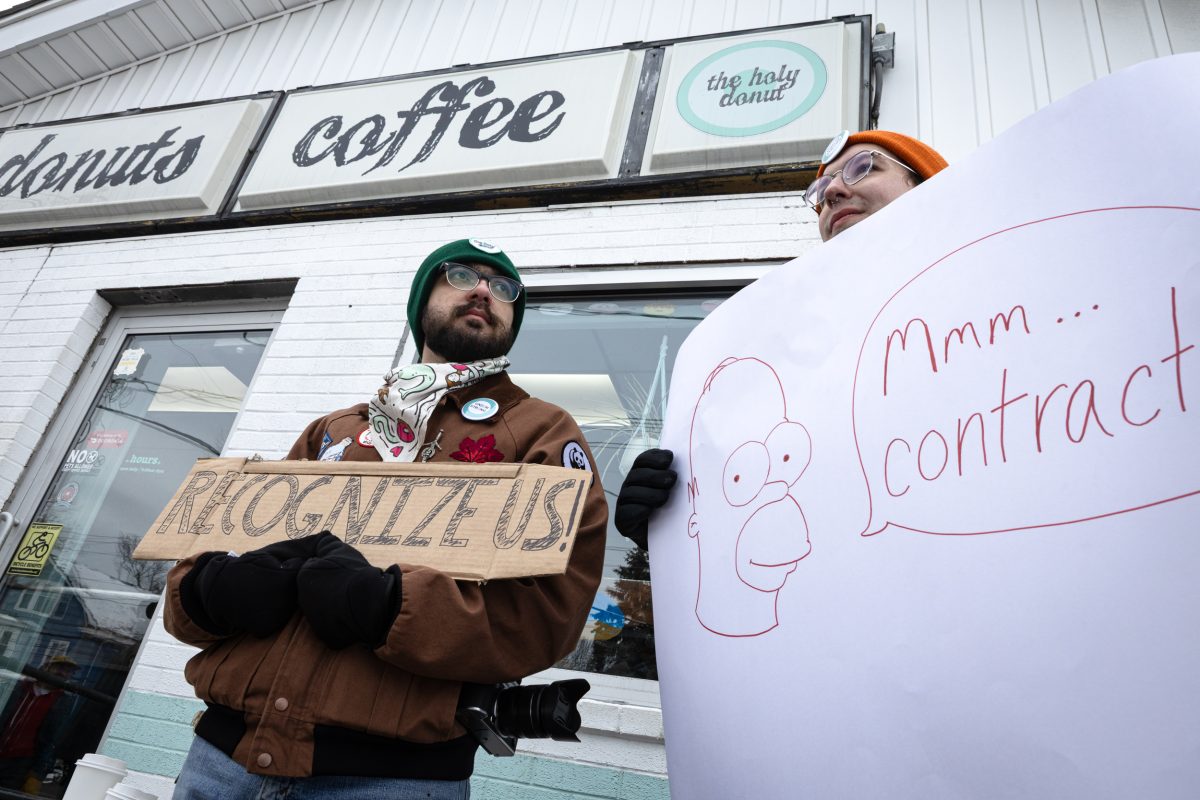
Communication, safe working conditions, and wages are the union’s top priorities, organizers told me as they stood behind tall snowbanks holding signs with supporters outside the Park Ave. shop on March 6. They said they’d been trying to bring their workplace safety and health concerns to Buckwalter’s attention for months and had gotten no response. They didn’t feel comfortable complaining to human resources about this, as that part of the business is run by Elizabeth Buckwalter, Jeff’s wife.
Entrepreneur Leigh Kellis opened The Holy Donut on Park Avenue in 2012. [Full disclosure: Among the jobs she’d had shortly before that was selling ads for this magazine.] Her mother, Cynthia, “invested her savings” to help provide $30,000 of seed money, according to the company’s website, and her father, Allan, put in long hours before and after the shop opened. Elizabeth Buckwalter is Kellis’ sister, and she and Jeff soon came aboard, too, Liz having left her job “to join the venture only working for tips,” the site says. Jeff had previously held a corporate sales job. The couple lives in Scarborough.
The decadent, potato-based Holy Donuts were a huge hit, garnering television spots on CNN and Travel Channel’s Man vs. Food and Food Paradise, as well as write-ups in the Boston Globe and Elle, among other national press. This coincided with Portland’s skyrocketing popularity as a food-tourism destination. When a second shop opened a few years later on Exchange Street in Portland’s Old Port, the lines routinely stretched out the door.
In 2017, The Holy Donut opened a big shop with a drive-thru on Route 1 in Scarborough. And after the pandemic began, this allegedly unprofitable company expanded again, and again, and again.
They opened a shop in Auburn and reopened the Old Port shop in a larger space on Commercial Street in 2021. The Auburn location closed a year later due to slow business, but by then the company was selling 2 million donuts a year, Jeff Buckwalter told a local podcaster in March of 2022. At an average price (back then) of $4.25 apiece, that’s $8.5 million annually, not counting beverage and merchandise sales.
The Holy Donut opened a new shop and built a production bakery in Arundel in 2023, though that shop, located next to the bakery, also underperformed and closed, and will likely be used as additional production space. The company cut the ribbon on a fourth location in Brunswick in 2024, and has over 120 employees in total, according to its website.
Jeff Buckwalter assumed control of The Holy Donut’s operations about 10 years ago, with Kellis stepping back into the role of “creative director,” helping with marketing and philanthropy. Neither the Buckwalters nor Kellis responded to my phone and online requests for comment.
In December of 2024, I interviewed Kellis for the Bangor Daily News about a cooperative arts venue she was trying to launch inside the Masonic Temple building in downtown Portland, called The Gallery of Life. She was looking for 100 artists willing to pay $100 a month to use and support the space, and lamented that she wasn’t able to finance the venture herself. “I have a nice car and a nice business but no cash,” she said. “But I believe in community, and I want to do something good for the world. Music, art, comedy — it’s what makes life tolerable.”
Kellis had only one criteria for events at The Gallery of Life: “It just has to be good energy,” she told me. “I was on a mission from God to make donuts and bring sweetness to the world — and it’s the same here.”
The Gallery of Life failed to get off the ground, and meanwhile, workers at the original Holy Donut were laboring under conditions they considered increasingly intolerable — “positive vibes” notwithstanding.
On March 5 of this year, Gross and seven other Park Ave. workers informed Holy Donut management of their intent to unionize the shop under the International Association of Machinists and Aerospace Workers District Lodge 4, which covers Maine and Maryland. They requested formal recognition within two days. That didn’t happen.
The company’s public response followed the trajectory one experiences eating a Holy Donut: anticipation followed by a giddy sugar high and an irritable crash.
The Portland Press Herald published an article March 5 quoting the workers’ press release, which cited “low wages; deceitful communication from ownership and management; unsafe and unhealthy conditions; [and] unfair labor practices.”
That evening, the company posted on Facebook: “We started as and remain a local, family-owned business committed to spreading positive vibes for our teammates, our guests, and our family. Our team has always been our greatest asset. Together, we have worked hard to build a culture of mutual respect, transparency, and thoughtfulness of which we are proud.”
“We want to be clear,” the post continued, “we respect our teammates’ legal right to explore representation and to engage in open dialogue about their workplace experience.” News reports and social media posts “alleging that The Holy Donut opposed the [unionization] effort and took action against employees … are simply not true.”
“This process is new to us too,” ownership conceded, “and we are taking the time to learn about what this could mean for our teammates and the business we built together.” The post’s tone suggested a willingness to discuss unionization with the workers in a cordial and productive manner.
The next morning, while the Park Avenue crew was rallying on the sidewalk outside the shop, the company posted a collage of smiling employees on Facebook for “Team Member Appreciation Day.” “From the first donuts in the morning to the last coffee poured, we’re grateful for the people who bring so much hard work and heart to this place,” it read.
A week later, the company’s tone on social media had darkened considerably. Ownership was “blindsided” by the Park Ave. workers’ “demand” to unionize, and taken aback by their “adversarial and confrontational” approach, the aforementioned March 12 post read.
Blindsided might be stretching the truth here. According to the workers, months before they went public with their effort, the Buckwalters changed the company’s employee handbook to forbid any discussion of wages or other workplace issues between employees. If true, that policy would likely violate the National Labor Relations Act. The National Labor Relations Board (NLRB) states that people have a right to discuss their wages at work “if employees are permitted to have other non-work conversations” on the clock, as has always been the case at The Holy Donut.
Gross was hesitant to discuss all the health and safety hazards the Park Ave. workers face before the union vote takes place later this month, but he shared one with me. The shop has a fryolator basket with handles so bent from overuse that they slide into the boiling oil along with the rest of the basket full of donuts, he said. Gross claims he’s repeatedly asked management to replace the basket, or at least provide protective mitts to fish it out of the hot oil, but neither have been provided.

“We have to use little chopsticks” to lift the basket out, “hoping it doesn’t slide onto our hands,” Gross said. “We’ve all gotten very good at it, but we’re risking getting severely burned by oil every day.”
Gross is paid 75 cents above Portland’s current minimum wage of $16.75 per hour after half a decade on The Holy Donut’s team. “Basically, the only way I’ve gotten a raise is when Portland has raised the minimum wage. I’m on food stamps and MaineCare,” he said.
Holy Donut workers toiling in towns where the state minimum wage of $15.10 per hour prevails are making even less. “We know someone at Scarborough that’s been working for seven years and is making forty cents more than [Maine] minimum wage,” Gross said. “It doesn’t really stop with the issues of health and safety, it doesn’t really stop with the lack of communication. It’s benefits, it’s pay.”
“Through the years,” the company posted on Facebook on March 12, “we have offered our teammates expanded access to healthcare, dental care, vision and pet insurance benefits,” in addition to funding a $500 annual Health Savings Account to “help with ever-increasing healthcare costs.”
Gross said the company health insurance plans are prohibitively expensive and most workers are kept just under the number of hours they’d need to qualify for full-time benefits.
According to organizers, Holy Donut management has hired Fisher Phillips to help guide their response to the unionization effort. A global corporate law firm that has a satellite office in Portland’s Monument Square, Fisher Phillips is considered one of the top anti-union firms in the nation.
The Holy Donut is also paying an Illinois-based company called Modern Management to step in, organizers say. On its website, Modern Management promotes services like “Union Avoidance” and “Counter-Union Organizing Strategies,” and says it helps companies “focus on direct, open and honest communication” with workers.
Here, it appears all three of those adjectives are a stretch. Gross said that since Modern Management was hired, corporate-type people the employees have never seen before have begun hanging around behind the counter at all Holy Donut locations. The strangers buttonhole workers into one-on-one conversations about the supposed disadvantages of unionization, while company managers stand nearby — a classic union-busting tactic known as “captive audience” meetings.
“I asked her name and she said, ‘Just call me T,’” Gross said of one of them. “She told someone else her name was V. They’re hiring people to lie to us. How is that honest, open and direct communication?”
Talking to Modern Management appears to be compulsory, while talking about them is forbidden on the job. On March 22, one of Gross’ regular customers came into the Park Avenue shop and casually asked how the union drive was going. Gross told him management had hired consultants to fight it. When the manager on duty overheard this, he sent Gross home early for the day. Gross said he subsequently received a disciplinary write-up for the incident and fears he’ll be fired. If so, he vows to fight on and file an unfair labor practice complaint with the NLRB.
The April 20 vote to unionize the Park Avenue shop may be just the start of a company-wide solidarity struggle — one that could inspire workers at similar Maine businesses to band together.
With a wicked grin, Gross told me there are now union organizing committees at every Holy Donut location. His eyes stared into the distance as he envisioned the day when all the underpaid and pushed-around restaurant and hospitality workers in Greater Portland unite as one union. Gross can see that day, he said, because he intends to help organize it.
“They’re all scared shitless of the Holy Donut organizing,” Gross said of other local food retailers and restaurant owners. “I’m not afraid. I have passion in my poverty, to better my conditions, and I will fight until I win or can’t fight anymore.”
Update: Holy Donut workers at the Park Ave. shop voted overwhelmingly in favor of joining the International Association of Machinists and Aerospace Workers on April 20.