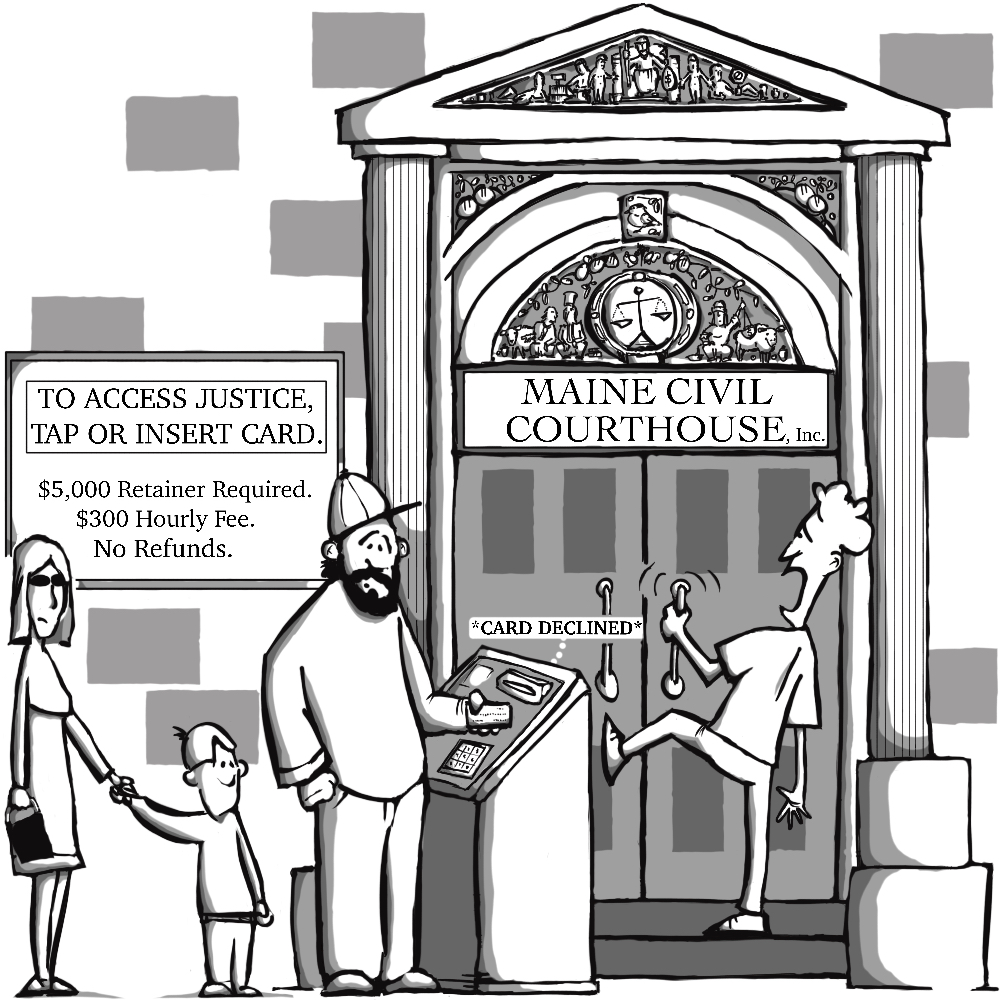
Maine’s failure to provide legal help in civil court for Mainers who can’t afford lawyers is unconstitutional
Editor’s Note: This essay is an adaptation and update of Donald Fontaine’s January 2020 Maine Law Review article, “Fee Shifting: A Proposal to Solve Maine’s Intractable Access to Justice Problem.” Bollard editor Chris Busby contributed reporting.
Update: Maine’s Legislature adjourned this spring without appropriating any additional funds for civil legal aid.
I. Crises
Last year, the lack of court-appointed lawyers for indigent people facing criminal charges was declared a “public defense crisis” in a Portland Press Herald headline and received widespread media coverage. In March of 2025, Superior Court Justice Michaela Murphy ruled the state was violating its Constitution by failing to promptly provide lawyers to the accused, leaving people in jail for weeks or months awaiting their day in court.
Justice Murphy announced her intention to free everyone, statewide, who’d been behind bars for more than three weeks without an attorney, and to dismiss all charges against those waiting more than two months. The state appealed, and Maine’s highest court paused any releases while it weighs the matter. Their decision is still pending.
Meanwhile, another judicial crisis of much greater magnitude continues with scant attention: the lack of legal help for low-income people involved in civil court cases, especially those of serious consequence, like evictions, foreclosures, debt collection, and disputes over employment or government benefits.
The lawsuit over the state’s obligation to provide lawyers in criminal cases, filed by the American Civil Liberties Union of Maine, has been going on for several years, and about 30 people may have been eligible for release last year under Justice Murphy’s order, the Herald reported.
Meanwhile, on the other side of the justice system, study groups and commissions composed of Maine’s most distinguished judges, legislative leaders, attorneys and legal scholars have been calling the state’s failure to meet its obligation to poor litigants in civil cases a “crisis” since the 1970s.
A quarter of Maine’s population, over 356,000 people, qualifies for free legal assistance based on their income — less than $31,300 for individuals, $64,300 for a household of four. Tens of thousands seek help every year from one of the seven legal aid providers scattered around the state.
A relative handful receive full representation. A larger fraction get little more than advice. About half who seek assistance get no help at all.
Then there are those who, being unaware these programs are available to them, or expecting little help from overburdened providers, don’t even ask. Their number could be enormous. As a bill currently before Maine’s Legislature notes, “most Maine residents with low incomes face at least one civil legal issue each year that cannot be fairly resolved without legal advice or effective legal advocacy.”
Those who show up for court proceedings unassisted represent themselves, a status called pro se, and studies show, unsurprisingly, that their outcomes are far worse than those who can afford a private attorney. For example, from 1967 to 2017, there were 15 pro se appeals of unemployment compensation decisions made to the Superior Court. All 15 pro se litigants lost. In Maine housing cases, a study of eviction actions in the Superior Court and the Law Court showed that from 1993 to 2013, every pro se tenant, except one, lost their case.
Pro se representation is helpful only to the extent a person is well educated and can devote significant resources to the study, writing and oral advocacy of legal questions. According to the National Assessment of Adult Literacy, only 15 percent of U.S.-born adults are proficient at completing complex and challenging literacy tasks, a category that includes court activities like completing forms and collecting financial information or evidence.
Researchers have found that when indigent litigants go to civil court without a lawyer, it’s almost always to answer for something they have allegedly done wrong. As civil legal aid advocate and former California Court of Appeal Justice Earl Johnson Jr. once quipped, “Poor people have access to the American courts in the same sense that the Christians had access to the lions when they were dragged into a Roman arena.”
For those who find themselves in legal positions opposing the pro se poor, there is little deterrent to suing a person of modest means or deciding to violate their legal rights, because such defendants rarely mount a strong defense or recognize when their rights are being challenged.
Statutes are written with the expectation that citizens will proactively protect their own interests. It’s by filing cases that working-class people could, if they possessed the resources, show they intend to affirmatively protect their interests. But the poor are seldom plaintiffs, and those who conduct business with them know they’re unlikely to sue.
Based on studies and statistics, one can conclude that the time of Maine’s courts is largely taken up with the civil problems of affluent people, institutions, corporations and government agencies, and with criminal cases, most of which are against the poor. Maine judges have made comments that it’s “rare” to see legal aid attorneys in small claims court, and that debtors are “almost never” represented at disclosure hearings during collections cases.
“Any visit to a Maine probate or district court will immediately make clear
how large the unmet need [for] legal assistance is,” Maine attorney Bill Harwood wrote in 2013. “By estimates of the judges themselves, seven out of every ten cases have at least one side unrepresented.”
The state’s response to past findings on the civil legal aid crisis has included some additional funding to providers, but not nearly enough to meet the need. More pro bono civil work by Maine attorneys has helped, but also falls far short of demand.
As a result, Maine is systematically denying its poorest citizens the justice they are due in civil cases. This clearly contradicts the aspirations of our state’s Constitution, which declares, “Every person, for an injury inflicted … shall have remedy by due course of law; and right and justice shall be administered freely and without sale, completely and without denial, promptly, and without delay.”
The State of Maine cannot claim to be a “government of laws” while denying equal access to its courts. For over half a century, Maine has failed to provide equal justice to its people despite copious evidence of this failure offered by its own judicial officials. Maine judges have evicted thousands of people from their homes, attached their property, seized their driver’s licenses, and denied them unemployment compensation and other public benefits, all without a hearing that met even basics requirements of fairness.
This is a national problem that concerns values foundational to the formation of any state. The administration of justice is a core function of government. That fact alone removes it from the sphere of private enterprise. Our United States Constitution forbids us to treat our day in court like a shopping trip to Macy’s.
As past Maine Supreme Judicial Court Justice Jon Levy observed in 2010, “Establishing and maintaining justice was at the heart of the rationale for forming our nation.” He called equal access to courts “a foundation of democracy.” Yet nowadays Americans boast that we all stand equal before the law while simultaneously accepting the common saying, “You can get about as much justice as you can afford.”
Justice Levy quoted James Madison, who wrote in the Federalist Papers: “Justice is the end [goal] of government. It is the end of civil society. It ever has been, and ever will be pursued, until it be obtained, or until liberty be lost in the pursuit.”
II. Commissions
The first major study of this problem in Maine was undertaken in 1972 by Pine Tree Legal Assistance (PTLA), a legal aid provider for which I previously served as executive director. PTLA found that the legal problems of a typical poor person required more frequent attention than those of the middle class. They estimated that to serve all Mainers without means who needed help in civil court would require more than 10 times the amount of assistance then being offered — at least 228 additional attorneys.
PTLA turned to the Maine State Bar Association for help. Maine lawyers increased the amount of volunteer work they performed on civil cases, but 17 years later, the problem had only grown worse.
The Maine Commission on Legal Needs was formed in 1989 and chaired by U.S. Senator Ed Muskie. It included 45 top members of Maine’s legal community, including the state’s chief justice and attorney general. This commission found that less than a quarter of the need for civil legal aid was being met. It estimated Maine would need 232 more pro bono lawyers to meet its constitutional obligation to low-income litigants.
Sen. Muskie’s commission recommended more state funding for legal aid attorneys and suggested making some amount of pro bono work mandatory. It further recommended that courts appoint counsel in all landlord-tenant, collections, family law, and other civil cases of serious consequence.
In 1993, the Legislature created the Commission to Study the Future of Maine’s Courts. Among its distinguished members was Janet Mills, then representing the District Attorneys’ Association.
A survey conducted for the commission the previous year found “the people of Maine were strongly dissatisfied with the cost and pace of litigation and with the inaccessibility of courts. The public wants an understandable system of justice that is fair, fast, and affordable. … If that dissatisfaction is not addressed, people involved in disputes will avoid the public justice system, resolve their disputes in socially undesirable ways, or suffer in silence and seek no redress.”
Regarding the imperative of equal access, the commission’s final report is clear and unequivocal: “Legal services in the future must be coordinated and sufficiently funded so that every citizen who wants and needs a lawyer can have one regardless of ability to pay.” The idea of establishing an explicit “right to court-appointed and state-financed counsel should be explored,” they wrote, particularly in cases involving “fundamental necessities or substantial interests.”
Fast-forward to 2007. Yet another commission composed of leaders in Maine’s legal field has been formed, this one organized by the Justice Action Group (JAG), a judicially led task force focused on equalizing access to the courts.
Almost a decade and a half into “the Future of Maine’s Courts,” 75 percent of people in the civil legal system were “not represented by counsel,” this commission found. Another 232 “full-time attorneys are needed to represent the poor,” they wrote, in addition to the 35 then working for all the legal aid programs combined, and assuming “every private practicing lawyer in Maine accepted three pro bono cases per year.”
In one month, the JAG study found, Maine’s legal aid programs collectively fielded 3,606 calls for assistance, but only 14 percent received full service, including in-person representation in court. More than half got no help whatsoever.
The need for free legal help in civil cases has continued to increase at a rate that outpaces the state and federal funding dedicated to providing it. In a Maine Law Review article I authored in 2020, I cited data from legal aid provider Disability Rights of Maine, which served 692 low-income clients in its 2018 fiscal year. Only 21 were “full representation cases.”
Rural Mainers tend to fare worse than those in cities when it comes to access to legal assistance. In the article, I quoted Judge Paul A. Cote, Jr., of the District Court in South Paris and Rumford, who said tenants before him in eviction cases appeared with counsel “less than five percent, perhaps less than one percent” of the time.

III. Pro se what?
In remarks to Maine lawmakers earlier this year, Justice Andrew Mead of the Maine Supreme Judicial Court reflected on his decades on the bench. “I have witnessed, time and again, the heart rending scenario, played over and over again, where people come to court — people from the absolute bottom rungs of the economic ladder, or otherwise rendered powerless by disability or circumstances — who try to navigate the complex waters of law.
“They are frightened, bewildered, and sometimes distrusting of this institution that doesn’t seem to be designed for justice for them,” said Justice Mead, speaking in his role as current chair of the JAG. “They make mistakes, or sometimes just clam up, unable to speak for themselves. The results can range from unfortunate to downright tragic.
“And of course,” he added, “they leave that experience cynical and hostile towards government. And at this point in our history we cannot afford any more individuals with that state-of-mind.”
“The right to be heard would be, in many cases, of little avail if it did not comprehend the right to be heard by counsel,” U.S. Supreme Court Justice George Sutherland wrote for the majority in the landmark 1932 case Powell v. Alabama, which helped establish a criminal defendant’s constitutional right to an attorney. “Even the intelligent and educated layman has small and sometimes no skill in the science of law. He requires the guiding hand of counsel at every step in the proceedings against him.”
In civil cases, one could argue that laypeople need the guiding hand of counsel even before court proceedings commence. For litigants to obtain a legal remedy, they must know from the outset whether something that happened to them violated a law. The barriers begin.
The first barrier is to “state a cause of action.” For example, many people complain, “My boss fired me for no reason at all,” erroneously thinking such unfair behavior must be against Maine law.
Next, a person must learn which legal body handles the type of claim they are making: a court or an administrative agency? State or federal? If it’s a court, in which branch of the court should papers be filed? In one’s own town or city, or in the court where the other party resides? Or somewhere else? How must the papers be served? Is there a deadline for filing?
Some statutes of limitation are very short. For example, Rule 80B of the Maine Rules of Civil Procedure requires one who appeals a “final” local government administrative decision to do so within 30 days. Is the decision you disagree with a “final” decision of the government entity?
How much must be said in the complaint? Does the person who is being sued have to admit everything said in the complaint if the statements are probably true? What if they do not?
After the suit has begun, what happens next? If the other party possesses some of the important documents in the dispute, how can they be obtained? What if the other party asks for every telephone record for the past two years? Must they be turned over? What about private information?
Maine, like all states, has an adversarial system of justice. That means a judge is not supposed to help a litigant prove their case. The Maine Rules of Civil Procedure govern what can happen in a case at every stage. Litigants must understand and follow all the rules. If they do not, the case may not be successful at trial or it may be dismissed before a trial begins.
In the three different civil courts in Maine — Superior, District and Probate — there are over 130 pages of procedural rules. There are nearly 100 pages of forms, some of which are accepted in all three courts, others in only one. Failure to take the steps mandated by the rules, or to do so before a deadline, can result in an order by the judge that harms the case, even leading to dismissal.
All complaints must meet certain requirements. For example, Rule 8 states that a complaint consists of “a short and plain statement of the claim showing that the pleader is entitled to relief.” That seems simple, but a subsequent Rule, 9(b), requires that a case in which one claims a fraud or a mistake must be stated “with particularity.” That means all the particular facts that are part of such cases must be pleaded, but Rule 9(b) does not describe what type of facts those are.
To prevent dismissal, the plaintiff must also show that the complaint pleads all the necessary elements of that type of case. This means one needs to understand, in detail, the laws governing the type of case you’ve filed, whether that’s contract, trespass, slander, personal injury, or any other.
One must then explain the legal theory in writing. For example, if the case is about a car you bought from a dealership, the Maine Sales Act in Title 11 of state statute applies. It has 90 sections. A plaintiff must state which section the defendant violated and explain how it was violated.
Trials are often avoided by defendants by use of a Rule 56 Motion for Summary Judgment. The text of the rule itself, in the hard copy used by Maine lawyers, is two and a half pages long. These motions can fill dozens or even hundreds of pages. To oppose such a motion requires meticulous work, and when a layperson fails to respond in accordance with the rules, no quarter is given for ignorance or inexperience. Maine’s Law Court has made very clear that the rules are to be enforced for pro se parties as if they were professional attorneys.
Perusing the Rules of Civil Procedure provides just a taste of the complexities of civil litigation in Maine. There are other, equally complex rules. The requirements are so technical that a Maine legal scholar once called them unnecessarily complicated even for attorneys.
An adversarial system of law depends on both sides being knowledgeable of the issues, factual and legal, and on counsel being capable of making an adequate presentation to the court. The weakness of one side in an adversarial hearing can lead to erroneous and unjust results. As Justice Louis Brandeis said, a judge “rarely performs his functions adequately unless the case before him is adequately presented.”
The vast majority of civil cases are settled before the trial stage is reached. The chronic lack of counsel for one party, the poor, increases the likelihood of cases being filed simply because there is little incentive for a wealthier plaintiff to attempt resolution before filing suit. The high likelihood of a swift default judgment against unrepresented defendants can make filing a case even more attractive.
The presence of counsel on both sides would result in more settlements and fewer trials. When both sides are represented by counsel in civil cases, 95 percent of the cases are settled before trial, one study found. Justice Howard Dana’s study of Maine eviction cases earlier this century showed that the presence of lawyers on both sides substantially increased the percentage of mutually acceptable agreements.
IV. Solutions
Proposed solutions to the systemic injustice of our civil courts have fallen into two broad categories.
One camp, the pro se movement, contends the answer is to teach litigants to navigate the legal system without counsel, and to make the civil court system more user-friendly and understandable for everyday people.
Those opposed to that approach, often citing the complexities just mentioned, say the state should simply provide legal counsel for the poor as it does in criminal cases, regardless of the cost. This is the so-called “civil Gideon” solution, in reference to the 1963 Gideon v. Wainwright U.S. Supreme Court decision that compels states to provide lawyers for indigent criminal defendants.
The Justice Index is a national standard that measures access to justice, and it calls for states to have 10 public legal aid attorneys available for every 10,000 residents classified as low-income. As of April of last year, Maine had only three attorneys available per 10,000 income-qualified people.
That gap prompted state Sen. Anne Carney, chair of the Senate’s Judiciary Committee, to sponsor legislation last year, LD 1022, to try to cover it. Reflecting the massive funding shortfalls identified by past commissions and study groups, the bill proposed to increase state spending on civil legal aid from $1.3 million annually to $9.5 million in the 2026-27 budget year.
Even that sum wouldn’t completely meet the need, said Lucia Chomeau Hunt, a directing attorney with Pine Tree Legal. But a provision in Carney’s bill would require the Legislature to regularly examine how close Maine is to meeting the Justice Index threshold and recommend any funding adjustments necessary to meet that threshold in the future.
LD 1022 passed in both chambers with bipartisan support but failed to get the two-thirds majority required for enactment. Instead, lawmakers approved a one-time $3 million increase last year, but even that funding bump is in jeopardy during the current legislative session, the last before a new set of lawmakers convene next year.
“Each year,” the text of LD 1022 reads, “tens of thousands of Maine residents without legal representation attempt to handle civil legal cases alone, resulting in the loss of essential rights and resources, as well as the damaging economic effects on our communities.”
Absent another increase, state funding will remain at $1.3 million and more than 10,000 Mainers who could have been served by one of the state’s legal aid providers will lose “access to legal help when they face crises that threaten their basic human rights and needs,” advocates said during a rally at the State House last month.
“I believe we have a responsibility to make sure that all Mainers can access legal help when they need it,” Sen. Carney said in a statement to The Bollard. “Civil legal aid services are a lifeline for those who cannot afford an attorney to help with significant, and sometimes catastrophic, legal issues, including critical problems like eviction, domestic violence, elder abuse and denial of veterans’ benefits.”
More than 60 years have passed since then-Attorney General Robert F. Kennedy told his colleagues, “Lawyers must bear the responsibility for permitting the growth and continuance of two systems of law — one for the rich, one for the poor.”
In Maine, lawmakers share that responsibility. It’s well past time our state truly provided “justice for all.”