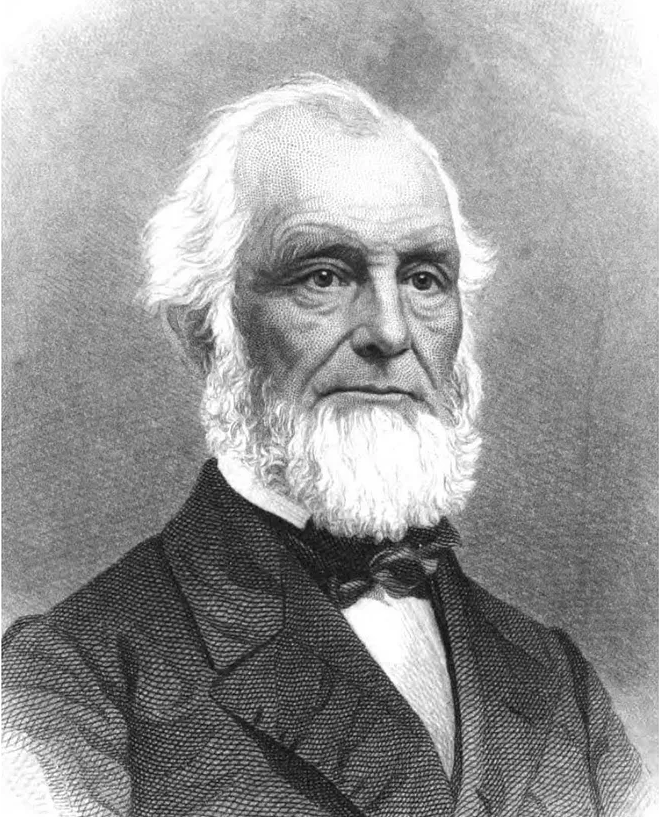
Alexander Crummell.
The Students of New England’s First Interracial Co-Ed Academy
On the Fourth of July, 1835, students and abolitionists gathered in Canaan, N.H., to celebrate the opening of Noyes Academy, the first interracial, co-ed college prep school in New England. Fourteen Black students and 28 white students had arrived that spring as part of a bold experiment in integration and a powerful symbol of democracy, freedom and equality. Various dignitaries from the American Anti-Slavery Society were in attendance to celebrate the result of the abolitionists’ hard-fought struggle for an integrated school.
The morning was filled with stirring speeches linking the historic occasion with the movement to end slavery and the nation’s revolutionary founding. One speaker described how thrilled he was “to spend the anniversary of our national independence in pleading the cause of the oppressed — in pleading for two and half million slaves, held in bondage by a nation which refused to bear the trifling yoke of a trifling tax on tea.”
Seventeen-year-old Thomas Sipkin Sidney of New York City, president of the school’s newly formed student anti-slavery society, gave a rousing speech that elicited thunderous applause. His 16-year-old classmate, Alexander Crummell, said Sidney’s speech “filled his soul with patriotic ardor” as his friend “dissected the hypocrisy of American Christians and Republicanism” and vindicated “the character of his Brethren.” Crummell followed his friend’s speech with a sermon “[s]ummoning the country to the experiment of immediate emancipation from the brilliant example in the West Indies, South America and Cape of Good Hope,” where slavery had been recently abolished.
The Noyes Academy students were idealistic and financially better off than most African Americans in the 1830s. But they still struggled mightily to obtain a quality education.
At 24, Julia Williams, the only Black woman among the Noyes cohort, was older than many of her male counterparts. Born in Charleston, S.C., in 1811, her family moved to Boston and then to Connecticut. There she attended Prudence Crandall’s Canterbury Female Boarding School until it was shut down following an attack by a racist white mob that ransacked the academy in 1831.
Another student was Thomas Paul, son of Thomas Paul Sr., the first Black minister admitted to the Baptist ministry and the first pastor of the historic African Meeting House in Boston.
Sidney, Crummell, and Henry Highland Garnet were childhood friends in New York before they enrolled at Noyes. Their families were part of a small Black middle class who lived in the city’s rough Five Points neighborhood in the early part of the 19th century.
Alexander Crummell was born in New York in 1819 to Charity Hicks, a free Black woman, and Boston Crummell, who had formerly been enslaved. Alexander’s paternal grandfather was said to be the son of a Temne prince who was kidnapped at age 13 from present-day Sierra Leone in 1780. When his son Boston decided he didn’t want to be enslaved anymore, he simply walked away from his enslaver one day and moved downtown, according to historian Wilson Jeremiah Moses. Boston also had no patience for white colonization promoters who thought they knew what was best for him. As he once told a recruiter for the Liberia colony, “You dragged me from Africa, when that was country and home to me, and now America has become so, and Africa a strange land, you would drag me back again.”
Still, Boston was very proud of his African heritage and Alexander grew up enthralled by his father’s stories of his childhood in Africa. He developed a strong sense of kinship with African people. Boston and Charity were very active and influential in New York’s Black community, rubbing shoulders with many of the city’s prominent Black leaders and thinkers. They hosted a series of meetings in their living room that led to the founding of Freedom’s Journal, the first Black-run newspaper in the nation.
Henry Highland Garnet also came from a proud legacy of resistance. His grandfather was a Mandinka warrior and chieftain born free in West Africa. A descendant of the Mali Empire that rose to power in the 13th century, Garnet’s grandfather was taken prisoner in battle with another tribe and forcibly put on a slave ship to the Americas. However, as Crummell wrote, “the fires of liberty were quenched in the blood” of Henry’s family, “and they burst forth into an ardent flame” in George Garnet, Henry’s father.
In 1824, when Henry was nine, his father and mother resolved to break free of their chains after their Maryland enslaver died, leaving his human property to various relatives who were notorious for cruelly treating their enslaved workers. After obtaining permission to attend a fellow slave’s funeral, the couple slipped away with their entire family (eleven people in total) in a covered wagon to Wilmington, Del., where they hid at the home of the Quaker underground railroad conductor Thomas Garnet.
Eventually they made it to New York City, where George Garnet continued his trade as a shoemaker while young Henry attended the renowned African Free School. It was there he befriended Crummell and Thomas Sidney. Founded in 1787 as a school for the children of enslaved and free people of color by the anti-slavery New York Manumission Society, the institution graduated students who went on to become distinguished entrepreneurs, physicians, lawyers, writers, ministers and activists. Black civic organizations, as well as Freedom’s Journal editors Samuel Cornish and John Brown Russwurm (a Mainer), actively supported the school, which focused on liberal arts, the trades and self-sufficiency.
In addition to lifelong bonds of friendship, the three young Black students developed a deep understanding of their own oppression. An 1824 account of the school’s annual examination, published in the Commercial Advertiser, quoted an African Free School student’s impassioned abolitionist sermon: “O Africa! The land of my fathers, ancestral of the sable exiles of America! My heart bleeds for thy children, while the clanking of their chains and the voice of their groaning ascend to the heaven like the blood of Abel.”
The three friends joined thousands of Black New Yorkers, many of them wearing colorful clothing of the Caribbean, in a massive parade on July 5, 1827, to celebrate the official abolition of slavery in New York. Young Henry not only inherited his father’s tall height and handsome features; he had George’s “readiness, humor, intellectual fire” and “steadiness of character,” recalled Crummell. But unlike his more reserved father, Henry was “the very soul of fun, wit, frolic and laughter” — traits he got from his mother Elizabeth, “a most comely and beautiful woman; tall and finely moulded with a bright, intellectual face, lit up with lustrous, twinkling, laughing eyes,” Crummell wrote.
To help the family make ends meet, Henry signed up as a cook and steward, at age 13, onboard a ship traveling between New York and Washington, D.C. One day he returned home to find his family had scattered following a visit from one of their former enslaver’s relatives seeking to claim his inheritance. Crummell had been playing outside and witnessed the white man calling up to the apartment, asking for George Garnet.
Recognizing the man’s voice, George called down and told him he’d check to see if George Garnet was home. Then he jumped from his second-story flat into the alley and escaped through the Crummell family’s backyard. Henry’s mother managed to find refuge at his friend’s home, but his sister Eliza was captured. She was later tried as a “fugitive from labor,” but was released after convincing the recorder of the city that she had always been a resident of New York.
When Henry learned of the raid on his home, he immediately bought a knife and carried it as he walked the streets of Manhattan, looking over his shoulder for slave hunters. Eventually he was able to hide out on Long Island, living with family friends and working as a contract laborer. Then a tragic accident left him without the use of his right leg, which later had to be amputated.
Garnet came out of the ordeal “like gold thoroughly refined from the fire,” Crummell wrote, and his suffering brought him “to the foot of the cross.” Henry joined the First Colored Presbyterian Church, where he was Baptized by the famed activist Rev. Theodore Wright, a founding member of the American Anti-Slavery Society. Wright took Henry under his wing as his own “son in the gospel” and helped him secure an education so he could enter the ministry.
White high schools were closed to Black students in the 1830s, but Crummell, Sidney and Garnet were fortunate to be among the first pupils of a Black high school founded by a group of Black leaders in New York City in 1831. As Crummell recalled, high school “only whet our youthful appetite for larger facilities of training and culture.” But “not a ray of hope was discoverable on the intellectual horizon of the country,” because there weren’t any institutions of higher learning that would accept Black students. In this respect, the opening of Noyes Academy in 1835 was a godsend for the ambitious young learners.
The unusual sight of a cadre of young Black men in “gentlemanly garb” traveling through rural New England on their way to the new academy surprised the locals and engendered some “sneers and ridicule,” wrote Crummell. Although the Black students received a “most cordial reception at Canaan” from the white students, others in town were not so welcoming.
“The Democracy of the State could not endure what they called a ‘Nigger School’ on the soil of New Hampshire; and so the word went forth, especially from the politicians of Concord, that the school must be broken up,” Crummell wrote. “Fourteen black boys with books in their hands set the entire Granite State crazy! On the 4th of July, with wonderful taste and felicity, the farmers, from a wide region around, assembled at Canaan and resolved to remove the academy as a public nuisance!”
Next month: The destruction of Noyes Academy.
Andy O’Brien is a writer and communications director for the Maine AFL-CIO. You can reach him at andy@maineworkingclasshistory.com.