When City Workers Took On Boss Barlow and the Portland City Council
On Sunday, June 30, 1946, at a meeting inside the Maine State Federation of Labor’s Labor Temple on Exchange Street, Portland Public Works Department (PWD) workers who were members of the American Federation of State, County and Municipal Employees (AFSCME) Local 946 voted 68-5 to authorize a strike. During the Great Depression, PWD workers had gone without pay raises for several years, and they’d dutifully done their jobs to maintain the city as the country fought wars in Europe and the Pacific. Now, with the war over, the workers demanded to be paid what they were worth.
Local 946 formed in the summer of 1945 and won its first victory when the Portland City Council finally agreed to enforce a 1937 policy granting them half a day off with pay on Saturdays. However, the city vehemently refused to recognize Local 946 as the official bargaining agent for the workers, just as the council had refused to recognize the Portland Professional Firefighters (IAFF) Local 740 when it formed in 1942. The city also refused to move on wage increases while post-war inflation rapidly eroded the workers’ paychecks’ buying power. By the following June, the PWD workers were ready for a brawl.
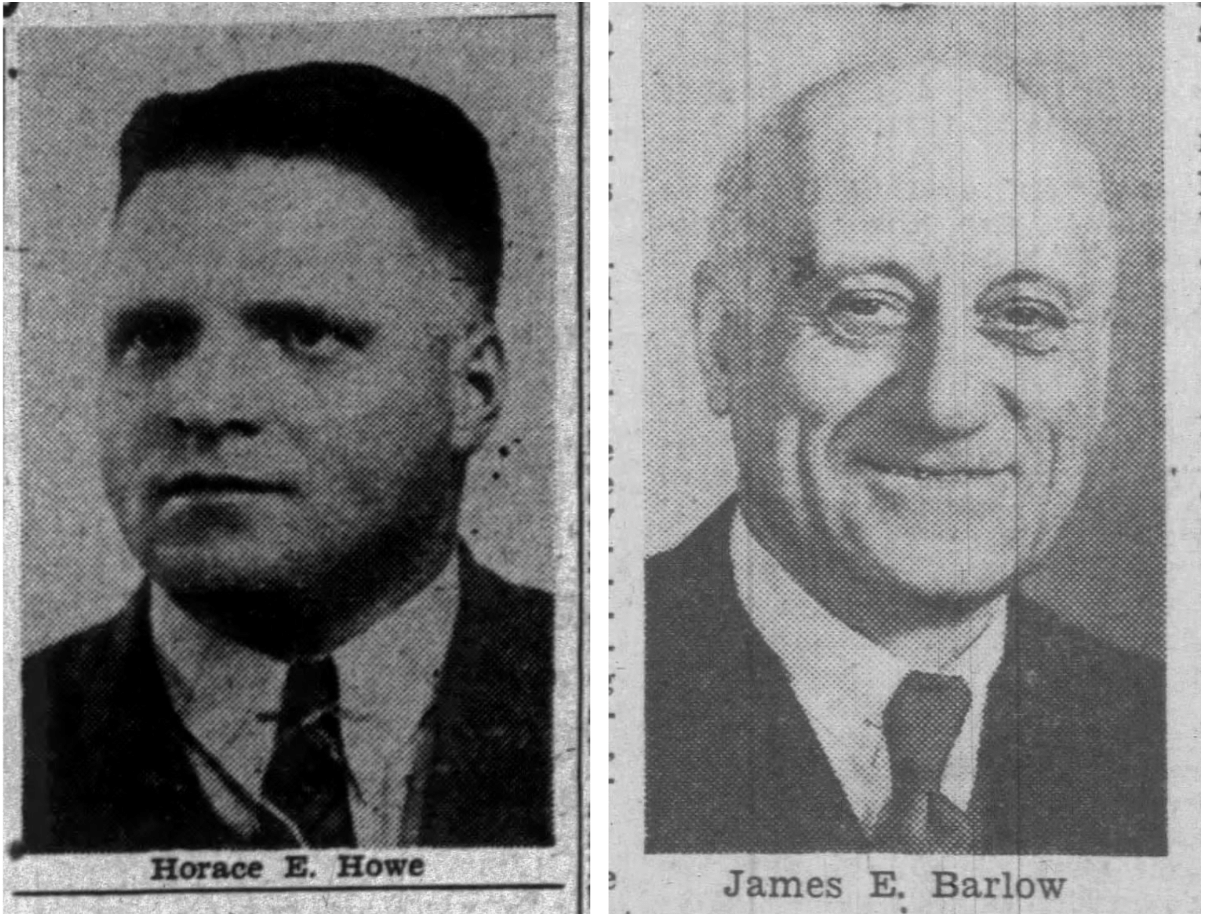
The workers voted to authorize a strike under the condition that the union would first ask Republican Gov. Horace Hildreth to allow the State Board of Conciliation and Arbitration to help resolve the labor dispute, even though it wasn’t clear whether the board had the authority to do so. Horace E. Howe, president of the Greater Portland Federated Labor Council, urged workers to wait “until all possible avenues of mediation have been exhausted” before walking out.
A native of Portland and World War I veteran, Howe came from a strong union family and was a longtime labor leader in the city. As head of the council representing 30 AFL unions in Greater Portland, Howe faced a huge challenge: leading a strike of workers who didn’t even have the right to unionize under the 11-year-old National Labor Relations Act. The walk-out would culminate in a massive general strike involving construction workers, garbage collectors, transit operators and truckers who shut down Maine’s largest city for days.
The world war was over, but the class war raged on as capitalists, left beaten and bruised by President Roosevelt’s New Deal, sought to reassert control over the masses of working-class Americans.
•••
On the other side of the bargaining table was Portland City Manager James E. Barlow, who ruled the city with an iron fist for 18 years with the blessing of a conservative, pro-business City Council and the support of likeminded local business and civic leaders. A civil engineer by trade, Barlow was fiercely anti-labor and laser focused on bringing down the city’s debt load at the expense of public investments and fair treatment of city employees. He was not about to cave to a bunch of insubordinate union hotheads.
In 1931, Barlow cut salaried city employees’ wages by 17 percent and accepted a 21.5 percent cut in salary himself. To prove his commitment to austerity, he refused to fully restore his own pay when the economy began to recover in 1937.
During the war, Barlow became an advisor to the Roosevelt administration on civilian defense, but continued to stoke controversy in Portland. He was widely criticized for failing to take full advantage of federal money, having blocked the U.S. Army’s plan to spend $700,000 to expand the Municipal Airport, and he balked at a proposal to rip up abandoned street car tracks for vital scrap metal during the war. Barlow argued that the benefits of these projects didn’t outweigh their expense. He preferred to spend federal money to promote tourism, using Works Progress Administration funding to expand the city’s Riverside Municipal Golf Course to 18 holes in 1937.
Barlow’s administration was particular hostile toward labor unions. In April of 1937, the city manager sparked outrage among the ranks of organized labor when he and the City Council authorized Portland police to use any means necessary to break potential sit-down strikes, including tear gas and even shooting strikers.
In late 1936, a wave of sit-down strikes rocked the auto industry from South Bend, Indiana to Flint, Michigan, site of the “great GM sit-down strike” at the General Motors there that galvanized disparate and isolated unions to combine forces. Then, in April of 1937, 5,000 striking shoe workers with the militant Congress of Industrial Organizations were met by baton-wielding police on a bridge between Lewiston and Auburn. The cops beat the predominantly French-Canadian female strikers, provoking a riot and prompting Maine’s governor to deploy the National Guard. Union leaders were arrested. The American Civil Liberties Union later published a report accusing state and local authorities of “fascist” tactics to break the strike.
It was in this climate of anti-labor hysteria that City Manager Barlow declared, “Portland will be one city that will resist attempts of outsiders to come in here and stir up trouble and discontent among its citizens. We will use every power we have to protect the property of our merchants and manufacturers.”
Portland Police Chief Ralph O. Brooks ordered plainclothes officers to trail and surveil union organizers and report on any talk of sit-down strikes or “refusal of employees to leave stores and factories.” “I told these men that the police department would go the limit in protecting property against invasion, either by employees or outsiders,” Brooks said.
As 500 CIO workers picketed shoe plants in Auburn on March 25, 1937, the conservative Portland Evening Express warned there was a “possibility” of a sit-down strike of department store workers and truck drivers in Portland. The Chamber of Commerce told the Portland City Council that CIO organizers planned to “get a foothold” in the city’s downtown department stores and “induce” employees to strike before the Easter buying season.
Cumberland County Sheriff Henry E. Burnell sent Deputy Sheriff George R. Bryant to canvas Portland businesses to determine whether the dreaded CIO had indeed come to town. Bryant told a conference of city and county officials that while five CIO organizers were believed to be in Portland, “only one group of store employees had been approached by the agitators” and “only two employers were at all concerned at the prospect of a strike.”
Sheriff Burnell also sent one of his men to Lewiston to study the methods of CIO organizers in case Portland was hit by a strike wave. He ordered additional tear gas just to be safe.
Portland Police Chief Brooks told the City Council he would immediately order the evacuation of stores and factories if workers launched a sit-down strike. “Resistance,” he said, “would be met with resistance.” However, city attorney Barnett I. Shur warned officials against “running out” labor organizers and reminded councilors that workers had a right to free speech and assembly.
On April 12, 1937, the Greater Portland Federated Labor Council passed a resolution accusing Portland’s police chief and members of the City Council of intimidation. The central union also called on Shur to teach Chief Brooks and the City Council about the legal rights of workers and to demand they refrain from using police detectives as spies for private businesses.
That had been precedent for that practice. In 1935, Republican U.S. Senator Ralph Owen Brewster, who was previously elected Maine’s governor with support from the Ku Klux Klan, hired a Scarborough Klansman to spy on local unions in an effort to expose leftists in their ranks. It doesn’t appear that Brewster’s investigation yielded any results.
Not all of Portland’s citizens supported Barlow’s power plays. Some sought to repeal the 1923 ballot referendum that abolished the alderman ward system, created a five-member council elected by voters citywide, and replaced the elected mayor with the unelected city manager position. Business-class “good government” reformers, known as the “goo-goos,” had pushed for those anti-democratic changes on grounds that they made municipal government more efficient, more pro-business, and less beholden to political parties and machine politics than the previous system with its 27 councilors and nine aldermen elected from each of the city’s nine wards.
As Samuel James detailed in a 2022 article for The Bollard, “99 Years,” and its accompanying podcast, the Portland Ku Klux Klan backed the 1923 referendum. They believed the ward system gave Black residents and those in predominately Irish Catholic and Jewish neighborhoods too much influence in city politics. Following passage of the referendum, one Klan official wrote in a letter to the Catholic Bishop of Portland, “Hereafter no niggers Catholics nor Jews will ever hold office in Portland.”
However, abolishing the ward system and sidelining political parties drained public interest in local politics. Voter turnout for municipal elections steadily declined after 1923. Just 4,000 Portlanders cast votes in 1945, out of a population of 73,000 residents.
But also by that year, enough Portlanders were fed up with Barlow’s authoritarian style that they backed a measure aimed at diluting the power of the city’s Protestant business elite and allowing for more diverse and working-class influence in city politics.
In the next edition: Portland workers fight back.