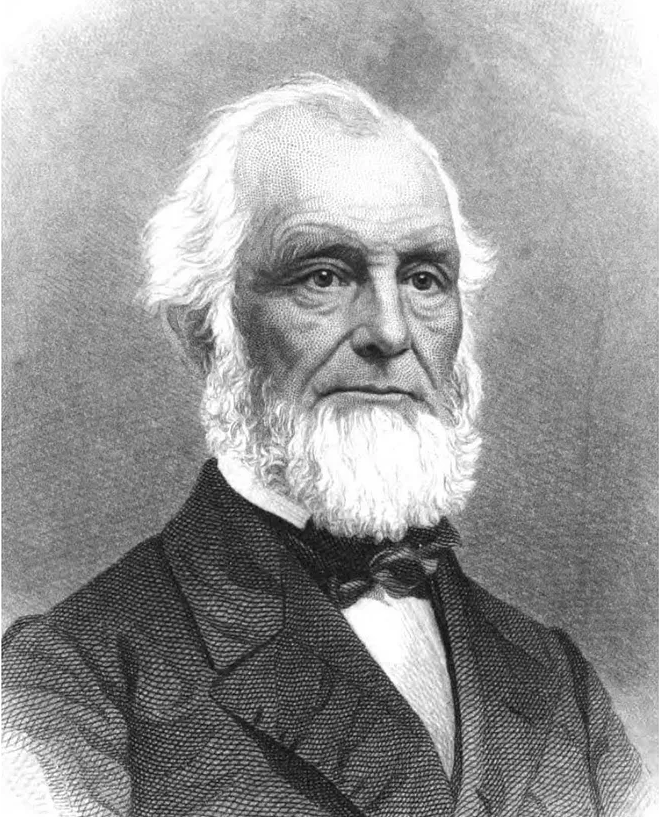
The Rev. Amos Noe Freeman.
On Friday, Aug. 13, 1835, the new Fourth Congregational Church in Portland, known today as the Abyssinian Meeting House, officially organized. On that summer day, 22 Black congregants of the predominantly white Second Congregational Church, who had been officially dismissed from the Second Parish Church, joined the new Black church on Sumner Street (now Newbury). The building became a religious, cultural, educational and political center for Portland’s Black community in the decades leading up to the Civil War.
In 1826, a group of prominent African-American small businessmen and workers announced their intent to start their own church. They were fed up with being forced to sit in the upper balcony of the Second Congregational Church. Coach driver and activist Reuben Ruby, his brother-in-law Christian C. Manuel and two other men petitioned the state to incorporate the Abyssinian Religious Society in 1828. However, it took seven years for the church building to be completed on a plot of Ruby’s land. The poor, largely working-class congregants donated what they could and the white community also pitched in funds in the beginning. The rest of the money to finish the church was borrowed with “little, if any assistance … from their white neighbors,” according to the Christian Mirror,a Congregational church newspaper.
“We mention this fact to illustrate their enterprise, and not to intimate any want of sympathy or readiness to aid, on the part of the good people of other societies,” the Mirror wrote.
The Abyssinian building also housed a new school for Black children who had been poorly served by the under-resourced, segregated school in an outbuilding behind the white school on Congress Street.
Early on, church life was disrupted by financial struggles that divided the parishioners into warring factions. Prior to 1835, the interior of the church remained unfinished and of limited use for years, and its congregation owed Ruby a substantial sum for the land. In the spring of 1830, Ruby, John Siggs and other church proprietors voted to stop public worship in the church building until parishioners settled its debts. The following year, Ruby drew up a deed transferring his land to the Abyssinian Religious Society for $250 and took out a three-year mortgage to cover it. The church committee also voted to sell its pews to bring in enough money to finish the building. The church was closed until its accounts could be settled.
When the Abyssinian Church was finally established in September of 1835, the state Congregational Council sent a white preacher, the Rev. Samuel V. Chase, to minister to its congregants. But it wasn’t long before the relationship between the white preacher and the Black congregation deteriorated.
In December of that year, the Eastern Argus newspaper reported that the Abyssinian Religious Society had repossessed the church in order to address its financial troubles, and the meeting house was once again closed to the public. The following month, Abyssinian Religious Society members Siggs, Ephraim Small, John Holland and John Groves signed their Xs to a letter stating that Ruby “has no right to open or to use the Meeting house of the Abyssinian Religious Society of Portland” and that any minister who preached there would be “prosecuted accordingly.”
It’s not clear what prompted this action, but during this time, Ruby filed a lawsuit in the Cumberland County Supreme Judicial Court charging that the Abyssinian Church owed him over $900. More money was borrowed to pay off the church’s debts, and Rev. Chase was apparently appointed to fundraise in the community. But on Sept. 20, 1836, Abyssinian Deacons Abraham Niles and William Hammett announced in the Argus that Chase had not been sent by the church to collect money. The men further claimed that Chase wasn’t the pastor of the Abyssinian Church, nor even an “ordained” or “licensed preacher”
Abyssinian committee members John Shorington and Small fired back in another public letter that Chase was a duly appointed “agent” of the Abyssinian Religious Society and was authorized to collect donations. Joseph Vaill, pastor of the Second Congregational Church in Portland, clarified two days later in the Argus that the Abyssinian Church was not yet “under the pastoral care of any one, but has enjoyed the occasional labors of different preachers.” The feud escalated into the following year, with Ruby publishing notices in local newspapers questioning Chase’s moral character. In May of 1837, the Argus ran an announcement from the Abyssinian Religious Society disavowing “all connection with [Chase], and the few misguided men who are his abettors.”
It’s unclear why the relationship between Chase and the Abyssinian congregants had soured so publicly, but Chase was clearly infuriated by the accusations. On July 3, 1837, Chase announced a libel suit against Ruby, Niles, Hammett, John M. Johnson, George H. Black and Franklin G. Pierre seeking $1,000 in damages, researcher Randolph Dominic reported in his University of Maine doctoral thesis. Chase cited the letters in the Argus,as well as another notice from the Society published in the paper that accused him of keeping church donations for himself. Prominent Portland attorneys Samuel Fessenden, one of the founders of the Maine Anti-Slavery Society, and former Maine Supreme Court Justice William P. Preble were appointed as referees during the trial.
In November 1837, Pierre and Black were found not guilty, but Ruby, Niles, Hammett and Johnson were ordered to pay Chase $150 in damages, plus his legal costs. The only reason the award wasn’t higher was because the defendants couldn’t pay more. After the court rendered its final judgment, it ordered the seizure and sale of Niles’ home, situated adjacent to the Abyssinian Meeting House, the following January, to pay his share of the damages.
Ruby settled his lawsuit against the Society in April of 1839 for $324.77, far less than he had demanded. The Abyssinian Society mortgaged the church property again to cover that debt. Finally, on Oct. 3, 1840, the Society sold the meeting house back to the church congregation for $10.
Prompted by the catastrophic Depression of 1837, their legal troubles, or both, Reuben and Rachel Ruby moved their family to New York City around 1838 and started a restaurant at the corner of Nassau and Beekman streets. Ruby advertised it as a “temperance” restaurant that served “[p]ure spring water at the bar” and breakfast, dinner and tea. He claimed the food was “rich and full, embracing the earliest supplies of the market.” On July 1, 1840, Rachel delivered their fourth child, the future Texas Reconstruction-era politician George Thompson Ruby, named after the British abolitionist politician the Rubys met six years earlier at the founding of the Maine Anti-Slavery Society.
Meanwhile, with the Rev. Chase out of the picture, Deacon Niles invited the Rev. Amos Beman from Connecticut to preach at the Abyssinian church. Beman was already a well-known anti-slavery, temperance and civil-rights activist. He led an early, unsuccessful fight for the right of African Americans to vote in Connecticut, and was a frequent contributor to Black newspapers, including the former Freedom’s Journal editor Samual Cornish’s Colored American and Frederick Douglass’ North Star. In a resolution passed on May 12, 1940, the Abyssinian Religious Society stated that “the Rev. A. G. Beman … will be the means of restoring our Church to its primitive state.” He was offered a salary of $300 a year, but it appears he only preached at the chuch for a short time during this period. Many years later, Beman was formally appointed pastor of the Abyssinian Church, a post he held from 1857 to 1860.
On May 27, 1841, the Abyssinian Church made a job offer to the Rev. Amos Noe Freeman of Newark, New Jersey, and he accepted. Freeman was a graduate of the radical abolitionist Oneida Institute in New York — the first school in the country to welcome both white and Black students. He went on to become a Presbyterian minister and taught at a Black school in Newark. In New Jersey, Freeman was active in the colored convention movement, and a few months before his arrival in Portland, he’d organized to petition New Jersey’s legislature for African Americans’ right to vote. Like most African Americans, Freeman fiercely opposed white efforts to resettle Black families in Africa.
Freeman arrived in Portland in June and was ordained as the Abyssinian’s pastor on Sept. 4, 1841. Rev. Beman traveled from New Haven to deliver a sermon on the occasion, and the Rev. Theodore S. Wright of New York, a founder of the American Anti-Slavery Society, reportedly gave a “pithy and appropriate” sermon with only a “single allusion to slavery,” according to the Christian Mirror. After years of financial struggles and bitter division, the little church was finally “blessed with a worthy, prudent and energetic pastor,” the paper reported of Freeman.
Freeman’s ordination was likely the first time in Maine history that so many Black and white Mainers had sat side by side in a church, forming a powerful symbol of racial equality, “united with the Spirit of God.” The Mirror’s account continued:
It was delightful to see the white brethren and sisters as well as other citizens, mingling with the colored congregation, as brethren and members of the same family. Our Abyssinian friends admitted their white visiting brethren and sisters into the same pews with themselves, and to as eligible seats as the house afforded — all in a natural, easy, Christian way; and we cannot allow ourselves to doubt, that this courtesy will be reciprocated, whenever the inclination or convenience of our colored friends shall induce them to visit any of our churches. During the interval, when the Council were waiting for the report of a Committee, inquiries were made respecting the pecuniary interests of the Abyssinian Society; the result of which was very hopeful. The Society is rising from its embarrassments, and with such additional help, as we cannot doubt, hundreds will be glad to afford, they may soon be free and independent.
A few weeks later, Samuel Cornish observed in the Colored American that it was rare for the Christian Mirror to write such a glowing article about the Black community. “It is indeed something new for that paper to express itself in matters in relation to our people in such strains,” wrote Cornish. “We are glad to see it, and hope that the white people will show themselves to be as good Christians, and as courteous to the colored people when they visit their Churches, as the colored people did to them on that occasion.”
Andy O’Brien is the communications director for the Maine AFL-CIO. You can reach him at andy@maineworkingclasshistory.com.