A That’s My Dump! special investigation
Portland’s waterfront is nearing the end of a long and profound transformation. Since the start of this century, city officials have been prodding the marine-industrial businesses that long dominated and defined its eastern end — manufacturing, shipping, warehousing, vessel repair — to cluster at the west end of the waterfront, in the so-called working part next to what’s left of our commercial fishery. The goal was to encourage the growth of cruise-ship and yacht tourism, hospitality, and white-collar work on the East End.
This historic reorientation has, for the most part, been successful.
Dozens of acres of urban wilderness west of the Casco Bay Bridge (memorably described as “Sherwood Forest” by then-homeless writer Robin Rage in a 2014 memoir for The Bollard) are now occupied by the international cargo port, a huge cold-storage warehouse, and Portland Yacht Services, which repairs and stores commercial and recreational boats.
East of India Street, the blocks abutting the harbor have become a sparkly new micro-neighborhood my partner Kiki calls Little Boston (we live a few blocks away on Munjoy Hill). Tall hotels, condos and corporate headquarters create canyons of gray panels and tinted windows. At street level: sushi, salons, wood-roasted coffee, three wine bars, an art gallery, and lobbies and lounges designed in the so-cool-it’s-cold style of Japanese minimalism.
Inside trollies and retrofitted firetrucks, tourists ascend Fore Street and gaze toward Casco Bay into towering walls of greenish gray glass: WEX’s world HQ and the compact campus of Northeastern University’s Roux Institute. They pass the squat, penal-like regional office of Sun Life, an investment and insurance corporation leasing three of this brutish new building’s four floors.
Then visitors reach the unsuccessful part of our port’s transformation: the historic Portland Company property, established 180 years ago.
Locally known and beloved for the days it hosted the Maine Flower Show and the Portland Boat Show, beer festivals and indie theater, the interconnected complex of old train factory workshops hasn’t smelled like flowers for over a decade. And it looks absolutely dreadful — a crumbling brick behemoth covered in graffiti tags, roof mold and sun-bleached plywood.
In a Minimum Maintenance Order issued last November, the city’s Historic Preservation Program manager listed “a number of persistent maintenance issues” including: “Extensive areas of loose or missing masonry, including intrusion of plant growth in mortar joints; areas of loose and failing masonry; large numbers of missing or broken window panes; areas of structural rot or sagging… [and] substantial holes or weak points in roofing and roof decking leading to active leaks.”
The acreage east of the buildings is an empty gravel lot. Walking up Munjoy Hill, you can catch glimpses of this wasteland through a rusty, weed-choked and litter-strewn chain-link fence topped with barbed wire until it’s consumed by a jungle of tall sucker-like growth. From the water side, where the Maine Narrow Gauge Railroad runs, cruise ships idle and a new mega-yacht marina floats, this rotten gap in the city’s smile reveals Portland’s original seawall, a sheer granite-block cliff rising over 80 feet, built a century and a half ago.

Why is this place still such a dump? tourists must wonder, the business-savvy among them adding, The land must be worth a fortune!
The Portland Press Herald attempted to answer that question this March, and the site’s co-owner and developer, Casey Prentice, had a bunch of excuses, including, reporter Kelley Bouchard summarized: “neighborhood opposition, a pandemic shutdown, lost financing, inflation and surging interest rates.” Furthermore, the article noted, city officials had refused to offer tax breaks, and there was now a need to “upgrade the construction quality of the project” to attract even fussier rich people, improvements that pushed the total cost of the development — estimated at $660 million upon city site-plan approval three years ago — to nearly a billion dollars.
As a fellow reporter who’s watched Portland’s waterfront during this transformative period, I too have a pet theory why this project, dubbed Portland Foreside, has failed: It’s Phin’s fault.
Phineas Sprague Jr., to be exact, and to distinguish this Phin from his father, the late Phin Sr., who owned the Portland Company property from the 1970s until his namesake bought it for $1 million in 1996 to run his business, the aforementioned Portland Yacht Services.
Phin (who did not respond to my interview request) must’ve known when he sold the property to Prentice in 2013 that this rich kid from Yarmouth with zero development experience could never pull off what Prentice now boasts will be “the biggest project in the history of the state of Maine,” built upon “the premier urban waterfront development site in the Northeast — or perhaps the country.”
Young Casey pitched the grumbly old yachtsman his grand vision of a new Old Port: 10-plus acres densely packed with boutique shops, classy restaurants, condos, luxury apartments, townhouses, a hotel, a marina, parking garages, office space, private and public event spaces, and a public market selling Maine produce and products. In Prentice’s telling — during a 2015 talk at the Portland Museum of Art co-sponsored by the defunct lifestyle magazine Maine — the sale was more than a lucrative property deal to Phin, the grandson of a Carnegie and yet another Phineas Sprague. “It was his family’s legacy,” Prentice said. “We both recognized that something spectacular had to be done down there.”
Still, he admitted to the museum crowd, “At twenty-seven, I had no business having anything to do with that project.”
Prentice’s development team — which includes partner Kevin Costello, a finance guy who lives in Massachusetts, and initially included local developer Jim Brady — has made some progress, including construction of the mega-yacht marina and the Sun Life building, a well as the relocation and reconstruction of one historic Portland Company building to house the critically lauded restaurant Twelve, which is owned and operated semi-separately by Prentice’s hospitality company.
But by the developers’ own estimate, that’s only about a fifth of the entire project. And it appears Portland Foreside has stalled again. Nothing new has been built in years despite repeated pronouncements that construction is imminent. And the plans are getting stranger, even menacing.

A surprise addition to the project came to light last February thanks to sharp-eyed reporting by Maine Public’s Peter McGuire. Prentice’s team now wants to build and run a 10-megawatt, methane-gas-fueled power plant inside the future development to provide electricity, heat and hot water to all its buildings, and to melt snow and ice on sidewalks and streets.
Munjoy Hill residents organized against the development 10 years ago over concerns its tall buildings will block waterfront views. They lost that battle at the ballot box, and now they’re freaked out by the prospect of four 114-foot-tall stacks spewing methane exhaust 24/7 in one of the city’s densest and more desirable neighborhoods.
“The height of the exhaust towers would put emissions directly at face-level,” St. Lawrence Street resident Maggy Wolf wrote to state utility regulators, also noting that the stacks would be almost across the street from the Munjoy South low-income housing project (where kids, mostly from immigrant families, play outside year-round).
Anti-global-warming activists also sounded alarms. A spokesperson for the Sierra Club-affiliated Portland Climate Action Team told the Press Herald the power plant would generate over 100,000 metric tons of carbon dioxide every year, drastically undermining city and state goals to burn less fossil fuel in future decades.
This February, Prentice tried to convince Maine’s Public Utilities Commission to rule that the methane plant would not be subject to state regulation, and to do so quickly. Financing to recommence construction was anticipated to close on April 14 (the day before Tax Day), he said, but only if the PUC agreed the power plant was not subject to state oversight. Prentice told the Press Herald his team had lined up $330 million in private investment, as well as “clean energy funding” from the Environmental Protection Agency (which has since eliminated limits on greenhouse gas emissions from power plants).
The commission rejected his arguments, citing, in part, the complex tangle of ownership interests assembled into a multitude of limited-liability companies to finance, own and operate various development “blocks” inside Portland Foreside, and the methane plant itself. City of Portland planning director Kevin Kraft also weighed in. Contrary to Prentice’s assertion that the project has a green light, Kraft said his staff believes the addition of the power plant would require additional approvals by the Planning Board and the Historic Preservation Board.
Construction has not resumed, and if the old Portland Company buildings are not rehabbed according to historic-preservation standards by Nov. 12, the city can begin charging fines of $100 a day, at minimum. In June, the City of Portland filed five liens against the Portland Foreside property for unpaid property taxes totaling over $80,000.
In recent years, the project has also been repeatedly slapped with liens for non-payment by construction companies and their subcontractors, including a $1.2 million lien filed early this year by SCB, an architecture firm based in Chicago, which remains unsettled, according to county property records. A former member of the development team who spoke to The Bollard on condition of anonymity said small-time local contractors like snow removal companies likewise got stiffed by Prentice and Costello with some frequency. Neither responded to my interview requests.
Phin Sprague “sought a steward, not just a buyer” when he considered selling the Portland Company 15 years ago, Prentice told a writer for the tourism industry website blooloop this spring. On stage at the museum in 2015, he told the audience, “Phin’s heart and soul is in that property.” He said he immediately recognized that Sprague “would rather hold on tight and never sell, rather than to sell to the wrong person.”
“To him, it was his family’s legacy,” Prentice continued. “His family had owned it forever. And he recognized that for me, it was the future of my legacy.”
So far, both legacies have amounted to over 10 years of broken promises, unpaid bills, antagonism with neighbors, and glaring blight upon one of the most valuable and visible historic properties in Maine’s largest city.
Boy, Phin really fucked up.

“Wow, I’m a bit of a prick”
In fact, the 2013 sale of the Portland Company to Prentice’s team was Casey’s second negotiation with Sprague to buy it, the first being four years prior, the year he graduated from Middlebury College, a small liberal arts school in Vermont. He’d graduated late, having taken a year off to “find a little focus,” he told a podcaster this April.
“I did some sailing and I worked on a farm in Italy,” Prentice recalled on The Story Effect pod, describing the tedious task of tying “thousands of acres” of vineyard vines in the Italian countryside as “prison work.”
He “learned Italian” and befriended the laborer next to him, a man in his mid-60s named Angelo. Angelo “told me about how he was born on the farm, his kids were born on the farm, he’s poor, his kids are poor, the Italian social system is poor, you know, but that’s life and so be it,” Prentice said. “And I’m sitting there being like, Wow, I’m a bit of a prick. I go to one of the best schools in the world and here I am wasting away an education because I’m, you know, out having a good time. I’m going to go back to school.”
Prentice told the Maine magazine crowd that back in 2009, “Portland wasn’t on anybody’s map.” Among the college grads he knew, “Everyone wanted to go to cities like Boston, New York, D.C.. Places where there were opportunities for both financial and social successes, and Maine just didn’t have those opportunities. … I had the stigma of failure, of having to move back to Maine…”
Prentice got a job waiting tables at The Front Room restaurant on Munjoy Hill, just “trying to get by.” “I very quickly realized that job hunting was a lot like dating, where desperation is a stinky, stinky cologne,” so he tried to make himself look like a professional player in the real estate world. He made a website with his “mug shots” on it and had business cards printed with “my fancy new business e-mail address for some credibility.”
Casey’s credibility as a 22-year-old developer derived less from his e-mail than from his last name. His father, Dick Prentice, was a partner at the prominent Portland law firm Pierce Atwood back then who specialized in big land development deals. He does legal work for the Portland Foreside team these days.
Casey’s uncle, E. Miles Prentice III, is a businessman and attorney who owns minor league baseball teams and had enough wealth in the 1990s to make serious (albeit unsuccessful) bids for numerous major league clubs, including the Red Sox. In 2011, he and his son, Gene Prentice, together with an operating partner, held the rights to 33 Five Guys locations in New England, according to the Press Herald, and were readying to open more in Maine. Miles was a partner at the prestigious New York law firm Eaton & Van Winkle and served for years as chairman of the Center for Security Policy, a far-right think tank condemned as a “hate group” by the Southern Poverty Law Center for its paranoiac Islamophobic views.
A “friend of my father’s down in New York” put Casey in touch with a contact to help scout for potential projects and “I discovered this ten-acre site on the waterfront that was grossly underutilized,” he said in 2015. “I looked at it, and called my dad.” Sprague’s property was so “special,” Casey said, that he’d debated whether or not to get his father involved, “as if a twenty-two-year-old has any business trying to redevelop a ten-acre waterfront site.”
“I decided that I should do it,” he continued. “So why not? What else was I doing?”
To Casey’s surprise, Tony McDonald, a real estate broker and partner at The Boulos Company engaged by Phin to find buyers, took him seriously and helped him negotiate with Sprague. Prentice said he worked for six months “trying to put together the impossible, trying to assemble money to come to Maine [when] no money wanted to invest here.”
At the museum, Prentice recalled the “beautiful, crisp” October day in ’09 when he sat at a picnic table by the waterfront with Sprague, McDonald and “a couple guys from New York” to firm up the details of the sale. Out of nowhere, “Phin dramatically changed the deal terms that we’d been working on for months. Just like that,” he said, beginning to chuckle breathily, “deal dead.”
It’s unclear what wrench Phin threw into the gears, but it’s possible he demanded Prentice also purchase land on the western waterfront for the relocation of his boatyard. The deal Casey and his new team struck with him four years later, for over $14 million, required exactly that. Portland Yacht Services now stretches almost all the way to Cassidy Point, where plans for a Hearts of Pine soccer stadium are reigniting debates about protecting the working waterfront.
Phin’s “a classic Mainer,” Prentice said at the museum. “He is gruff, he can be super-obnoxious, he’s crass, but he is honest as the day is long, he is extremely loyal. A handshake and eye contact to Phin mean more than any legal document ever will.”
Except when they don’t, as at that sunny picnic table in 2009.
As fate had it, Casey got a call the next day from a college friend who worked at the Chebeague Island Inn, asking if he wanted to bartend for a wedding there. Prentice took the gig and heard the inn was for sale. “Like the [Portland Company] property, I looked around thinking to myself, Places like this aren’t for sale. These places never come on the market. They get passed along for generations. They’re too special,” he recalled at the museum. “And sure enough, it was in fact for sale.”
Martha Dumont, a former Wall Street executive who bought the historic 21-room island hotel in 2003, offered to finance the sale herself. During the podcast interview this spring, Prentice recalled proudly showing the sale contract to his father, who asked if he’d even read it, given how terrible the terms were. The interest was outrageously high, Dumont would get the property back if a payment was missed, and the place had never turned a profit under her ownership.
“‘Let me just make sure I understand,’” Casey told his dad. “‘Today, I don’t own a hotel. Tomorrow, this woman is going to sell me her hotel. If I don’t pay her for her hotel, she can take her hotel back and come asking me for everything I’m worth, which is currently about $330,000 in student loans. She could have my student loans if she wants them. I don’t understand really how there’s a risk.’” He laughed. “‘It’s like, the worst possible thing is that we will be sitting here in a year having tried and failed and having a good story for somebody that’s looking to hire me, because right now nobody’s hiring.’”
In Casey’s telling, he bought, revitalized and made the inn profitable almost singlehandedly, with some help from family members here and there. But that 2011 Press Herald article about the Prentice clan plainly states that his parents, Dick and Gerri, bought it, and Casey worked as a co-manager with his mom. His sister Caitlin did marketing work for Diamond’s Edge, a restaurant, event venue and marina the Prentices were leasing on Great Diamond Island, and she and Casey shared a Portland apartment with Miles’ son, Gene.
“The Prentice family is tight,” reporter Amy Anderson wrote. “They work together, live together and between them run three businesses” — the inn, Diamond’s Edge and Five Guys. Some local observers of Portland’s real estate industry suspect Miles is a major investor in Portland Foreside, but that hasn’t been confirmed, and lax reporting requirements for LLCs are such that almost none of the project’s investors may ever be publicly known.
Casey’s turnaround of the Chebeague Inn earned him “credibility in the business community,” he said in 2015, and McDonald “became a loyal customer of mine. He used to come out and we would sit on the porch and joke about how I was that punk-nosed kid that was knocking on his door harassing him on a Monday morning about some project down on the waterfront.”
When Phin again decided he wanted to sell and move westward, McDonald called Casey, “Not because Tony probably thought that I could actually do the deal,” Prentice said. “But because he figured, Why not give this kid a shot? He’s kind of defied the odds twice already. Maybe he can get it done.”
Following passionate public debate for and against the project, the City Council voted in 2015 to change the property’s zoning to allow Portland Foreside to proceed. Councilor Ed Suslovic called the development “transformative for the city of Portland,” adding, “Portland really needs this project to be the city we all want it to be.”
Sprague groused to Press Herald reporter Randy Billings that he was “forced to sell the Portland Co. property because he could never have fulfilled the plan adopted by the community,” Billings wrote. The redevelopment proposals others had pitched him fell short of his legacy-making aspirations. “‘I met a lot of idiots,’ Sprague said, noting one person wanted to build a rugby field on the site,” Billings reported.
That same year, speaking at the museum, Prentice recalled “sitting there [with Sprague] looking at what the professionals said should be down there. There was four condo buildings with surface parking in between each. And I looked at him and I said, ‘Phin, I think they’re all nuts. This property’s way more than that.’ And he looked back at me and said, ‘I think they’re nuts, too.’ And we bonded over the fact that we both thought everybody else was wrong, and therefore we must be right.” The Maine magazine crowd cracked up.
“I’m sure the business world was looking at us like, ‘You guys are both bat-shit crazy.’” This punchline was met with silence. “But it’s fine,” Prentice continued, “because that relationship and that trust gave me an opportunity to succeed and gave him the opportunity to succeed with his new boatyard and his new plans. I look back at where I am now and I’m most certainly boxing way outside my weight class. … But we’ve done some really remarkable things as a group.”

The Old Port, but make it Disney
As of this spring, plans for Portland Foreside included an apartment building called Harbor Hill, built next to the seawall atop levels of parking and possibly the methane plant, with 186 units next to 17 townhomes; a luxury hotel called The Promenade (previously said to have 128 rooms) built at the shoreline and also containing 39 condo units; and Channel Mark, a 132-unit condo development also at the water’s edge. Retail shops and restaurants would occupy most of the newly built ground-floor space, and the public market would be inside one of the refurbished Portland Company buildings.
I asked the former Portland Foreside team member why none of this has been built. “I just don’t think they have the money. I don’t think they ever did,” the source said. And “they kept changing the plans, trying to reduce costs, and sending it back to the architects. … Casey would change his mind all the time and the ideas were pretty crazy. That certainly delayed things.”
“Casey is a great salesman,” the source remarked. “He’s very charismatic. That’s his superpower. I can see how he won over Phin. It’s the grand dream and it’s what people want to hear. It does sound great. I believed it.”
Costello, the source said, is competent and committed to finding financing for the project. “I always preferred dealing with him. He lives in reality.”
Casey, not so much. By his own account, he’s restless and always looking to take on a new project regardless of the additional workload. By my source’s account, he’s “probably overstretched, trying to run these restaurants and do the development shit. … I don’t think he’s evil, just a serious dreamer. He is very motivated. The guy doesn’t sleep. I don’t know how he does it.”
On Chebeague in those early years, Prentice recalled on the podcast, “Every summer would come to an end. I’d get a little bored because I’d be running so hard and so fast, and I would look for another opportunity and pick up another opportunity in the winter. And then I’d realize that I have two things on my plate the next summer. We learned to operate at a new speed. You get used to that speed. And then wintertime comes and you get a little bored and add a third. That’s been the story of my life since 2010 up until about three years ago,” when he and his wife had a child.
But in that same interview, Prentice said he’s in the midst of yet another huge endeavor that is not building Portland Foreside: establishing a hospitality degree program at a local university. He didn’t name the school, but it’s not the University of Southern Maine. Prentice serves on the university’s foundation’s board and had hoped to get USM interested in starting a program on par with Cornell University’s Nolan School of Hotel Administration.
This is in addition to being the boss responsible for “several hundred employees across nine active food and beverage businesses,” he said, including the Chebeague Island Inn, Twelve, Douro (a restaurant and wine bar on the rear ground floor of the Sun Life building), Evo Kitchen + Bar in the original Old Port, The Good Table restaurant (now a pizza and pastry shop) in Cape Elizabeth, a catering company, and a bakery with a food truck parked near the Portland Foreside marina’s entrance. The Prentice Hospitality Group now operates the 1912 Cafe inside L.L.Bean’s newly renovated Freeport flagship store, and it bought the northern half of House Island in Casco Bay for $5.3 million a few years ago for vacation rentals and private events at what it calls The Harbor Club.
All of this and more, including new fatherhood, has been going on while Portland Foreside languishes and its historic buildings disintegrate, possibly beyond repair. The pandemic and rising construction costs and interest rates obviously haven’t hindered the construction of hotels, apartment buildings and condos elsewhere in Portland, including Little Boston.
Brady, who sold his shares and left the team in early 2018, had previously converted the Press Herald’s downtown offices into the boutique Press Hotel. He’s gone on to convert two smaller Portland properties into high-end short-term rentals, and is currently renovating a towering former bank building in Monument Square into a hotel with a fancy restaurant. (Brady declined to comment for this story, citing a non-disclosure agreement.)

Around the same time Brady left, Prentice and Costello realized Portland Foreside was fucked. The mega-project’s infrastructure costs were significantly higher than the sums they’d budgeted. “Banks and construction companies evaluated their plans and came up with numbers — as much as $70 million for all the improvements — that the developers hadn’t anticipated,” the Press Herald reported in 2020. Beginning in early 2018, Prentice’s team secretly worked with city officials to devise a tax break scheme that would divert Portland Foreside’s property taxes to pay for its infrastructure.
News that an unnamed waterfront developer was seeking a tax break caused a scandal in March of 2018, and when it was revealed two years later that it Prentice’s team, the idea went nowhere. It didn’t help that Prentice was proposing an especially convoluted and novel structure to manage the taxes that involved forming a new nonprofit that would also oversee “event planning” there.
But before he struck out, Casey gave an inspired pitch. He was now calling his new Old Port the “Portland Market District,” emphasizing the one component potentially accessible and appealing to working-class locals. Prentice claimed the fully built project would support 3,400 jobs and generate $12 million in tax revenue for the city. “I’m obviously a believer that this area will have energy, because I’m moving my restaurant [Evo] down there,” he said. That obviously didn’t happen, either.
Portland Foreside already benefits from a federal tax-break program applicable to developments inside so-called Opportunity Zones in what the government terms “economically distressed communities.” The program allows investors who put large capital gains (like from stock sales) into OZ projects to reduce or avoid taxes on those profits.
Prentice & Co. are betting heavily that the OZ program, which was made a permanent tax break as part of last year’s One Big Beautiful Bill, will entice elites to bankroll the rest of Portland Foreside. In a slick PDF pitch prepared in early 2024 for The Promenade Hotel & Residences (and apparently left online by mistake), the OZ’s rules and process are laid out in an illustrated, easy-to-follow flow chart. The pitch claims investors can expect to triple their money and receive a 22 percent annual return in interest. They were seeking $87 million in private investment for the $217 million hotel-and-condo block, with the balance covered by a $130 million construction loan. The “Development Fee” Prentice and Costello would pocket would be $7 million, and the hotel was projected to open this fall.
The confidential pitch drips with details intended to make an oligarch drool: “best-in-class mega-yacht marina,” “an array of elevated club amenities,” “select boutique shops and top culinary partners,” “‘smart living’ development,” “a different kind of luxury.”
“The Promenade project, including the rare asset of House Island, presents a true ‘Maine in full’ experience perfectly aligned with the interests of affluent travelers and second home buyers — perfectly timed for motivated real estate investors,” the pitch reads.
Portland Foreside, in Prentice’s imagination, is not just a destination, it’s an experience. And it’s here that the novice developer’s vision gets downright ridiculous.
In his April 2025 interview with blooloop, Prentice claimed the final four-fifths of the project were “currently … under construction.” The new public market will be “something like London’s Borough Market; an iconic, authentic place to shop.” The oxymoronic concept of creating authenticity from scratch comes up a lot when Prentice talks.
“We’re also mapping out the ground floor carefully, focusing on the movement of people and ensuring the right mix of uses,” he said. Underlying this claim is an idea commercial landlords would consider “bat-shit crazy”: that the developers will be able to choose which specific types of retailers and restaurateurs lease specific spaces in Portland Foreside, arranging them so as to guide people through the project using subliminal cues, and maintaining this precise balance of storefronts and eateries year after year.

The illustrative example Prentice gave the Story Effect podcaster goes as follows: “I’m going to put a coffee shop next to a daycare center next to a yoga studio, because the kids are going to get dropped off, someone’s gonna go do yoga, someone’s gonna get a cup of coffee, and then wrap it up. And then maybe across the street you put a spot that’s like a happy hour spot…”
The guiding principle is what Prentice calls “rev-par, which is revenue per available room” in hotel industry parlance. “We want [people] on property, spending money with us, for as long as humanly possible. And if we do our jobs right, they’ll do it because it’s just a great place to be.”
The new Portland Foreside “neighborhood” will have “almost a ‘block party’” atmosphere, Prentice told blooloop. It will host 200 free public events per year, he predicted, like a Cinco de Mayo celebration, a Pride parade and outdoor movies. “We’re also incorporating experiences like farmers markets, ice skating rinks, swings along the waterfront, and dog parks with local breweries,” he said. Everything’s being carefully designed to hide the messy, stinky, but necessary work behind the scenes from public view, like trash storage and collection and delivery truck traffic.
“You start looking at it and you’re like, Oh my god, this whole, like, city is really just a resort if you really think about it,” Prentice gushed on the podcast. “And it can be done really well, and it can function smooth, and you don’t even notice that the trash is getting picked up or that the food is getting delivered, or it’s a cluster and there’s traffic, congestion, busy streets, noisy things.”
There is an enchanted place on Earth where the streets are lined with shops and services and eateries hand-picked by the developer to create synergy and keep customers walking down desired paths free of traffic and the distractions of reality. It’s called Disney World, and Prentice is consciously trying to bring the Magic Kingdom’s magic to Portland Foreside. He told blooloop last year that he’s been working with AOA, a design firm that specializes in “themed entertainment,” to create his project’s streetscapes, and that they brought in Bob Weis, a retired executive at Walt Disney Imagineering, to weigh in on Portland Foreside’s plans.
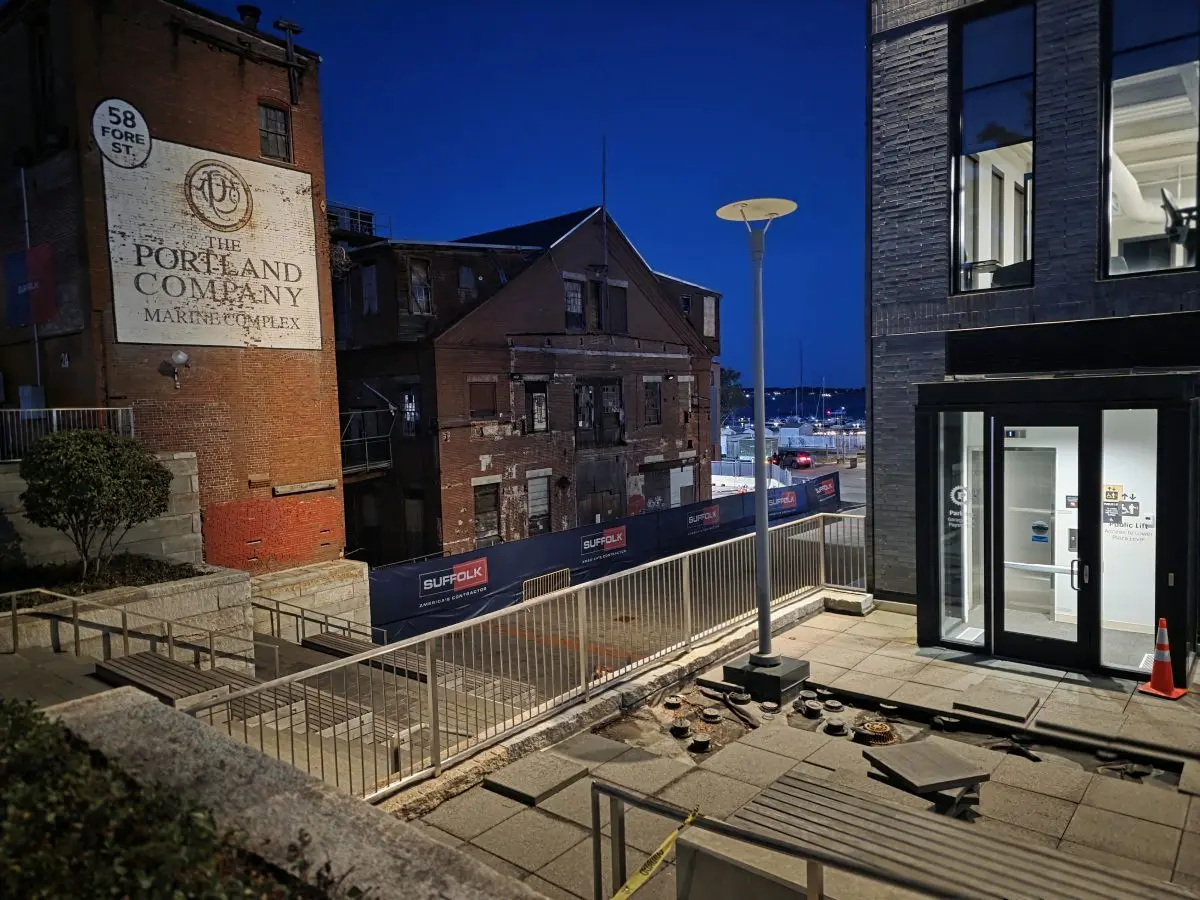
Meanwhile, the wonderland Prentice has built so far is already falling to shit. A big section of the wide stairway descending into the project from Fore Street, designed to double as a public amphitheater someday, was broken and blocked off with yellow-spray-painted bike racks when I walked down and visited in mid-September.
To open a locked door in the Sun Life building and access the elevator next to this stairway from below, you must have a smart phone, scan a QR code, and then create an account with the parking company that manages the hourly surface lot on the property. I didn’t care to give that company any personal information just to check whether a mobility-challenged neighbor could access the site here, and it would have been futile anyway. The corner of the Sun Life building above, where people would enter or exit the elevator, was roped off with yellow caution tape and blocked by a traffic cone because several slate paving squares in front of the door were broken or missing.
Two weeks later I walked down and visited again — nothing was fixed.
Support local investigative journalism by subscribing at bollardhead.substack.com.