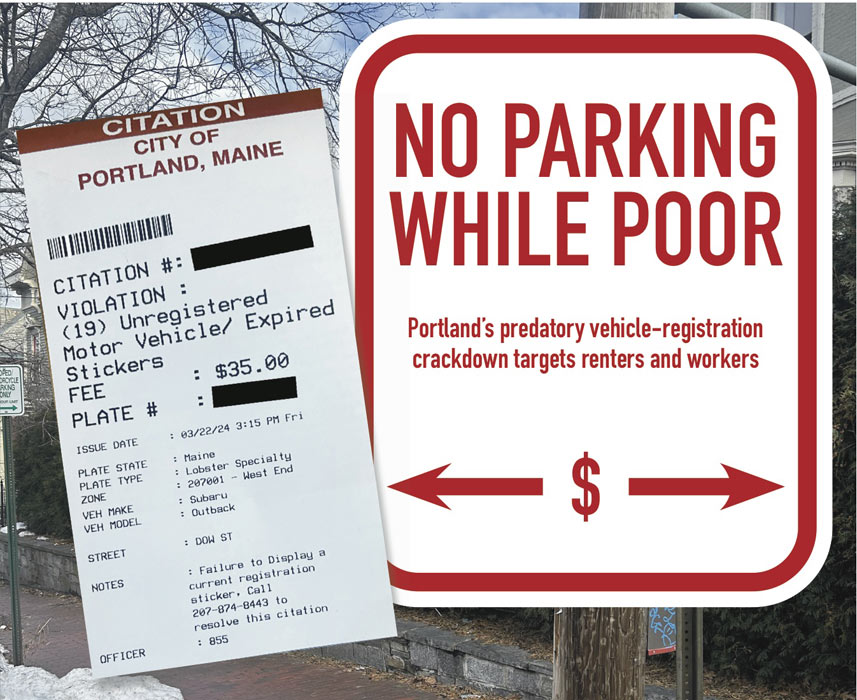
Portland’s predatory vehicle-registration crackdown targets renters and workers
No, it’s not just your pot-headed paranoia: the City of Portland really is hunting down and punishing its poorest residents while giving the wealthiest a free pass. The tenants and workers whose rent checks and labor are the true engine of Portland’s prosperity are being soaked by the city to avoid angering landlords and homeowners whose status as such exempts them from the same fines, fees and fears.
And Portland’s supposedly “progressive” city council? They’re unanimous in their support of this racist and classist crackdown and lack the integrity to defend their bullying when questioned. The same City Hall that refuses to fine landlords when they violate rent-control laws — preferring to send them a polite reminder — will ticket, tow or immobilize most tenants’ most valuable asset, their vehicle, without warning for the “crime” of being forgetful or financially stressed, thus compounding their stress with demands for more payments and threats to seize one’s means to work and survive.
What fresh fuckery is this?
It’s Portland’s new law giving parking-meter readers authority to ticket, tow and boot vehicles if their registration is out of date. Even if the vehicle is legally parked. Even on Sundays and holidays (Merry Christmas!). Even in the middle of the night, most frequently in the most racially diverse and low-income neighborhoods downtown.
And even, in many cases, if the vehicle is registered, because meter readers can’t be bothered to check state records that are literally at their fingertips. Portland’s policy is punish first, then make the driver spend the time, money and effort to prove they already paid the fee.
If you’re late making your annual registration payment, the only way to elude Portland’s newly deputized meter readers is to park your vehicle on privately owned property — a driveway, if you have or can afford one, or a commercial lot or garage, for which you will pay dearly. Any vehicle parked on a street or in a publicly owned lot next to, say, a school, or a playground, or Hadlock Field, is at risk of a ticket or worse.
Private ownership of property is like a force field Portland’s parking enforcers can’t breach. The city will ticket and fine the owner of a car legally parked on the street with an out-of-date sticker, but an unregistered car in a driveway six feet away is untouchable. We’ve been conditioned to believe there’s something so right and natural about this discrimination that it’s not even worth debating.
Granted, renters have long been subjected to fines, threats and hassles from city parking cops that property owners and residents with off-street parking never have to worry about. Particularly on the peninsula, where parking is at a premium, unpredictable snow bans and confusing alternate-side parking rules (enforced regardless of whether the streets are swept; and they’re rarely swept) are a jackpot for city coffers and towing companies, and a recurring nightmare for tenants and their unwary guests.
Mercifully, those are only seasonal, or weekly, risks. Portland’s predatory registration-enforcement regime is on the prowl for scofflaws 24/7/365.
But wait, it gets worse! Turns out the city is harassing people who can’t afford these fees and fines because the city itself is too broke and dysfunctional to fulfill its civic duties.
“The Portland Police Department [is] understaffed and this has led to them prioritizing their services to maintain public safety,” city spokesperson Jessica Grondin wrote in response to The Bollard’s questions about the crackdown. Furthermore, the Cumberland County District Attorney’s office, likewise struggling with more cases than it can handle, “has not prioritized prosecution of moving violations for ‘minor’ infractions,” Grondin added.
So, yes, it’s true, at least in theory, that any motorist is at risk of a ticket if they drive with expired registration. But our self-abolishing police force is too busy responding to incidents of actual harm to chase down safe drivers for registration revenue. And softhearted D.A. Jackie Sartoris is of the unfortunate opinion that “a traffic infraction [a.k.a. ticket] rather than a criminal summons” is the more appropriate way to deal with these violations.
“The vast majority of these cases are brought when someone has simply forgotten to renew a license or registration, and I am confident that most people will correct the issue quickly, because that’s what they do now,” Sartoris wrote in a press release last month explaining the new approach — which is only a suggestion, by the way, not a mandate local law enforcement must follow.
In other words, Portland’s mayor, city councilors and managers wish armed police would stop more drivers to shake them down for fees unrelated to public safety, and wish the D.A. would prosecute such people as criminals. But, troublingly, forgetful and cash-strapped folks are being allowed to safely travel unmolested and unprosecuted, so the city deputized its meter readers to pounce on them as soon as they leave their car on a precious patch of public pavement.
City Hall’s own staffing failures have made it more difficult and expensive for drivers to register or renew their vehicle’s paperwork, and to challenge unlawfully issued tickets — many of which are the result of the city’s dumb mistakes and money troubles.
Back in the day, you could bring your driving documents and a check to City Hall at the time of your convenience, register or renew in person, and affix the new stickers the friendly clerk handed you as soon as you returned to your vehicle. But due to chronic staffing shortages unfixed since the onset of COVID-19, one must now make an appointment to do this in person, or register or renew online via the Maine Bureau of Motor Vehicles’ (BMV) website, which charges an additional fee for the convenience of paying them without any human help.

Portland City Manager Danielle West, whom we pay $210,000 a year, couldn’t handle her busy job, so the city council gave her a second assistant city manager this year; her two helpers earn over $316,000 annually combined, not counting other benefits. photo/City of Portland
If you renew online, as an increasing number of people are doing in response to the breakdown of Portland’s bureaucracy, the stickers will arrive by mail maybe two or three weeks later (the Postal Service is also in distress these days). In the meantime you’ll be legally registered, but still subject to daily ticketing by Portland parking authorities, who could easily access the BMV’s registration records in the field, but won’t.
Why not? Because doing so would impose “an additional cost to the City,” Grondin wrote.
As a result, we get clusterfucks imposed on people like Margaret S., a renter in Portland’s West End who works in the hospitality industry and asked that her surname be redacted for fear of reprisal by what locals have long ruefully referred to as Portland’s “Parking Nazis.”
On a Saturday morning this winter, Margaret found a ticket for a registration violation on the windshield of her legally parked and registered car. When she looked at her license plates, she discovered someone had peeled off and stolen her current registration stickers — an increasingly common crime downtown, according to feedback Margaret got from neighbors when she posted about it online.
Unlike Margaret, most City Hall staff take weekends off, so she went there the following Monday to get the city’s mistake resolved. Sorry, she was told, you need to make an appointment to challenge a ticket. But sometimes someone cancels or no-shows, so she was welcome to wait in the lobby, which Margaret did for about an hour and a half, until she got fed up and made an appointment for the following day.
On Tuesday morning she walked to her car and found another ticket for expired registration fluttering under the wiper. When she got to her appointment at City Hall, they voided both tickets, gave her two new stickers (for an additional fee, naturally) and gave her some advice: remove all past years’ stickers and stick the new one directly onto the license plate, then slash it several times with a razor-sharp blade so thieves attempting to peel it off will have a harder time removing it intact. (Of course, if the sticker is mangled and rendered unreadable as a result of this bungled nighttime theft attempt, you may be ticketed every day until you get another appointment to buy new ones.)
“They did waive them,” Margaret said of the illegally issued citations, “but at the end of the day it’s just so fucking stupid. They didn’t think through that people will do crazy things to not have to pay for things” like vehicle registration.
•••
Indeed, there appears to be a willful ignorance inside the granite walls of City Hall to the harsh economic climate outside, where the cost of gas and car loans and housing and food and pretty much everything else has risen much faster than wages.
Credit card companies and banks are keenly aware of our situation, which they likewise exploit for profit using late fees and other penalties. In 2022, a lending-industry report found that more than 80 percent of people earning less than $50,000 a year were living paycheck-to-paycheck. A contemporaneous Federal Reserve Board report found that nearly a quarter of all U.S. adults would be financially screwed by an unexpected $400 expense in any given month — a sum typical of Maine’s auto registration fees, or any more-than-minor vehicle repair, which is almost always unexpected.
In a groundbreaking report last year titled, “Debt Sentence: How Fines and Fees Hurt Working Families,” the Fines and Fees Justice Center, a national advocacy group, observed “a disturbing trend unfolding among working families impacted by fines and fees: money needed for necessities like food, housing, and healthcare is often being redirected to pay off court debt.”
Yes, as the county’s top prosecutor observed, most people will eventually pay to keep their registration current. But that’s because losing the privilege to drive is a catastrophic consequence for most Mainers, living as most do far from work and grocery stores. In paycheck-to-paycheck households, covering the $400-$500 annual registration fee you forgot about means other expenses go unpaid, or someone goes hungry. Maybe the credit card bill gets put off that month, triggering yet more debt, fees, bad credit reports, etc.
By tacking on a ticket for late registration payment, the city further afflicts those who can least afford to live and work here. And as if to rub it in, the mayor and councilors decided to launch this crackdown in the midst of persistent inflation, sky-high rents and a housing crisis, right before winter, the holidays and the heating bills arrived and Maine’s economy prepared to hibernate for about five months.
The scandal of cities preying upon poor and minority urbanites with petty fines and fees exploded into national consciousness a decade ago after the uprising in Ferguson, Missouri, sparked by the police murder of Michael Brown. The U.S. Department of Justice conducted a lengthy civil rights investigation and determined Ferguson was engaging in unconstitutional and racist practices. At the dark heart of this fuckery, the DOJ found, was the fact the city’s strict enforcement of traffic and parking laws was intended to boost its budget, not improve public safety or commerce on behalf of the people it served.
Among other questions, The Bollard asked Mayor Mark Dion and every Portland city councilor to explain how their practices differ from Ferguson’s in this regard. None responded.
The ordinance giving city meter readers authority to ticket for state registration violations passed last 7-0 last October, with then-Mayor Kate Snyder and Councilors Dion, Pious Ali, Regina Phillips, Roberto Rodríguez, Anna Trevorrow and Andrew Zarro present. Councilors Victoria Pelletier and April Fournier were absent that night but still serve on the council. The two councilors elected the following month, Kate Sykes and Anna Bullett, were likewise unwilling to say a word about this.
•••
This major policy change was included in a package of considerably more mundane amendments and additions to the City Code, like a new fine for parking at an electric vehicle (EV) charging station “if the vehicle being parked is not an EV or is an EV which is not plugged in.” Blocking bike lanes, which was never cool, is also now a fineable offense.
One thing all the changes have in common: they make it harder, riskier, more expensive and more confusing to park in Portland, conveniently increasing the likelihood you’ll get ticketed for something.
For example, another law passed that night requires drivers to move their vehicle to “another/different block” after parking for the maximum amount of time allowed in any given spot: two hours. In the past, you could simply roll forward or back into an open space nearby, or drive around the block and re-park in the same spot if it was still available. Now you must wait at least three hours before you can legally park on the same “block” again.
What does the city mean by “block” in this context? A block, by definition, is an area of town defined by four streets. A literal reading of the ordinance gives one the impression that you can’t just move your car across the same street or park around the corner of the same block.
But according to Grondin, you can legally do either, even within three hours. By “block” the city doesn’t mean a city block. They mean one side of one street comprising a block, which is slang usage, at best, not any dictionary’s definition. So the city is applying the word incorrectly, but guess who pays if you get this stuff mixed up.
Bored yet? I sure am. Perhaps that’s why all the local media seems to have missed the much more consequential expansion of ticketing authority granted to meter readers last fall. City officials didn’t make any effort to alert people of this big change beyond the pro forma public notice of “Order 42-23/24 Portland City Code Chapter 28 Re: City Parking Regulations” on the council’s Oct. 16 agenda.
According to Grondin, the public’s response to the blizzard of new tickets has been predominately positive; some ticketed people are allegedly even thankful for being cited.
“We have had very little negative feedback since this ordinance was enacted and we began enforcement,” Grondin wrote. “In fact, most people have been appreciative of our forgiveness policy and many of these were just a simple oversight where they forgot to put their stickers on, which they have done now. They have been appreciative of the reminder.”
Ah yes, the forgiveness policy. “Our Parking Division policy states vehicles will only be given a citation if the expiration is greater than two months,” Grondin wrote. “If a person receives a ticket(s) we will void it if the owner registers their vehicle or affixes a current sticker to their plates within 30 days.”
You can be forgiven for not knowing about this policy, since it’s not in Order 42, or the City Code, or on the Parking Division’s homepage, which simply warns, under “NEWS UPDATES,” that “UNREGISTERED VEHICLES are subject to being ticketed.” The internal forgiveness policy is buried several clicks deep inside the city’s website, and if you visit the site just to pay the ticket, you’ll never see it.
Now let’s look at the stats. As the Press Herald reported in mid March, the city had already issued 1,567 tickets for unregistered vehicles since the change went into effect Nov. 15. Fewer than 300 had been forgiven, which includes the gratefully reminded citizens Grondin mentioned, who promptly re-registered, as well as folks like Margaret who shouldn’t have been ticketed in the first place but were cited multiple times.
About 500 tickets had been paid, at $35 a pop, which implies the violator did not pay to register or renew their vehicle so as to get the ticket forgiven, or was unaware of that unpublicized internal policy.
The largest number of tickets — about 767, or roughly half of all those issued — had not been paid or forgiven as of mid March. All those motorists were thus exposed to additional tickets, fines and fees, seizure of their vehicle using immobilization devices (the dreaded Denver boot), or removal to a sketchy junkyard in another town by a wrecker, with cash payment required in full for repossession and additional storage charges accruing every day until you come up with the scratch. (Note: the city will check state records before booting a vehicle for expired registration, but you can accrue enough registration tickets to make your car bootable or towable for any number of other parking offenses once you have three unpaid citations.)
“Most people,” it appears, aren’t actually appreciating these tickets or the city’s clandestine offers of forgiveness.
Michael Orne, who lives and works from home on the East End, was also ticketed for legally parking his registered vehicle in his neighborhood. He’d neglected to affix the new stickers in a timely manner. Unaware that parking staff could issue these tickets, he flagged down a cop and asked him about it. According to Orne, the officer said, “I’ve never seen this and it shouldn’t be happening. This is our jurisdiction.”
Like Margaret, Orne wonders why parking enforcers aren’t checking the BMV database before citing registered vehicles for registration violations. “I don’t think the parking division being able to issue tickets for an unregistered vehicle makes any sense to begin with, but if you’re going to do that, give everyone the tools they need to do it effectively,” he said. “They’re just pissing people off and creating more work for everyone.”
Orne also thinks the new crackdown is bound to infuriate and alienate visitors to this tourist town, since out-of-staters can also be ticketed by Portland meter readers. Grondin confirmed that the new policy equally applies to tourists from away, but noted that not all states require registration stickers or window decals (the fine people of Connecticut, New Jersey and Pennsylvania are among them), and the city does not “run license plates to check for a valid registration, we only enforce expired stickers.”
So the struggling Portlander who hasn’t yet scraped together the dough to renew their registration is constantly targeted for enforcement — and “could receive multiple tickets in a week,” Grondin acknowledged — while vacationers driving up from Philly or Hoboken can park their unregistered SUVs in our neighborhoods with impunity. This, we are told, is the way life should be.
•••
In fact, the city does use an app for parking enforcement that’s connected to the BMV database of registered vehicles. Problem is, the app’s owned by Passport, a creepy fintech (financial technology) company funded by vulture/venture capital firms like Mitt Romney’s infamous Bain Capital. Passport charges cities a fee to access their state’s motor vehicle records for them — a fee cash-strapped Portland would rather not pay, relying instead on those patently unreliable plate stickers.
Portland’s adoption and heavy promotion of Passport’s app as an alternative to coin-operated meters is part of a broader shift in city policy that’s made parking harder to find, more expensive for locals, and lucrative for big banks, credit-card sharks and other companies most of us would rather not do business with — like Passport, Uber, and the malignant Unified Parking Partners, which operates scores of off-street lots at exorbitant rates.
For example, more and more spots once available to anyone are now reserved for those rich enough to buy an EV or a recreational street ride like a motorcycle or moped, which get exclusive free-parking spaces all over downtown even in winter, when no one rides them. The Wi-Fi–connected, electronic parking-meter machines introduced last decade to replace coin meters and human collectors accept credit cards, which is convenient if you can afford to use one, and they charge the city processing fees for every transaction — a sizeable expense that’s ultimately paid by you-know-who.

“In the future, almost everyone in the world will live in a city, so there’s no more important challenge to work on than how people move through communities and transact with cities,” Passport co-founder and CEO Bob Youakim (pictured; photo/Passport) said in a 2019 press release announcing the closure of a $65 million investment funding round.
Passport charges the City of Portland 40 cents for every transaction done through its app, “but the customer is charged a 25¢ convenience fee to offset the cost” to the city, Grondin wrote — conveniently eliding the fact Portland residents are “the city” side in these transactions, too. That’s 40 cents (times hundreds of thousands of transactions) that rightfully belongs to us, the people who pay to maintain Portland’s pothole-riddled streets, and perhaps we could think of a better use for all that money than further enriching the Mitt Romneys of the world.
Passport also gets $3 for every Portland parking ticket “paid online or via IVR [interactive voice response; used for phone transactions with robots] from the person paying the ticket,” wrote Grondin. So the city and the fintech firm it’s in bed with are both financially incentivized to generate as many tickets as possible.
If you’re foolish enough to download and use it, Passport’s app will secretly snitch you out to the parking police the millisecond your metered time is expired. You may think you can extend your time without returning to your car by feeding the app more digital cash — Passport and the city heavily promote the convenience of this feature. But, Grondin revealed, Passport’s “digital chalking” function knows if and when you’ve moved your vehicle. So if you pay for more than two hours without driving to “another/different block,” Passport will take your money and the city will promptly give you a ticket that rewards Passport with three more bucks should you pay it without getting any people involved.
The back of every Portland parking ticket makes the company’s pitch for them: “Download Passport Parking to Pay for Parking on your phone! Passport Parking allows you to track your parking session and extend your time from your mobile device! [That’s two exclamatory sentences in a row, for those of you counting at home.] Look for Passport Parking in the App Store or Google Play Store.”
How convenient it is to pay a parking ticket with Passport!!! By contrast, the back of each ticket lists all the steps you’re required to take to challenge one, and warns of additional costs if you lose: “Request a court hearing within 10 days. You must appear in person between the hours of 9 am-4 pm Mon-Fri at City Hall Room 20 to receive a court summons for this violation. You must present your driver’s license and the vehicle registration to receive a summons. You should call 207-874-8910 and verify a constable is available when you want to come in. Please note that, following a full hearing, the court may impose fees and court costs in addition to the waiver fee listed on the violation if you are found to have committed the violation.”
That’s exactly what the Justice Department accused Ferguson of doing: piling fees atop fines and pulling people into a vortex of court procedures and legal requirements from which many can’t escape. To the extent there’s any difference between Portland’s and Ferguson’s enforcement practices, it’s one of degree, not of kind or intent.
“State and local officials are starting to consider the disproportionate effects of criminal legal fines and fees on the lives of families with low incomes — especially Black, Latine, and Native American families,” wrote the authors of an Urban Institute report last year titled, “The Cost of Parking.” “Although policymakers have focused mostly on court and prison fees,” they continued, “most individuals may interact with the criminal legal system via parking tickets, which if left unpaid can turn into lifelong financial burdens.”
The Urban Institute noted that research into the racial impacts of parking enforcement is still quite limited, but “prior research and news investigations have shown that Black families and other families with lower incomes can be disproportionately impacted by ticketing practices as well as from the resulting outstanding court debt.” The high-density downtown Portland neighborhoods where most poor and minority families live are the places where parking restrictions and enforcement are the most complex and strict.
If Portland’s Justice, Diversity, Equity and Inclusion Director, Umaru Balde, was consulted before this change became law, no one’s saying. Grondin ignored that question, and Balde, who was copied on our e-mail to Grondin inquiring about it, did not respond.
•••
Patrick Dean is a chef who lives and works in the West End. Last month he made the common mistake of thinking that re-registering your car makes it safe for another year. But the sticker indicating the month you first registered the vehicle never changes, so if you pay a couple months late one year, you only get 10 months of legal registration with the new sticker. His parked car was ticketed for this outside his apartment by a meter reader last month.
Lesson learned, Dean re-registered through the state’s website. But he’s not feeling appreciative for the reminder.
“This is only and directly effecting local workers living paycheck to paycheck,” he texted. “[T]oday alone I have seen 4 different meter maids cruising the neighborhood. And 75% of the cars I have walked by have had tickets.”
Dean said a meter reader told him the city is not ticketing vehicles with out-of-state plates, only Mainers who appear to be late paying up. “That’s just locals on the peninsula, people that live in the neighborhood and work in the area,” he said.
Dean said the meter reader also acknowledged that this Parking Division policy has nothing to do with parking — it’s just a cash-grab targeting people still struggling to recover from the pandemic’s decimation of the economy. “The way that she put it — the way that she was told to explain it to other people — was that since COVID, people have been lax about registration … so that’s the reason why they’re implementing this new law,” he said.
Not only are police charging fewer drivers with crimes for late payments, but revenue from cop-issued fines for violations of state law is split with the state. Portland gets to keep all the money from all the tickets its meter readers issue, aside from the kickbacks it pays Passport for ratting you out.
On balance, the Parking Division is a cash cow for City Hall, not an expense. For fiscal year 2023, Portland expected to collect well over $4 million from parking-meter payments, over a million more than it collected in FY 2021 (final budget numbers for last fiscal year are not yet publicly available). Its “Snow Tow” lot for parking-ban violators was expected to rake in almost $90,000, about five times as much money as it extracted from panicked renters three years prior.
Parking tickets brought in almost $1.9 million in FY 2021 and were projected to earn the city $1.8 million last fiscal year. Money earned from booting cars, a separate line item in the budget, was projected to increase by $10,000 last year, to $70,000. (Oh, and as of last fall, tampering with or otherwise trying to remove a boot is now a crime punishable by a $500 fine upon first offense.)
“Revenues in this department are greater than expenses,” Grondin wrote of the Parking Division, “and these revenues help keep property taxes low.”
Who complains when property taxes go up? Answer: homeowners and landlords whose driveways and garages protect them, by law, from this type of enforcement.
But lest we forget, residential and commercial landlords pay property taxes with tenants’ rent money, cash mostly earned for work done in Portland. So the workers and renters targeted for parking tickets are also paying (albeit indirectly) the ever-increasing property taxes those tickets are supposed to lessen. They just don’t get any of the benefits of property ownership, like the comfort of knowing you can stay in your home from one year or month to the next.
Who complains about parking? Frankly, almost every Portlander and every Mainer who tries to live, dine or shop in the Forest City. In every respect other than profitability, Portland’s parking regime is a dismal failure.
The unfairness and downright cruelty of Portland’s predatory parking enforcement are obvious to anyone with eyes. Tickets are routinely issued and vehicles routinely booted and towed solely to punish people for harmless oversights, not for any discernible public benefit.
It’s also contrary to the values that make Maine a more desirable place to live than, say, Boston. Up here, we dig and push strangers’ cars out of snow banks, hand money and food to homeless people shivering at intersections, and generally don’t flip out when trucks block our streets to deliver packages, food or oil. The tolerance everyday Mainers extend a million times every day to delivery drivers blatantly breaking our traffic and parking laws is decidedly not reciprocated by the parking police prowling the mean streets of Portland.
“[P]ublic trust in government can be undermined if parking restrictions and enforcement are seen primarily as a means to generate revenue as opposed to ensuring traffic flow and the safety of residents,” the Urban Institute report’s authors wrote. Or, to quote the great Maine novelist Carolyn Chute: “Treat us like dogs and we will become wolves.” Respect is a two-way street, and these days, both lanes are closed.
It wasn’t always this way. Portland was once known and appreciated for its tolerance and goodwill. For example, until the city policy was repealed in the summer of 2010, residents’ first parking ticket was automatically forgiven. There was always the chance one might benefit from some extra time left on a meter, or seeing one expired and a meter reader ambling up the block, locals might pop a coin in to save a stranger a ticket, one of those so-called random acts of kindness. No more.
Just as we’re all responsible for keeping the sidewalk in front of our home shoveled, neighbors in olden times would sweep leaves and litter from the street out front using an ancient tool called a broom — no fossil fuels required, no jet-engine roar of the giant sweeper machines shattering the calm of late nights and mornings in every neighborhood every week of the year (more, or much less).
Now we’re all on our own, paying faceless fintech firms a small fortune for the convenience of doing what we used to do for free. The little daily courtesies that knit a community together are no longer encouraged, expected or allowed by city officials, who view every inch of God’s Green Earth under their governance as a revenue opportunity, and every privately owned parcel as sacred ground. No parking, no stopping, no standing, no loitering, no napping, no drinking, no smoking… Unregistered vehicles and unhoused people both get boots courtesy of City Hall: one for the wheel and another for the stomach.
The dearth of on-street parking downtown creates safety threats almost exclusively risked by renters — who, as noted earlier, already grapple with daily anxieties caused by Portland’s aggressive parking enforcement.
“We’re always worried and doing the car shuffle,” Margaret said. “What day is it? And how long have we been there? That’s on top of everything else we’re dealing with. … We work in our industries fifty to seventy hours a week. It seems like a huge hassle to just get home at the end of a shift.”
“Sometimes I’ll have to park really far from the house,” Margaret continued, and her husband “will come to meet me and walk me home … or I’ll call him and talk to him all the way to my house.”
Chef Patrick, whose wife also works in a Portland restaurant, said attacks in recent years on female pedestrians in the West End have caused them to dread her long walks home from parking spot to apartment.
“Especially that time of night and somebody coming back from the restaurant business,” he said. “People can definitely, like, pinpoint somebody who’s doing that [and know] they probably have cash on them.” He said it’s not uncommon for his wife to drive around their neighborhood for 45 minutes trying to find a parking spot within a safe distance from home — a task made doubly difficult every night the alternate-side rules are in effect to accommodate the street sweepers that rarely sweep anyway.
“It’s infuriating,” Patrick said, recalling that when he lived on a one-way street near Maine Medical Center years ago, people routinely blocked the driveway, but “nobody ever got tickets on that street because they were hospital employees.”
“So here I am, now off of that street, dealing with the fact that I’m being chased after, like constantly,” Patrick added. “They’re just like following my car around. It’s almost like they recognize people’s cars, too, because they will find us in certain spots in certain places during certain times, pinpoint and get us.” (Patrick is among the locals who’ve made the fateful mistake of downloading Passport, which explains the meter readers’ newfound omniscience.)
“I’ve paid so much in parking tickets,” Patrick added. “I’ve lived in Portland for the past seven years, and it’s the highest expense that I’ve had here so far — outside of paying rent.”
Dean told me that on March 15, during an interview at LFK, the nightspot in Longfellow Square where he cooks. He’d been ticketed 10 days prior but was awaiting his new stickers, which will now give him only about nine months of freedom from this harassment.
Late afternoon on Friday, March 22, shortly before this story went to press, Dean texted me a photo: another parking ticket for expired registration. The state’s stickers still hadn’t arrived in the mail, and the first ticket for expired tags hadn’t yet been paid. Having plucked this second ticket from the wiper, Dean and his wife were now vulnerable to a third citation for “expired” registration while their car was parked on the street for the weekend — which both were working, in a freak spring snowstorm, leaving little time to mount an appeal.
A third ticket could have grave consequences. By the time City Hall reopened for another working day, they’d be bootable again.