Christy Armstrong makes amazing music “by any means necessary”
The most brilliant and beautiful album released in the state of Maine to date was made by a young trans woman in Saco named Christy Armstrong with a guitar she turned into an orchestra. It’s called Tarping, as in sailing, but with a tarp to catch the wind.
“Tarping / Up and down the moonlit river,” the title track lazily begins. “And far uptown the states got something to cell dear,” the lyrics read. “I know it’s been hell here / And those men at the top they oughta have something to fear.”
Self-released on cassette, CD and Bandcamp two springs ago, Tarping is the kind of record that expands what you thought music could be, revealing new rooms in the dark and endless hallways of your mind and filling them with treasure. Most fans can come up with a short list of great albums that changed what they thought was musically possible. During an interview last month at Elements, the bookshop cafe in downtown Biddeford, Armstrong cited Brian Wilson and Pink Floyd as influences, “just that approach to music production, the arrangements all kind of converging in the sound design … converging to a single song.”
The tattooed clerks in indie record shops would probably file this one in the “experimental folk” section, and that’d be fair. There’s acoustic singer-songwriter material at the heart of most of these compositions, and the rest is a mesmerizing swirl of electronic instrumentation, sound effects and noises arranged into movements, à la classical or jazz, within cinematic tracks that stretch into the five, six and seven-minute range. Delivered directly into the brain through headphones or earbuds, the effect is revelatory — layers upon layers of huge sounds and minute details meticulously arranged over a period of editing and experimentation that spanned about 10 years.
And, good god, what songs! Like Joni Mitchell, Nick Drake and pre-Electric Warrior Marc Bolan, Armstrong’s songwriting veers off traditional folk and pop pathways in novel melodic directions, unerringly leading you to an unexpectedly wondrous destination. She had a grand concept in mind when this project started, but it kinda fell apart along the way, she admitted. References to environmental destruction and ground warfare surface repeatedly, and Christy also cited “prison and gentrification, displacing people,” and “homelessness” as themes. She began socially transitioning and got sober while finishing this stunning debut album as the pandemic waned, and there are oblique lyrical references to those journeys, too.

If there’s a misstep on this masterpiece a critic like me is obliged to point out, it might be the first step — her decision to begin opener “Spirit Of The Hearth” with the warbly recitation of a mysterious poem comes off a bit hokey, like overly ostentatious prog rock. But after that, my friends, you’re off on a fantastic trip you’ll never forget, full of harrowing thrills (“Incantation,” “Rosie’s Return”), heartbreak (“Glass,” “Flash Flood”), adventure (“God Don’t Make No Junk”), redemption (“Screen Door,” “Red Rover”) and rebellion (“Tarping”). Spoiler alert: it ends with a heartbeat in a void.
The heartbeat in a void that became Christy Armstrong grew up in western Oxford County, well north of Fryeburg, near the New Hampshire line. “Really out in the sticks,” she said. “The nearest grocery store was like thirty minutes away, at least.”
Her father, Davey Armstrong, was a member of The Rude Boys, a notable Scottish ska band formed in the late 1970s. In Maine, he’s had weekly pub gigs as a Celtic musician and has played in the Celtic bar band Acoustic Nuisance. Pop, folk and other roots music filled the home — “My mom’s really into James Taylor,” Christy said, and Alison Krauss was also in heavy rotation. (Her crushing cover of Krauss’ “Tonight I’ll Be Lonely Too” is on YouTube.)
“Because of my upbringing and my background, my dad being a folk artist, I identify most with being a folksinger,” she told me. “And then kind of everything else falls into that. If I don’t know how to do something, I’m gonna figure out a weird, experimental way to do it.”
Davey Armstrong plays “drums, trumpet, guitar, banjo, harmonica,” Christy said. His musical abilities are “all over the place,” then she added one more: “bagpipes.”
In high school, Christy’s focus was visual art, though she did pick up the harmonica and “really took an interest in just playing it.” At the University of Southern Maine, where she earned a visual art and design degree, she began experimenting with song composition in her bedroom using the program GarageBand on her iPad.
“I didn’t know how to play guitar, I didn’t know how to play keyboard,” she recalled. “I just didn’t have the patience to sit down and learn that way. I just wanted to, like, make the music and perform it by any means necessary.”
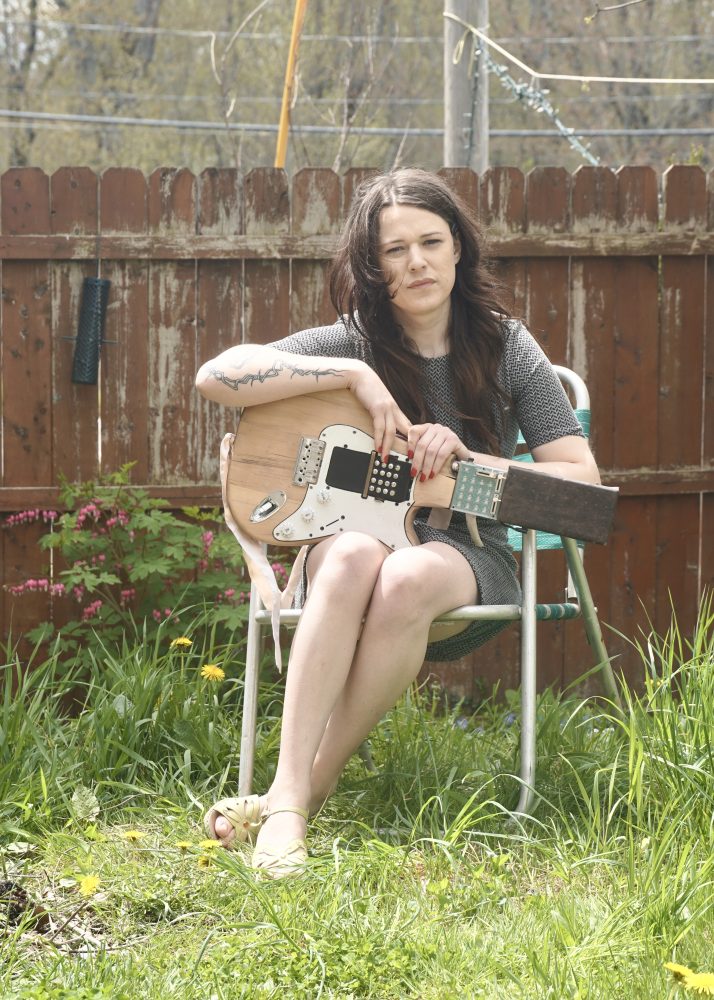
This led her to invent a remarkable new instrument: a stringless digital guitar outfitted with 16 buttons cued to specific chords — “a bit like an Omnichord, where you’ll trigger the chord and then you can strum,” she explained — and multiple devices known as MIDI controllers that enable her to further manipulate notes and samples by programming additional parameters.
“The longer I’ve worked on the instrument itself, the better I’ve figured out how to play it,” Armstrong said, “how to translate the songs I write to a live performance.” For example, there’s a gyroscope-like element that enables her to bend sounds by tilting the instrument — she simply calls it “my guitar.” And when the pulsing lights on the touch pad of one the MIDI controllers attached to the foreshortened neck became distracting, she covered it in leather and embossed indentations where each “note center” is, so she can play it without looking, just feeling.
“I think the whole ethos of the instrument is much like feel — so I don’t have to think about looking at a screen, all the finicky things with digital, editing from a software. If I can assign all the parameters that I want physically to be instrumented, then I can move with it.”

Now 32, Armstrong had a series of odd jobs at the Portland Museum of Art, Duckfat, and the now defunct cooperative cafe Local Sprouts, on Congress Street, after college. She said her current Portland workplace was a very supportive environment in which to transition a few years ago.
Also, “I know a lot of other trans people in the city,” Christy said. “Local networks of support are so important. These kind of like ballooned political things are important, but knowing that you have a community and the support at the local level is the most important. Especially,” she added, “when political parties can’t meet the needs of their constituents or their voting base. People will want to abandon that.”
Armstrong’s Instagram page, boldly titled “gorgeoustranssexual,” describes her as a “performing artist and musician on unceded Wabanaki land,” and adds, “Free Palestine,” with three Palestinian flag emojis. She contributed a straightforward protest song, “In Palestine,” to the local compilation Songs of Hope for Gaza, which came out last fall and benefits humanitarian efforts in that decimated territory.
The dynamic on Tarping is a continual push and pull between beauty and brutality, between calming and alarming sounds. Armstrong’s output since its release has been similarly split. Newer folk songs like “Dedra,” about a dragon avenging nature, have a sweetness and simplicity in keeping with her goal of writing material more easily performed live. She’s got about 10 new songs like that in the works.
Then there’s experimental stuff like the “bird cage” piece she’s recently performed at underground venues like Bandsaw, a woodworking shop in South Portland that hosts occasional shows, and Open Systems Studios, a warren of offices in Bayside run as a collaborative arts space. For that piece, Armstrong attached microphones to a bird cage, made a sonic bed of drone tones with a harmonica, set those sounds in looping patterns and created a narrative based on the bird being freed — a reference to her transness, she said.
“It was just full of happy accidents,” Christy remarked of a recent performance. “I think that’s what I wanted to lean into. That’s the exciting part about it. It feels like it’s living or evolving or becoming something else.”
“My mind is always on the next project,” she told me, like her ongoing effort to build a website that’ll present all her artistic pursuits in one place.
Engaging with the “music industry,” or what’s left of it, in hopes of reaching a bigger audience is not in the cards for Armstrong. “I’ve always been like a visual artist and I like privacy,” she said. “I know people who have pursued music and have grown a much larger audience, but I’ve always been very DIY — just, like, local. Most of the shows I play are local; that’s kind of like where my heart is. But if people find the record, I think it’s great.”
Congratulations, Bollard reader: now you’ve found it, too.
You can hear and purchase Tarping on Bandcamp at christyarmstrong.bandcamp.com. She recently ordered another pressing of cassettes, as well.