The Radical Congregationalists of Maine’s Abolitionist Movement
In 1834, Rev. Amos Phelps, a Congregational minister and American Anti-Slavery Society organizer from Massachusetts, made a plea to his brethren to preach for the immediate emancipation of the nation’s 3.2 million people in bondage. In the introduction to his treatise, “Lectures on Slavery and Its Remedy,” Phelps included a “Declaration of Sentiment” signed by over 120 ministers and others from Maine, New Hampshire, Massachusetts, Vermont, Rhode Island, New York, New Jersey, Pennsylvania, Connecticut, Ohio and Kentucky. The declaration expressed “a sense of duty to God and man” to eradicate the “great and threatening evil” of slavery, and asserted that “every man … is personally responsible, and has personal duties” to fight for immediate and universal abolition.
Among the signatories were 26 religious men from Maine, which had more signers than any state besides Massachusetts. Most were Congregationalists, but there were also four Baptists. The signers included several men who’d founded the Maine Anti-Slavery Society that year: Rev. David Thurston of Winthrop, Revs. Swan L. Pomeroy and Joseph Lovejoy of Bangor, and professor William Smyth of Bowdoin College.
Congregationalists stressed “freedom of conscience” to interpret the Gospel according to one’s personal convictions. Each church was independent and autonomous, so when it came to the slavery question, economics and geography typically determined where Maine Congregationalists stood on the issue.
Churches in port cities like Bath and Portland did a lot of trade with the South, and wealthy merchants and businessmen filled church coffers, so it’s hardly surprising that Congregational ministers there were hostile to abolitionist ideas. None of the signatories to Rev. Phelps’ Declaration of Sentiment were from any of the major commercial centers in Lincoln, Cumberland and York counties. While Phelps was lecturing in Maine, he couldn’t find a church willing to host him in Freeport, Saco, Wells or Kennebunk.
But in inland towns, Congregational preachers were leaders in the state’s anti-slavery movement.
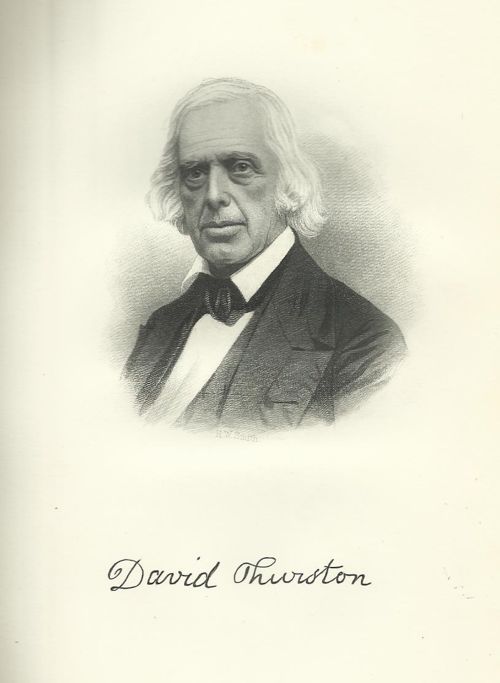
Rev. Thurston was one of the most well known anti-slavery activists in Maine. Born in 1779, the Congregational minister served in national leadership positions in the church despite his relatively radical politics. After time on the faculty of the Maine Charity School in Bangor (later renamed Bangor Theological Seminary), Thurston served as president of the American Missionary Society until his death in 1859. He was a founding member of the American Anti-Slavery Society and attended its first convention in Philadelphia, in 1833.
In the late 1830s, Thurston was an indefatigable organizer for the Maine Anti-Slavery Society, traveling from town to backcountry town delivering sermons, distributing books to establish abolitionist libraries and forming local auxiliaries. His colleague, Rev. Austin Willey, who edited a series of anti-slavery newspapers in Maine, remembered Thurston as “a man of solid ability, ‘without guile,’ of eminent piety, and courteous in manners.” Thurston, he said, “devoted a year to arduous, self-denying, earnest labor all over the state, ‘preaching deliverance to the captives.’”
“If he could scatter the seed of truth over the state and plant the right ideal of the cause in the minds of the people, it would grow; and no man in the state could have commanded for it more respect and confidence against the tempest of falsehood and slander,” wrote Willey.
A Mr. N. Gammon recalled Thurston once travelled to the Western Maine town of Phillips to give a lecture on slavery, only to find that prominent local businessman Joel Whitney had locked the church, taken the key and left town to prevent the event from happening. “Phillips was strongly Democratic in those days. With a few others I stood by the poor slaves amidst the most bitter opposition,” Gammon wrote. “I took papers and tracts, and the postmaster, Lincott, would often write ‘nigger’ on them.”
Thurston was able to get his congregation to take the dramatic step of banning slaveholders from taking communion. But by 1851, his anti-slavery politics had caused such division in the parish that he was forced to resign.
Rev. Pomeroy, then in his mid-30s, carried the flag of abolitionism in Bangor for years and served as secretary for the American Missionary Society until a sex scandal forced him to resign in disgrace in 1859. The Bangor Daily Commercial remembered him as “a powerful and impressive preacher” whose departure from Bangor “was regarded as a public calamity.”
Another minister in his 30s, Rev. Lovejoy, the brother of slain abolitionist editor Elijah P. Lovejoy, was a devoted activist and prolific writer whose columns regularly appeared in the New York-based Emancipator newspaper. He co-wrote Elijah’s memoirs with their brother Owen and wrote the biographyofabolitionist Charles Turner Torrey, who died in a Maryland penitentiary after being sentenced for aiding African Americans fleeing slavery on the Underground Railroad.
Their contemporary, Smyth, taught mathematics at Bowdoin and was very active in the abolitionist, temperance and school-reform movements of the 1830s and ’40s. In addition to co-founding the Maine Anti-Slavery Society, he was the first editor of its newspaper, the Advocate of Freedom.
As a longtime member of the Brunswick school committee, Smyth led the effort to unify the town’s schools into one district, create separate grades and establish Brunswick’s first high school.According to Smyth’s son, many freedom-seeking former slaves showed up at night on thefamily’s doorstep, a known station on the Underground Railroad. The home is now the Russwurm African American Center at Bowdoin.
Rev. Thurston led the effort to get Congregational churches to accept abolitionism by shepherding through a mildly anti-slavery resolution at the 1834 General Conference of Maine. It declared, “That it is the duty of Christians to sympathize with the enslaved of our race, and to pray that involuntary servitude may come to an end as soon as may be throughout the world.” Even the Rev. Asa Cummings, a leading critic of abolitionism who edited the Maine Missionary Society’s Christian Mirror, couldn’t find anything to criticize in the resolution. “It is the least we can do, and prayer to God for them is indispensable, whatever else we may do,” Cummings wrote.
Conservative pastors from coastal churches were able to block efforts to take a stronger stand against slavery. It took more than a decade of agitating before activist clergy were able to pass any meaningful anti-slavery resolutions. Meanwhile, the abolitionist ministers of the countryside took their resolutions to their local Congregational conferences.
The radical Kennebec clergy were the first to call for immediate emancipation. In September of 1834, Rev. Phelps spoke at the Kennebec Conference, where delegates passed a resolution declaring, “Slavery is a violation of God and is therefore a sin which ought immediately be abandoned.” The resolution also condemned Northerners who bought slaves “for filthy lucre’s sake.”
A year later, the Kennebec County delegates went further, declaring it “the imperious duty” of “churches to humble themselves before God, on account of the sin of this system, and earnestly to pray for its immediate removal, and to purify themselves from all its abominations.”
By contrast, the Congregationalist conference in Cumberland County, which was dominated by Portland’s churches, made no reference to slavery between 1830 and 1844, according to Congregational historian Calvin Montague Clark.
At the York Conference in Biddeford in 1835, delegates passed a resolution calling slavery “a great moral and political evil,” but emphasized that it was up to slaveholders to end the practice. Conference delegates declared they had “no other than the most kind and benevolent feelings towards slaveholders,” and wrote that it was “the duty of the slave, submissively to yield to his condition, till in the providence of God the way is opened for his release from bondage in a peaceful manner.”
A number of leading Congregational ministers supported the American Colonization Society’s scheme to ship free African Americans and enslaved people to colonies in Liberia, on belief that they couldn’t coexist with white people. Church historian Clark wrote that Maine clergy were deeply involved in colonization efforts from the beginning.
In 1822, Rev. Jehudi Ashmun, the first theological instructor at the future Bangor Theological Seminary, became one of the first ACS agents and helped establish the first colony in Liberia before dying of a tropical disease in 1828. Other abolitionist pastors in the ACS included Maine Anti-Slavery Society co-founder Rev. Benjamin Tappan of Augusta and Rev. Pomeroy.
But despite the General Conference urging Congregational churches to support the ACS, and Rev. Cummings’ constant promotion of the organization in the pages of the Mirror, efforts to start ACS chapters here faltered. William Lloyd Garrison and his acolytes in Maine despised the ACS, and the Liberator editor famously dominated ACS organizer Rev. Cyril Pearl in a debate over the issue in Augusta in 1833. Even moderate Christians weren’t interested in joining the group.
Still, moderate Congregationalists believed there was middle ground between the fanatical abolitionists and the slavers of the South. Toward that end, they formed a paternalistic organization called the Society for the Relief and Improvement of the Colored Race to counteract the radicalism of the Maine Anti-Slavery Society.
But the country was on the verge of a violent backlash against freedom. Anti-abolitionist mobs stormed post offices to seize anti-slavery mail, destroyed meetinghouses, and dragged Garrison through the streets of Boston in an attempted lynching. When it came to the slavery question, it was becoming increasingly clear that the center would not hold.
Andy O’Brien is a writer and communications director for the Maine AFL-CIO. You can reach him at andy@maineworkingclasshistory.com.