The Destruction of Noyes Academy: Aftermath
After a mob of white men dragged Noyes Academy — the first interracial, co-ed school in New England — off its foundation and left it in ruins in the middle of the road on a hot August day in 1835, the townspeople gathered on the spot to pass a series of resolutions.
Local merchant Phineas Eastman delivered remarks condemning abolitionism, drawing loud applause from the crowd, according to Canaan, N.H., historian William Allen Wallace. Eastman declared that the U.S. Constitution was a pact between the Northern and Southern states by which they pledged to protect each others’ rights and privileges. “Revolutionary Patriots” from both the North and South, he continued, fought side by side in the American Revolution, and it would be a disgrace for their descendants to “surrender their rights” to anti-slavery zealots.
“The Patriots of New Hampshire,” Eastman proclaimed, “will fight for the rights and privileges of their Southern brethren [to own slaves] which are guaranteed them by the Constitution, so long as there is a man that can shoulder or handle a gun.”
The abolitionists, he continued, “must be checked and restrained within Constitutional limits or American liberty will find a speedy grave.” Perhaps the biggest applause line was the one in which Eastman blasted British abolitionist George Thompson, who was then on a lecture tour through New England [see Radical Mainers, Aug. 2023], for “sow[ing] seeds of discord between the North and South.”
“May he be removed from the continent as suddenly as the Noyes Academy has this day been removed from the control of the Abolitionists,” Eastman exclaimed.
Those gathered then voted to order Noyes teacher William Scales and the Black students to leave town within one month or “be removed by force.”
By that time, the most prominent Black students — Henry Highland Garnet, Alexander Crummell and Thomas Sidney — had fled Canaan following a brief gunfight with the mob. The three young men huddled together atop carriages and on the decks of riverboats in the poor weather because they were barred from sitting with white passengers. They faced outright hostility when they sought to secure accommodations from white farmers along the way. And to make matters worse, Garnet developed a fever. His friends did their best to make a bed for him with their coats and to shade him with their umbrellas while traveling home to New York.
Long after the attack, there was lingering hostility among the anti-abolitionists toward the school’s supporters, especially the anti-slavery Congregational minister Edward Fuller and his wife Rebecca, who had cut the rope to the family’s well to deprive the mob of water after they’d hauled the school away. Rev. Fuller, wrote Wallace, was “repeatedly warned by ghostly looking messengers upon white horses at the dead of night” that unless he renounced his abolitionist views, he would face their wrath. It doesn’t appear the Fullers ever did comply, but they moved to Piermont, N.H., the following year.
A month later, the Canaan selectmen held a meeting on the town common near the ruins of the school to decide what to do with it. Men from Canaan and nearby Enfield arrived with their teams of oxen and a plan was made to drag the building across the road to the corner of the Baptist Parsonage field. After it was placed on that spot, the men hauled a cannon through town and fired it outside the homes of every known abolitionist, smashing their windows with shockwaves from the blasts. They then slaughtered another cow, again paid for by the Canaan selectmen, and settled in for a massive feast.
The mob’s ringleader, Jacob Trussell, rose triumphantly to deliver an address to celebrate their victory:
Gentlemen, the work Is done! The object Is attained! The contest has been severe, but the victory glorious! No sable son of Africa remains to darken our hemisphere! The Abolition Monster, that ascended out of the bottomless pit, is sent headlong to perdition, and the mourners go about the streets. To you, Gentlemen, who have assisted in attaining this glorious victory, I present you hearty and sincere thanks, for your prompt attention and your unexampled exertions in repelling an enemy, far more to be dreaded than the pestilence that walks in darkness, or the destruction that awaits at noonday. May the sun of liberty continue to shine on you with increasing splendor, and never be obstructed by the sable clouds of Africa. And should It be your misfortune to be invaded by a similar foe, we pledge ourselves to unite our exertions with yours in putting down by all lawful exertions, every plot that threatens the subversion of our liberties, or disturbs the public tranquility. May that being who presides over the destinies of nations, reward you a hundred fold in this life and in the world to come, life everlasting.
Around sunset, the men reassembled and paraded back through the streets of Canaan accompanied by the patriotic pomp of fifes and drums, and again firing the cannon outside every abolitionist home.
“At each discharge the broken glass jingled in unison with the yell of triumph that went up from the crowd, the firing and shouting was kept up until late at night,” wrote Wallace. “Just before night one chivalrous fellow ascended the cupola of the Academy, painted the black ball thereon white and nailed a white flag to the spire.”
One Canaan resident who watched the terror unfold wondered what future generations would think of what had just transpired and how each side would be perceived in history. The lasting bitterness is evidenced by the fact that some years later someone accessed the town records and scrawled notes next to the names of those who served on the committee responsible for the school’s removal. Notes like: “dead and rotten and now forgotten,” “still at 90 broken and defiant,” “a common drunkard,” “an idiot,” “an old witch too mean to live or die,” “old foolish jealous and insane,” “a blasphemous cripple” and “killed by God after having stolen money sent him to keep his wife’s father from starving or thrown on the town.”
Some of the mob leaders later felt remorse for their role in the attack on Noyes Academy, and a few even became abolitionists.
Two years after the incident, when Garnet returned to give a sermon at the invitation of the Congregational church, he was approached by Ben Porter, who had been part of the mob. As Porter took Garnet’s hand, he expressed sorrow and regret for taking part in the attack. When he was on his death bed years later, Rev. Joseph L. Richardson also looked back on his actions that day with regret and wished the destruction never happened.
But others remained proud of the work they’d done. Salmon P. Cobb, one of the local sheriff’s deputies, was known to hiss and spit at any abolitionist he encountered in the years that followed. He was never disciplined for harassing abolitionists and the only rebuke he ever received, according to Wallace, was to “keep within the law.” Trussell never regretted his behavior, either, although he was later expelled from the local Congregational Church for leading the mob.
As one Noyes supporter wrote, “Had it not been for Trussell and the foreign element which rode over and insulted us for two days, we know that the Academy would never have been touched. Jacob Trussell is an intolerant bigot, opinionated, unforgiving, not a drop of warm blood in his veins except what is warmed by the passions that animate him. He never forgave an injury and he never had a friend. He never performed an act of pure charity, and he never forgot to be selfish.”
The town later fixed up the Noyes building to house an all-white school called Canaan Union Academy. The selectmen attempted to reach a compromise with the Noyes Academy trustees and the mob that destroyed their school. What the abolitionists really wanted was for law enforcement, the courts and the selectmen to uphold the law. But no one was ever prosecuted for the acts of terror committed on that sweltering day in August of 1835. In fact, the town voted to defend Trussell from any lawsuits for his role in the crime.
On March 7, 1839, the Canaan Union Academy building was burned down in an act of arson. “The building had been standing several years a silent monument of all the bad feelings of the human heart. Its doors were seldom opened to the student,” wrote Wallace. “Many persons had expressed a wish that it might burn down, and its ashes scattered to the four winds, and that the recollection of it might cease from the recollection of man.”
But the students never forgot what happened and they carried that trauma for the rest of their lives. A number of them became quite prominent in the abolitionist movement.
Garnet, Crummell, Sidney, and Julia Ward Williams eventually were able to finish their education at the highly influential Oneida Institute in upstate New York. Williams became a teacher in Boston and a well-respected member of the Female Anti-Slavery Society. She married Garnet and the couple spent the rest of their lives traveling the world, fighting to end slavery and promoting equality. Garnet taught at a Black school and became the pastor of the Liberty Street Presbyterian Church in Troy, N.Y., where the couple gave shelter to freedom seekers on the Underground Railroad. In the 1850s, Williams ran a female industrial school in Kingston, Jamaica, while her husband did missionary work there.
Garnet grew deeply pessimistic that America would ever change through democratic means. He encouraged Black emigration to Mexico, Haiti and Liberia. He supported armed struggle against oppression and celebrated the militant abolitionist revolutionary John Brown’s ill-fated raid on Harper’s Ferry, stating that it was “the duty of every man who loved the cause of freedom to declare that the Harper’s Ferry movement was right, and that any one who would not say so boldly had much better say nothing at all.”
After the Civil War broke out, Garnet actively recruited Black soldiers to fight in the Union Army and ministered to colored regiments. Following passage of the 13th Amendment abolishing slavery, he became the first Black faith leader to address Congress. In 1881, he was appointed the U.S. Ambassador to Liberia, where he died the following year.
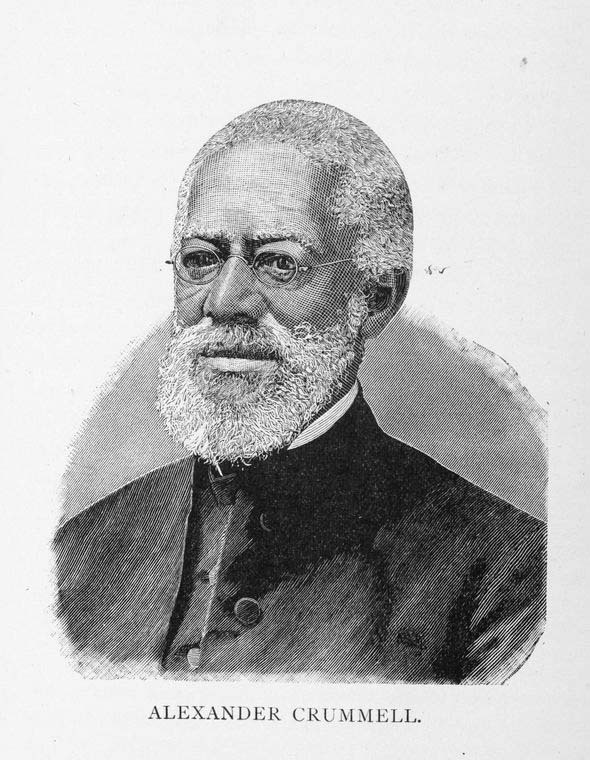
Crummell became a Presbyterian minister and eventually moved to Liberia, where he spent several years as a missionary. In 1895, Crummell went back to visit Canaan for the first time since a white man fired a bullet into his dorm room 60 years earlier. Prior to delivering a sermon to the Methodist Church, he was denied a room at a hotel in town due to his skin color and had to board with a white family. While en route to Canaan, Crummell excitedly told Boston librarian George Washington Forbes about his plan to found the American Negro Academy, a liberal arts school to educate a new generation of Black professionals, intellectuals and activists.
As Forbes recalled, Crummell’s “face glowed with the warmth and radiance of youth as he enlarged on the need of his proposed academy from his vast experience. He hoped to enlist the congenial souls from all walks of life — preachers, lawyers, doctors, teachers, journalists as well as writers — so that the combined influences might lay the foundation of a genuine historical society for preserving our records and achievements.”
The academy’s members included the African-American historian Carter Wilson, future NAACP President James Weldon Johnson, and a 29-year-old socialist scholar named William Edward Burghardt Du Bois. In 1898, a year after the academy’s founding, Crummell died at the age of 79, his final mission completed.
Andy O’Brien is a writer and communications director for the Maine AFL-CIO. You can reach him at andy@maineworkingclasshistory.com.