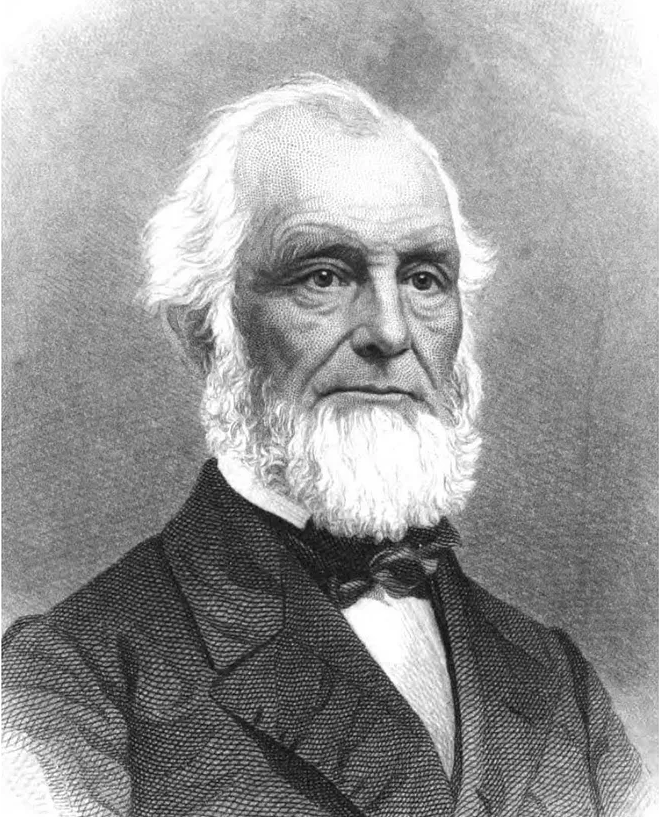
Preacher of doom William Miller.
The Black Millerites of Maine & The Great Disappointment
On a cold spring evening in April of 1845, a group of 40 white men disguised as African Americans burst into a house in North Bucksport to disrupt a meeting attended by religious disciples of the controversial preacher William Miller. Once inside, the men in blackface surrounded the group and pressured them to pledge not to attend any more meetings nor spread Miller’s prophecies.
After the intruders hustled the Millerites out of the house one by one, they ransacked it, finding “a large quantity of provisions” and $40, which they gave to the Bucksport selectmen, according to the Bangor Daily Whig and Courier. The paper reported that several of the invaders were “men of intelligence and property,” and some were even magistrates, who sought to “drive Millerism out of Bucksport.”
Several years earlier, Miller, a farmer and Baptist lay preacher from upstate New York, had been intensely studying his Bible when he became fixated on the prophecies of Daniel, specifically the passage, “Unto two thousand and three hundred days; then shall the sanctuary be cleansed.” Miller believed the “sanctuary” represented Earth and the cleansing was a righteous fire that would spread over the planet upon the Second Coming of Christ, sometime between 1843 and 1844, based on the prophesied timeframe.
The Boston-based newspaper Signs of the Times broadcast Miller’s teachings all over the land, amassing a zealous following of an estimated 50,000 Christians. However, the Millerites were relentlessly attacked elsewhere in the press as unhinged fanatics, and newspapers frequently attributed violence, suicides, and other dreadful acts to Millerism.
They were also guilty of a particularly egregious societal taboo: “race mixing.”
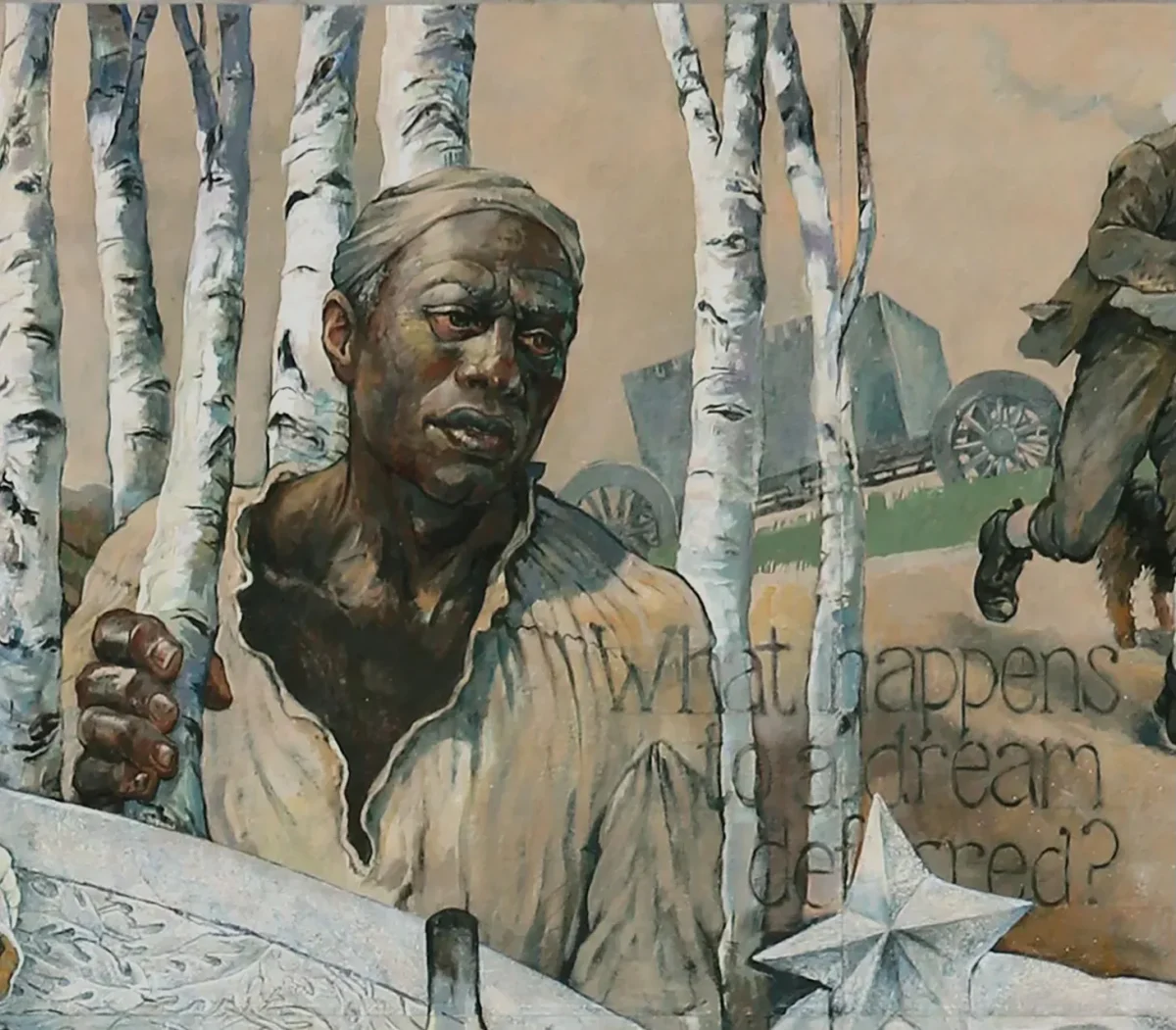
One of the most important prophets in the Millerite movement was Rev. William E. Foy, an African American Freewill Baptist minister from Maine. Born in 1818 on a large farm just north of Augusta, Foy had a religious epiphany as a teenager watching the Rev. Silas Curtis, an influential white pastor and outspoken abolitionist, preach in the city. Foy felt called to the ministry, and in 1842 he and his wife moved with their daughter Amelia to Boston so he could attend seminary. The family settled on the north slope of Beacon Hill, in Boston’s largest Black neighborhood. Coming from the predominantly white Maine countryside, Foy had his first experience in a majority-Black community and with the religious and political currents then thriving there.
Foy befriended the Rev. George Black, a West Indian Baptist preacher who previously lived in Portland, where he was involved in the anti-slavery and Colored Convention movements. Black had moved to Boston in 1838 to become pastor of the First Independent Baptist Church, on Belknap Street, now known as the African Meeting House. In 1840, he led a group of 36 dissenters to break away from the Independent Baptist Church and form the Twelfth Baptist Church, on Southack Street, because their former church was not taking an aggressive enough stand against slavery.
It was in that church that Foy had his first apocalyptic vision, as the congregation knelt in silent prayer on Jan. 18, 1842. Foy later recalled in a pamphlet, titled “The Christian Experience of William E. Foy,” that he was “immediately seized as in the agonies of death” and his breath left his body like his spirit had departed. He saw a figure wearing a crown dressed in white with an expression shining “beyond the brightness of the stars” and sun.
“This shining one, took me by my right hand, and led me upon the bank of a river; in the midst was a mount of pure water,” Foy wrote. “Upon the bank, I beheld a multitude, both great and small; they were the living inhabitants of the earth. Soon all moved towards the west, walking on the water, until we reached the mount. This became the separating line between the righteous and the wicked.”
Witnesses said Foy lay motionless for two and a half hours before he finally rose to his knees, raised his right hand and motioned for water. A few weeks later, on Feb. 4, 1842, Foy had a similar vision and passed out for over 12 hours at the African Methodist Episcopal Church, on May Street.
In this vision, he reportedly saw Rev. Black, who died two weeks later. Foy recounted that his spiritual guide directed him to “return to yonder world, and thou must reveal those things which thou hast seen, and also warn thy fellow creatures, to flee from the wrath to come.” He was very nervous and initially hesitant to follow the command, “knowing the prejudice against those of my color.” But word soon spread throughout the neighborhood of Foy’s visions.
Soon he was traveling throughout New England, speaking to packed meetings about his religious experiences. As historian Benjamin Baker writes, Millerites were quite progressive by the standards of the period. They embraced abolitionism, were egalitarian in their views, and their services were often racially mixed at a time when most white churches discriminated against Black Christians. Baker notes that Black Millerites served as leaders in the movement and dozens of northern Black Millerites formed churches, some of which were used as stations on the Underground Railroad.
Even enslaved people in the South were drawn in by Millerism’s prophetic message, because they saw Christ as a liberator from an oppressive earthly government that deprived them of freedom and human rights. However, Baker argues that African Americans didn’t just join the movement, they “transformed Millerism for their purpose, empowerment, expression, community, and liberation.”
Appalled at the idea of a Black preacher leading a white flock, newspapers frequently mocked and dehumanized Black Millerites with racist caricatures. The Portland Transcript ran an especially racist commentary on Foy’s appearance in the city in 1844:
“When will Wonders cease? The Millerites of this city have recently imported a great bull n ——, who has been rolling up the white of his eyes, showing his ivory, and astonishing the good people by his dreams and prognostications. It is said the fat and greasy black can neither read nor write — but he told of the joys of the blest and the wailings of the damned with such gusto, that even the weakest disciple of the prophet smacked his lips for more…. We soon expect to see this fat bull n— —, superbly dressed, seated in a chariot, and drawn through our streets, by the devoted disciples of Miller, who will bow down and worship him as a God.”
African American anti-slavery organizer Rev. John W. Lewis — a Freewill Baptist minister from South Berwick — was one of several prominent Black abolitionists who found solace in Miller’s prophecy that Christ would soon return to gather the righteous, punish the wicked, and dissolve America’s caste system. The anti-slavery movement that had seemed so promising in the early 1830s had fractured into bitter rival factions, while Southern enslavers tightened their grip on the levers of power.
Rev. Lewis had lost a lot of friends when he publicly quit the New Hampshire Anti-Slavery Society over one such split, and in the summer of 1842 he had an infection in his throat and lungs that made him unable to undertake his usual traveling lecture circuit and earn money to support his family. When he was finally able to get out and do his work, he found most churches were unwilling to receive his message.
“In one town, it was said they are all abolitionists, but don’t do much. The minister was in the way,” Lewis complained in a letter to the Morning Star in June of 1842. “He professed to love colored people; but then there were some rich men in his congregation who were pro-slavery, and they wouldn’t like it, if he spoke on the subject, or let me lecture in his pulpit.”
At another anti-slavery meeting, Lewis described how he was forced to pay an exorbitant fee to take a private coach to a Literary Society meeting in Massachusetts, where he was scheduled to give a lecture, because men in a shared coach refused to ride with a “n——.”
Lewis began to lose faith in the political system’s ability to liberate his brethren as the date of the apocalypse Miller had predicted approached. In May of 1844, the Millerite newspaper Midnight Cry published an essay Lewis penned titled, “To the colored people of the United States who love our Lord Jesus Christ,” in which he declared the abolitionist movement had failed.
“Although we have felt sanguine in our hopes, our expectations have not yet been realized: we are still in bondage and affliction, under an aristocratical power, which is a natural element of all worldly governments,” Lewis wrote. “But we are now thrown on a new point of time, and, to my mind, the last period of the existence of earthly power. I firmly believe a glorious scene will soon be ushered in. Then shall be established the eternal kingdom of God in power and righteousness. I believe, dear brethren, that THE END is just upon us.”
Miller had originally predicted the end of the world would come between March 21, 1843, and March 24, 1844. But when those dates came and went, he revised his prediction to Oct. 22, 1844. Expecting the Second Coming that fall, many Millerites didn’t bother planting crops, bringing in hay or cutting firewood. Some even sold their farms. On the supposed day of reckoning, Millerites in the Midcoast climbed to the top of Mount Megunticook in Camden and sat until dawn awaiting the apocalypse, only to end up sheepishly walking back down to the mocking of their neighbors. The spot where the Millerites sat is today known as the Millerite Ledges.
It’s not clear how Rev. Foy and Rev. Lewis took what became known as “The Great Disappointment,” but they both continued their itinerant preaching and led revivals for many years afterward. Foy died in 1893 and is buried in Sullivan, Maine, but he is still revered in the Seventh Day Adventist Church, which was formed from the ashes of the Millerite movement in 1863. Lewis remained active in the abolitionist and Colored Convention movements, but he did not live to see his brothers and sisters freed from bondage. He died in early 1861, six months before the First Battle of Bull Run.
Andy O’Brien is a writer and communications director for the Maine AFL-CIO. You can reach him at andy@maineworkingclasshistory.com.