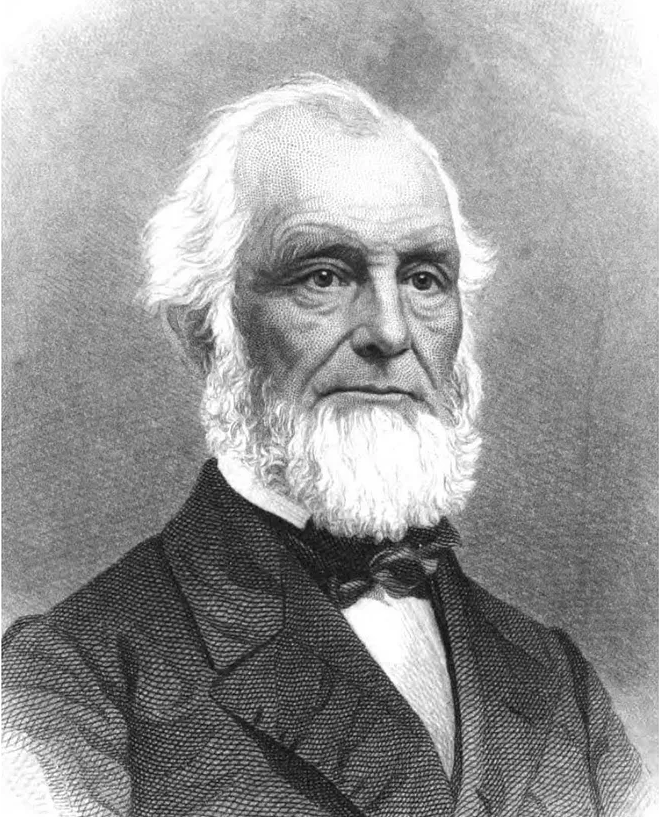
Nathanial Peabody Rogers.
Fissure of Abolitionist Movement Leads Rev. Lewis to Black Activism in Maine
The late 1830s and early 1840s were very trying times for the anti-slavery movement. Throughout the 1830s, the main strategy of abolitionist leader William Lloyd Garrison and the American Anti-Slavery Society was of moral suasion: appealing to Americans’ conscience by educating them about the evils of slavery. Garrison scorned electoral politics, supported women’s rights, advocated non-resistance and called on abolitionists to leave any church that refused to oppose slavery.
But by the late 1830s, the abolitionist coalition began fracturing as some members sought to enter politics, and conservatives, led by clergymen, attempted to block the inclusion of women in the movement. After they failed to take control of the national organization, the anti-Garrisonians broke away from the American Anti-Slavery Society to form the American and Foreign Anti-Slavery Society at a meeting in May of 1840. Many of its members also joined the Liberty Party, a third party focused on anti-slavery political reforms.
The New Hampshire Anti-Slavery Society was not immune to the factional struggles playing out nationally. In 1838, the Garrisonian abolitionist writer Nathaniel Peabody Rogers, of Plymouth, took over the editorship of the state Society’s Herald of Freedom newspaper following the death of its 24-year-old editor. Historian Steve Cox notes in a 1980 doctoral thesis that Rogers could be extremely provocative for his day, and became “one of the most uncompromising ‘ultras’” in the anti-slavery movement. Rogers condemned churches as “the most formidable obstacle” to ending slavery and hailed abolitionists who stood “fearless of the Popery that tyrannizes over the soul of the country, and that hydra ‘brotherhood,’” by which he meant the clergy.
He called the U.S. Senate “that ungodly body” and dismissed the Fourth of July as “a poor old prostituted, rum-soaked, power smoked anniversary.” As Cox observed, Rogers blasted this country’s military and militias as “human-tigerism — rational brutality — hatred dressed up in regiments … homicide under pay and murder per order.” Voting, Rogers argued, was a futile exercise in deciding “which of two rival Caesars shall be captain-general.”
Conservative anti-slavery clergy soon launched a crusade to thwart Garrisonions like Rogers. The state group’s president, Rev. Jonathan Curtis, threatened to form a new organization if the New Hampshire society continued to support Garrison’s tactics and rhetoric.
At the society’s 1840 convention, Garrison’s adherents soundly defeated the conservatives by a vote of 197 to 58 to allow women into the organization. After a resolution to leave the American Anti-Slavery Society and join the upstart American and Foreign Anti-Slavery Society was scuttled, President Curtis resigned and his supporters walked out of the convention.
No love was lost. Cox wrote that the Herald denounced the “pro-slavery clergy” and invited everyone to join the society regardless of gender. The conservative “disorganizers” responded by forming the rival New Hampshire Abolitionist Society with its own newspaper, the Abolitionist Standard.
New Hampshire Anti-Slavery Society organizer and Maine native John W. Lewis was very sympathetic to Garrison’s views, but he eventually grew tired of the constant in-fighting. At the end of 1840, Rev. Lewis announced he was fed up with the “improper spirit of contentiousness” that had split the Granite State’s movement, and delivered a resignation letter to the executive board in late December.
“Gentlemen,” Lewis’ letter began, “As I have concluded to resign to you my agency to your society, I feel it my duty to give the reason why. I have for a long time past felt it my duty, in view of the useless controversy going on between the N.H. Anti-Slavery and Abolition Societies, to assume a strict neutral ground, not on the subject of slavery, but on a contentious spirit and action going on, in my view, to the great disadvantage of the anti-slavery cause.”
The letter went on to chastise both sides for “trying to build itself up on the ruins of the other, instead of spending all the moral strength to pull down slavery.” This contention only played into the hands of their enemies, he argued, and Lewis declared he could now “do more for the abused slave” on his own than within any society.
“[W]hile I fear there is an alarming degeneracy from genuine principles, I am wishing to stand in the breach, and use my influence to check evil,” Lewis continued. “Again, my ideas of carrying on this work differ from some of the prominent men in your society. I think the preaching of the gospel, as it is technically called, will open the way in those places where there is an aversion to hear anti-slavery.”
Rogers was shocked and hurt by Lewis’ resignation. Lewis had been a star organizer and excellent fundraiser during his first 10 months with the society, bringing in $565.37 — a large sum in an era when most workers earned between 50 cents and $2 a day, according to a 1840 report to the Maine Legislature. In a racially charged response, Rogers called Lewis’ comments “ungratefully said,” given what abolitionists “have done and suffered to relieve” Lewis’ “down-trodden people from degradation.” The “colored people,” Rogers continued in an editorial, “will not be proud” of Lewis’ decision.
“The truth is, brother Lewis [would] rather [be] flattered by great congregations at [religious] meetings, or gathered to see how a black man looks speaking — and by the attentions he gets as a clergyman and a Free Will [Baptist] brother — than be breasting the pro-slavery storm, without compliments and without pay, and [without] his white brethren, in the winter anti-slavery service,” Rogers bitterly remarked.
Black readers rose to Lewis’ defense. Charles B. Ray, co-editor and co-owner of the New York City-based Black newspaper the Colored American, declared that he could not “pass by in silence such thrust at our brethren” and penned a searing response to Lewis’ detractors.
“Brother Rogers must not suppose himself to be the oracle of wisdom, we know a little ourselves,” wrote Ray. “We have not, as an expressed class, suffered so much and so long for nothing, and experience teaches us that our judgment is certainly worth something. He is certainly mistaken, also, when he says that the colored people will not approve of the course of friend Lewis. We firmly believe that nine tenths of the enlightened portion of them, unmoved by prejudice, by fear or by favor, would, upon reading the letter, endorse every sentiment it contains.”
That same month, the Colored American announced it hadhired Lewis as a traveling lecturer and agent for the paper in Northern New England. Originally named the Weekly Advocate, the Colored American was helmed by Ray, a Congregational minister, and former Freedom’s Journal editor Samuel Cornish. It was similar to Freedom’s Journal in its focus on educational, moral and political uplift for African Americans. And like the earlier paper, it also struggled financially during its five-year run between 1837 and 1842.
In his pitch to potential subscribers, Lewis said the Colored American would “pour the soul stirring power of truth into the minds of thousands of colored parents and children, of young men and maidens.” He believed passionately in the publication’s mission to both elevate Black people and serve to “correct the feeling so general among the white population, that the colored man is inferior to the white.”
Come the spring of 1841, Lewis set out for Maine, doing lectures in Kennebec, Waldo and Penobscot counties. It didn’t go as well as expected, according to a letter Lewis sent to the Colored American that June. Maine’s abolitionist movement often struggled for lack of funds, but the “Panic of 1837,” this nation’s first Great Depression, caused widespread economic misery throughout the land for nearly seven years. Lewis complained that by 1841, “the state of anti-slavery feeling” was “very low,” and few could afford the $2 annual subscriptions due to their “pecuniary embarrassment.”
In Maine, members of the state Anti-Slavery Society “have no agent … and have not had [one] for more than a year,” he wrote. “The consequence is, the people are in a pathetic state of feeling, a very large portion seem to be under a spell-bound influence of pro-slavery, but they are willing to hear, and do hear with some degree of attention.” Lewis continued: “The fact is, those who have the means have not the heart, they have not the will, they are of the aristocracy; and those who have the heart and will, have not the means.”
Lewis was also in poor health, and eventually had to cut the tour short, as his “lungs had become so enfeebled and worn down as to render it unsafe to go on.” In spite of his disappointments, Lewis was heartened to have found that members of Portland’s small Black community were “pure abolitionists,” and many of them subscribed to the Colored American despitetheir deep poverty.
“Although they are down, far down east in a cold region, the radiant beams of truth have done much to warm up their hearts, and enlist their sympathies on the side of humanity,” Lewis observed.
It was in Portland that Rev. Lewis met the new preacher of the Abyssinian Church, Rev. Amos N. Freeman. The two of them would go on to build a strong partnership and a local movement for Black uplift and empowerment.
Andy O’Brien is the communications director for the Maine AFL-CIO. You can reach him at andy@maineworkingclasshistory.com.