Gun Wrongs
On Oct. 25, 2023, hours before a Maine Army Reservist allegedly committed the most deadly mass shooting of the year (so far) — reportedly the worst gun massacre in Maine’s history — the U.S. Senate passed an amendment preserving gun rights for mentally ill veterans. Both Susan Collins and Angus King voted for the amendment.
Last October, the Bangor Daily News reported on Gov. Janet Mills’ dismal right-wing gun-control antics: “The Democratic governor supported gun control when she was in a contested 2018 primary, including banning high-capacity magazines and passing a red-flag law. But she warded members of her party off from raising gun control early in her tenure. In a recent Sportsman’s Alliance of Maine questionnaire, she opposed magazine limits and a red-flag law.”
The first gun law in what would eventually become these United States was passed in Colonial Virginia in 1640. Back then, not only were guns very different, but their role in society was impossible for us moderns to comprehend. Most people worked outside in one capacity or another, which meant having to fight off bears and wolves and pumas and bobcats. Taking away a person’s gun was essentially sentencing them to death by wolf pack. This is why the first gun law was “prohibiting negroes, slaves and free, from carrying weapons including clubs.” The law’s intent was to assure whites that “all such free Mulattoes, Negroes and Indians … shall appear without arms.”
Restricting guns wasn’t the point in those days, so much as restricting the citizenship of anybody not white. Virginia kept writing law after law restricting or banning Black ownership of firearms. South Carolina soon joined in and then, in 1791, the Second Amendment became the first national gun law.
It reads: “A well regulated Militia, being necessary to the security of a free State, the right of the people to keep and bear Arms, shall not be infringed.”
That’s the whole thing. You’ll notice that race isn’t mentioned anywhere, but it is implied, as a Black person was only counted as three-fifth of a person in that same constitution. Even so, they spelled it out the following year, when the Militia Act of 1792 defined that aforementioned “militia” as white-only.
In the decades that followed, more than 20 laws were passed banning or restricting Black firearm ownership in the new nation’s first states. But then the Civil War ended and all that nonsense stopped.
Just kidding. They started writing laws as though Jim Crow himself had been elected president.
In 1866, Alabama passed a law making it illegal for Black people to own guns and for white people to sell or give guns to us. This was a time during which the KKK would steal guns from Black people, and in 1876, the Supreme Court (in United States v. Cruikshank) said that was just fine with them.
Alabama passed another anti-Black gun law in 1893, this time trying to tax guns out of Black folks’ reach. Texas more or less copied that law in 1907, as did the federal government with the National Firearms Act of 1934. The Gun Control Act of 1968 was criticized at the time as “Black control” for its obvious racism, having been passed by a racist and reactionary Congress in response to the civil rights demonstrations of the era.
And then there’s the Federal Assault Weapons Ban of 1994, part of that year’s notoriously racist crime bill. It targeted Black people in more ways than I can list here, but to note just a few, it expanded the school-to-prison pipeline, forced mandatory life sentences on people with three or more felony convictions, and authorized the death penalty for 60 new federal offenses.
Aside from targeting Black people, the Assault Weapons Ban didn’t do much else. According to Christopher Koper, author of the definitive study of the ban, while there were “clear indications that the use of assault weapons in crime did decline after the ban went into effect,” that decline was “offset through at least the late 1990s by steady or rising use of other semi-automatics equipped with large-capacity magazines.”
The reason these laws never stop violent crime is because they’re not designed to. They’re designed to criminalize Blackness while simultaneously reinforcing one particular facet of American white male identity: The government can and should come for their guns while also defending and protecting my right to mine.
When a country spends 383 years legally prioritizing white men’s monopoly on gun violence, certain outcomes — like the disproportionately high number of white, male mass-shooters, as well as the disproportionately high rates of firearm suicide by white males — become a lot more predictable.
It’s entirely possible to write laws that work, but not if we never address why we haven’t done that yet.
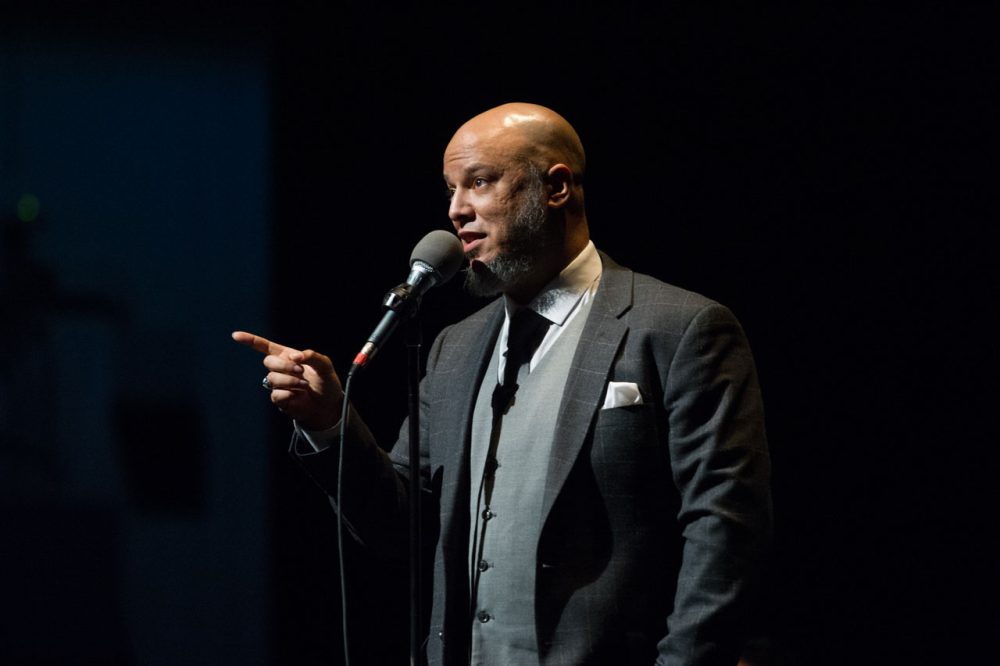
Samuel James is a musician and storyteller whose work has been featured on The Moth as well as This American Life.