Dispelling myths and seeing real solutions to addiction
It’s summertime in Portland, and Maine’s tourism marketing aside, this season reveals the way life really is around here, not “the way life should be.” Mainers are struggling with a housing crisis, a healthcare crisis and a cost-of-living crisis, and all the beauty of Vacationland can’t erase that.
People experiencing homelessness, addiction and mental illness are most visible this time of year, just as millions of visitors arrive, and sometimes all people know about those problems is that they don’t like what they see. So summer in Portland has also become a season of heated debates and hot takes about what can and should be done to get people in crisis off the streets and into recovery.
I grew up here and got to know my hometown by walking it. It started the morning I missed my school bus to Portland High. I became a walker — across the Deering Ave. I-295 overpass, through Deering Oaks and then through Bayside, where the city’s social service agencies, and those in need of them, have long been clustered. It was the mid-1990s and I don’t recall anyone telling me this was an unsafe route for a solo 15-year-old. I walked to my first jobs in the Old Port and on the West End. If a friend wanted to meet on Munjoy Hill, I’d hike up there, too.
I remember the controversy back then about human eyesores loitering in Tommy’s Park and other open spaces downtown and in the Old Port. These were local teenagers like me and my friends, infamously labeled undesirables. One business owner piped classical music into Monument Square in an attempt to drive us away.
Were we all angelic youths, acting as we were supposed to? No, but neither were we a civil disturbance. The real problem was we weren’t spending enough money to occupy such premium space. Our presence tarnished the image of a quaint seaside resort town that city officials and business interests — ever more since then — seem to value over Portland’s people.
Three decades later, I’m now a licensed clinical counselor in the same city I walked as a kid. I love meeting and working with all kinds of clients, but my specialty for the past 13 years has been substance use.
I listen to people much the same way I navigate the streets on foot: don’t assume something’s wrong, but don’t assume all is well; be open-minded without being naïve. This work is deeply humbling and there’s always more to learn.
Since last summer, I’ve been self-publishing my thoughts and observations at A Cure for Addiction (acureforaddiction.com). In this piece for The Bollard, the first of a series that will appear in these pages intermittently, I want to share with my community what I’ve learned so far— from my clients, my colleagues, and a lot of research — because public discourse about addiction has been going around in circles for a long time.
I’ll start this summer by summarizing four common attitudes about addiction and how to treat it, identifying what’s missing in each (mis)understanding of the problem and providing a deeper perspective in hopes of steering our public conversations toward practical solutions.
“Addiction is a chronic disease, like any other, and requires similar approaches to treatment.”
The disease model of addiction is so prevalent today that you’ve probably seen it presented as objective fact. If you have an addiction and find it helpful to understand it as a disease, I would never argue with that. But the more closely we look at the disease model as a way to describe how drug addictions begin, why they continue and how they can be ended, the more contradictions appear.
Treatment researchers have called addiction a “disease of the will” or a “disorder of choice,” and while we have no perfect language or analogy, I think those descriptors are more accurate.
My first full-time job in this field was at a recovery residence, sometimes called a sober house, specifically for college students. This was in the 2010s, when a movement was rising to “smash the stigma” around addiction, and indeed, stigma is never helpful. That’s not my opinion, by the way — it’s been established in cross-cultural research on substance use that communities in which it is judged harshly show higher rates of use and related problems than more tolerant communities.
The destigmatization drive focused on young white opioid users during a panic about suburban youth with promising futures developing addictions and overdosing on drugs like OxyContin. One of its tenets was that these were good kids who just happened to get a disease called addiction, or “substance use disorder.” Improving access to treatment and providing judgement-free support were considered critical to prevent more deaths.
Advocates from Black, Indigenous and Latine communities pointed out that this sympathetic approach — viewing addicts as patients needing medical attention — had only emerged for white people’s drug use. People of color who struggled with addiction were seen from the perspective of the War on Drugs: as criminals deserving punishment. Of course, addiction was just as deadly for them, but apparently their lives didn’t matter.
My residents at the collegiate sober house had to honor a curfew, submit random urine tests, allow tracking of their locations and fully participate in a 12-step or other peer-support recovery program. Part of my job was to regularly call their parents to discuss how they were doing.
Most of them were young white people from affluent families who embodied the anti-stigma activists’ conviction that addiction is a disease that can strike anyone. Favorite comparisons included cancer and diabetes. I remember my boss telling us to call a return to substance use a “recurrence,” because this was a medical condition, rather than a “slip” or “relapse.”
But if this is strictly a medical problem, I thought, why all the surveillance of the patients?
Requiring participation in intensive, structured peer support also fit oddly with the concept of addiction as a disease. Peer support is offered for sufferers of many chronic illnesses, but cancer patients don’t attend daily meetings or study recovery texts to prevent recurrence, and the idea of requiring them to do so is absurd.
We were pretending free will had nothing to do with addiction, but all the tools we used against this “disease” showed we didn’t really believe that. For example, most of the medications prescribed for substance use disorder are controlled substances; both the government and prescribers track them closely to see if patients are misusing or diverting them (which happens). If this were simply medical treatment for a physical condition, there would be no justification for such monitoring.
Neuroscientists have been trying for years to identify consistent biomarkers of addiction, or a definitive way to test for this purported brain disease, but they can’t find any. Furthermore, no client of mine ever said they thought such a test would be helpful to them.
Many of my clients strongly object to the idea that they have a brain disease over which they have no agency. I once shared with a treatment group the 12-step slogan, “We are not responsible for our disease, but we are responsible for our recovery.” The group disagreed, insisting they were responsible for their addictions given all the conscious choices they made leading to its development and maintaining it over time. To them, the disease model feels condescending and invites pity. Research on other mental health challenges demonstrates that using medicalized language to explain them actually increases stigma and social exclusion.
Regarding the other tenets of this belief — that addiction is a chronic condition requiring treatment — research doesn’t support those claims, either.
Here’s a fact you likely know intuitively, but which may surprise you nevertheless: Most cases of substance use disorder resolve spontaneously and permanently. In other words, when someone develops a problem with alcohol or other drugs, they usually overcome it on their own. Addiction’s rates of spontaneous remission (remission without treatment) are much higher than those of any other psychiatric condition, discrediting the chronic disease analogy even in a mental health context.
So why are we all so convinced addiction is a chronic disease that needs treatment? It’s all about who attracts attention and study.
Only the people whose substance-use problems are most noticeable to others, and never seem to go away, become known as alcoholics or addicts (or identify as such themselves). The experiences and observations of such people thus represent all those who have addictions, even though they’re actually a small minority of those affected.
Likewise, the people who end up in treatment are more likely to have longstanding substance-use problems they couldn’t solve on their own. Most research on addiction is done on a clinical population, focusing on this sub-group to the exclusion of everyone else.
Treatment providers like me, considered the front-line experts, also interact almost exclusively with this group. We want to believe treatment can heal this so-called disease despite so much we see every day that suggests otherwise. The person you see on the street who supposedly needs addiction treatment may already have gone through a program, perhaps many times over.
“They don’t want help.”
From this point on, we’re talking about the minority of people with substance-related problems who do not resolve them on their own. These are the subjects of the debates and hot takes. Regarding this common attitude toward them, whether they want help or not all depends on how you define help.
Do they want help in the form of addiction treatment, with the goal of permanent abstinence? No, often they do not. If treatment actually appealed to patients, more of them would enroll voluntarily rather than being forced to attend.
Do they want rules, restrictions and monitoring to detect relapse? Also, typically, no. You might think someone whose goal is to stop using would welcome any means to control their “disease of the will.” But people frequently enter treatment without wanting to stop, or at least with mixed feelings about it. What they want is to retain their autonomy, including the freedom to use if and when they wish.
In a cruel irony, many people with addictions who do aspire to quit now and forever are no better served by the “help” available in treatment. Some can’t attend due to lack of childcare or transportation; few treatment facilities offer either. They may not be able to take time off work. And among those who do come, some of my most motivated clients have wanted services they couldn’t receive, like individual counseling (as opposed to group) or a treatment setting free of triggers.
This is where the axiom “meet them where they are” rings hollow. In my experience, treatment will never meet a person where they are if doing so requires increased funding or staffing. This kind of help must always optimize for efficiency.
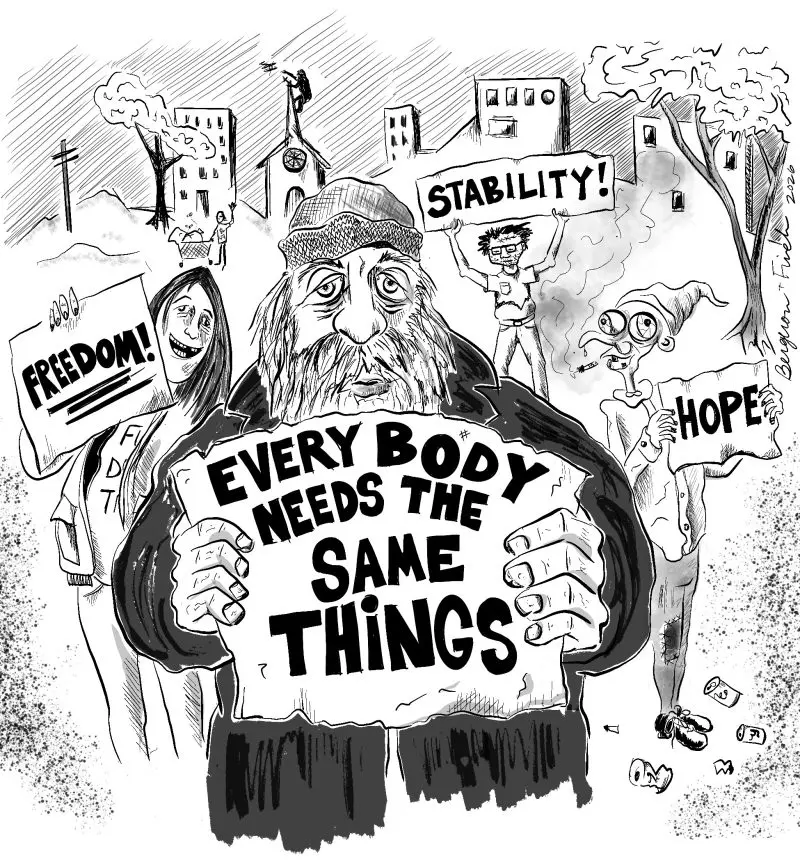
What kind of help do people consistently want when struggling with addiction? The same things that are helpful to everyone else: nutritious food, stable and safe housing, quality medical and mental health care, childcare, transportation, enough money to meet expenses. And they want this assistance to remain accessible whether they’re using or not.
Nor surprisingly, the clients I’ve worked with who’ve fared best overall are those who never had to wonder if their basic needs would be met. For the rest, these are massive additional hurdles when dealing with a substance-use problem. Even if they commit to sobriety and complete all the recommended treatment, they return to the same deprived circumstances.
“When people face bad consequences from their substance use, they find the motivation to change.”
Addiction treatment puts a great deal of emphasis on building motivation to change. The idea is that, at some point, negative consequences from substance use tip the scales of personal judgment in favor of abstinence as risk outweighs reward.
This does happen. But as to when it happens, I have not seen that it depends on the frequency or severity of bad consequences. For some clients motivation arrives before any serious repercussions from their use. For others, sadly, the consequences are already dire, but motivation to change still fails to arise. People can lose everything to their addictions, they can understand they’re at risk of death, and still not be ready to quit.
That may sound irrational, but as just noted, unmet needs are barriers to recovery — and this holds true regardless of why someone’s needs are unmet. Whether a person is living outdoors despite “doing everything right,” or they’re living outdoors as a consequence of addiction, they face the same obstacle. If your reaction is the addict should have found motivation before ending up on the streets, they might well agree with you. But now stability is even further out of reach, and despair is hardly motivating.
Furthermore, at this point the unsheltered person knows sobriety is going to make an already hard day-to-day life even harder. The metaphorical scale mentioned above has the harmful consequences of substance use on one end and the benefits of quitting on the other. So motivation must be driven by an upside as well as the downsides. The more difficult a person’s long-term prospects appear to be, the less likely they are to see the good to be gained by giving up what may be their only comfort or dearest pleasure.
By contrast, people with addictions who have material security (housing, savings, a good job, a retirement plan) may face only minor consequences for their use while still having many rewards waiting for them when they change. Again, this is the group I have seen be most successful beating their addictions. And long-term studies on individual treatment outcomes corroborate my observation: people’s basic life circumstances strongly predict their chances for recovery.
“If they won’t accept treatment, they should go to jail instead.”
Some people seem to think this is a new idea, but it basically describes drug policy in the U.S. since the War on Drugs began over a century ago, and it’s a popular idea among Republicans and Democrats. Across the country, the most common reason people enter substance-use treatment is by mandate (i.e., under threat of incarceration) from the criminal legal system.
Working in addiction treatment in Maine, I’ve had legally mandated clients from a variety of referral sources. Most often, treatment attendance is a condition of probation. It can also be required by drug courts or Maine Pretrial Services. For these people, it’s already “treatment or jail.”
Then there are legal mandates by DEEP (Maine’s Driver Education and Evaluation Program) by which treatment is required to end license restrictions imposed after an OUI charge, and by Maine’s Department of Health and Human Services, which requires parents with suspected substance-use problems to attend treatment to keep or regain custody of their children.
The result is a treatment environment in which few clients want to be there. It’s hard to help anyone build motivation when they’re only present by coercion and can’t be honest with providers for fear of legal consequences. Treatment becomes its own form of incarceration, rather than an alternative to it. Those who do attend sessions voluntarily are also unhappy, and sometimes leave, because group-based programming is frustrating and ineffective when your peers don’t want to engage.
Here’s a popular belief about human behavior that’s actually true: people don’t change unless they want to. I have seen clients benefit from mandated treatment, but it’s more common for people forced into programs to cycle through again and again as they deteriorate further.
Jail doesn’t help. Incarceration for more than a day or two can have disastrous consequences for one’s personal and professional life, and a criminal record creates yet more barriers to recovery, limiting access to housing and employment.
We can hold up individual success stories and judge everyone who “fails” treatment for not living up to this ideal. But until we start offering services people actually want, in most cases we’re just going through the motions.
Real Talk
Anyone can develop an addiction. But as I hope you now see, a person’s chances of moving past it are much better when their basic needs are met. They need the autonomy to choose for themselves when and how to address their substance use, and they need a realistic vision of something better on the other side.
If this sounds like more than they deserve, consider what our community really wants for people with addictions. If the goal is for them to simply go away, we’re drifting into eugenics territory, condemning people to die of exposure, overdose, or blood-borne diseases. If the goal is for them to recover and thrive, we need to get out of this mindset of deservingness.
Here are three suggestions for a better-informed conversation about addiction and how to end it.
Harm Reduction
Though a treatment provider myself, I don’t recommend pressuring — much less coercing under threat of jail — anyone to attend treatment. Change cannot be forced, and we’re wasting a great deal of time, effort and money in the attempt.
Anyone not (yet) seeking to reduce or end their substance use should be offered harm reduction. The term has been assigned many different meanings, but for my purposes here I define harm reduction as any practice that reduces the harm of substance use without expecting people to stop (or even cut down).
Harm reduction frequently serves as a starting point in the process of change. “Dead people can’t recover,” as advocates say, and people who engage with harm reduction are more likely to eventually begin treatment. I’ve heard people in recovery say harm reductionists were the first people to approach them as if they mattered, as if their lives had any value at all.
Portland has many forms of harm reduction available, including “housing first” facilities, syringe exchange, low-barrier emergency shelter and mobile outreach. Overdose prevention phone lines are accessible here and nationwide, and Maine has a Good Samaritan law designed to shield people from prosecution for drug crimes and other charges if they call for emergency help for an overdose. We also have free distribution of Narcan, a medication anyone can administer to help reverse opioid overdose, and test kits to check for dangerous drug adulterants like fentanyl — although the Trump administration recently ended federal funding for life-saving test strips.
Harm-reduction programs should not have to fight so hard for funding, or even permission to operate. I understand why harm reduction draws scrutiny from the public and lawmakers, but I wish more of this attention was directed at abuses inside the treatment industry.
Meaningful Choices for Voluntary Treatment
For those interested in change, Portland has a lively recovery community and many treatment providers. What we don’t have is much variety among the accessible treatment options — nor does anyone in the U.S., to my knowledge.
If you’re looking for intensive addiction treatment, the programming covered by insurance will be very similar wherever you go. Much of this is due to staffing and billing policies, both of which need to change if we want more people to enter treatment voluntarily. They need meaningful choices for services they actually want.
One treatment approach with exceptionally good results is in too short supply, here and elsewhere: contingency management. Contingency management involves paying patients to test negative for drugs. (I hear all the alarms about consequences and deservingness going off now!) More broadly, contingency management describes programs in which patients who perform any of a wide variety of positive activities are rewarded with something of material value.
Decades of research, including studies conducted by the federal government, shows that participants appreciate and benefit from contingency management. It encourages an “upward spiral” of constructive choices, enabling people to get their material needs met and find direction for the future while retaining their autonomy. Rates of substance use decline during this treatment and after the program has ended.
If the opportunities were available, I think a lot of people with addictions would choose programs of self-development that don’t focus on substance use at all, but instead support the growth of a more positive self-identity and build on personal strengths and talents. Think art and music therapy, working with nature and animals, growing and cooking food, body work, culture-based healing, service to the community, or job training and apprenticeships.
I’m sure this all sounds expensive, but the costs of the status quo are staggering. Plus, we’d actually be supporting and healing people like my clients, rather than just trying to contain them.
Better Lives for All
Material deprivation, in and of itself, does not lead people into addiction. But it closes off the kinds of opportunities and pursuits that people tend to choose over substance use, like college, or travel, or starting a small business, or any passion that requires significant time and financial investment. Economic precarity diminishes people’s hope for their future, even their hopes for each other. It encourages short-term decision-making.
Thus some of the most important actions we can take to prevent or resolve substance-use problems are the same actions we urgently need to take anyway. No specialized clinical input is needed. Anything we can do to make this community more livable for everyone is a strike against addiction and a boost for recovery.
•••
The problem in Portland this summer is not unhoused or addicted people on the streets, it’s blaming them for what they represent: the bottomless unmet need in a society that requires us to earn our survival, yet promises absolutely nothing even if we “do everything right.” Let’s stop repeating tired clichés and, more crucially, building public health policy around discredited ideas. Let’s get interested in how people actually change, and in interventions that actually work.
Rosalie Genova, LCPC, CCS, writes the newsletter A Cure For Addiction at acureforaddiction.com.