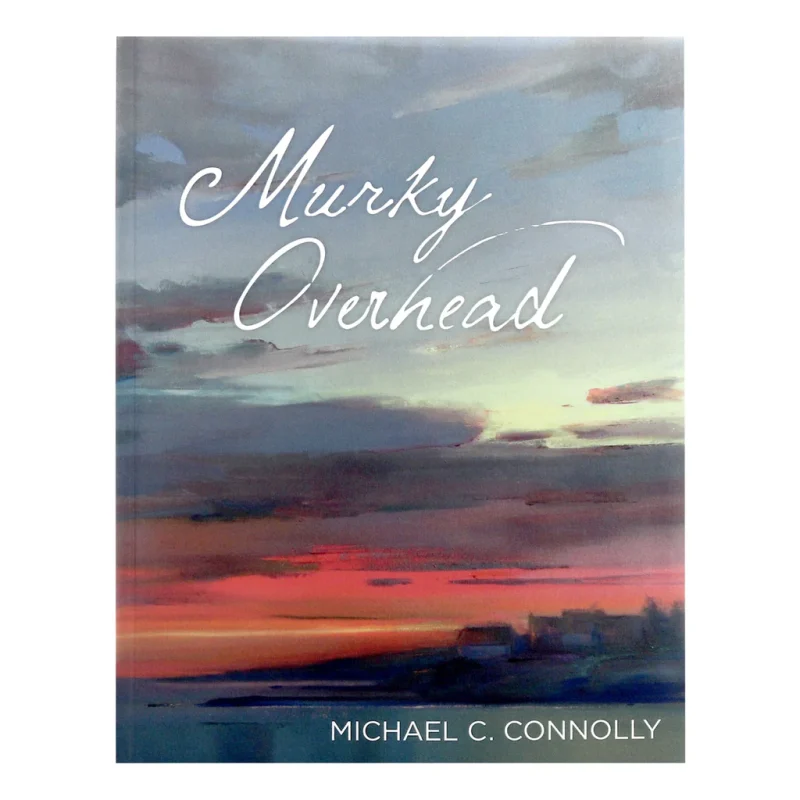
Murky Overhead
Michael Connelly
Tower Publishing
Portland was in a deep freeze when a thousand working-class Democrats gathered at City Hall on the night of Jan. 31, 1901, to see “The Great Commoner,” William Jennings Bryan, deliver a stem-winder of an address. The crowd went wild as the “silver-tongued” progressive and former presidential candidate railed against corporate trusts and American imperialist adventures overseas. Even silver-mustached Civil War hero Joshua Chamberlain, a former Republican Maine governor, made an appearance to pay his respects. Among the throng was Irish American high school student Johnny Folan, who stood enraptured by Bryan’s fiery rhetoric.
In Murky Overhead, the first in a trilogy of historical novels, historian Michael Connolly takes us back to the streets of Portland where immigrant laborers eke out a living in Maine’s precarious economy. The Portland of 1900 is populated by Italian freight-handlers, Chinese laundrymen, Jewish peddlers, Irish dockworkers, and the old-money Yankee Republican Protestants who own the big businesses and dominate city politics.
Connolly, a Portland native, has extensively covered the history of Irish immigrants in Maine in such deep and fascinating works as They Change Their Sky and Seated by the Sea: The Maritime History of Portland, Maine, and Its Irish Longshoremen. In his new fiction, he draws on his research and upon stories passed down through generations of Irish Portlanders.
This story centers on Coleman, nicknamed Coley, and his wife Mary Folan, first-generation immigrants from County Galway in Western Ireland, and their large Catholic family of eight children. Both Coley, who’s 41, and Mary, 35, are illiterate, native Irish (Gaelic) speakers who emigrated in the early 1880s after widespread crop failures in Ireland. They arrive in a land of extreme cold and heat, with a shoreline reminiscent of their beloved Connemara.
While Coley performs backbreaking labor on the waterfront with a gang of Irish union longshoremen, Mary supplements the family’s income by operating an informal dinner house for single Irish workers. They pray their children will be able to escape a lifetime of hard labor through education, but their two eldest are forced to miss school to work part-time to support the family. Now with a ninth child on the way, Mary wonders how they’ll all survive.
The novel is set in Portland’s East End and the Gorham’s Corner neighborhood (site of the John Ford statue today), where Irish families packed into tenements near the waterfront in the early 1900s. Coley stays busy during winter loading Canadian grain from Montreal, delivered via the Grand Trunk Railroad, to ship off to Europe, and by shoveling coal, then the most common source of heat in Northern New England. Sometimes his son Johnny snatches opened cans of lobster, clams and sweet corn from the Burnham & Morrill (B&M) cannery down the street to help feed the family. Like most of their class, the Folans depend on a network of family, neighbors and fellow church members to get by.
To Coley, few things are more sacred than his membership in the Catholic Church, the Ancient Order Hibernians, the Democratic Party and his union, the Portland Longshoremen’s Benevolent Society. Democratic ward captains ensured Coley and Irish immigrants like him could pass the citizenship test and become naturalized despite their illiteracy. Beginning with the first waves of Irish famine refugees in the mid-19th century, Democrats embraced the hardscrabble peasants and defended them against nativism and anti-Catholic bigotry. Party leaders also promised more relief for the masses than the pro-business Republicans were back in that day. By 1900, they had begun electing Irish Catholics to seats in city government.
Coleman is focused on the union politics that shape his work life on the docks, but idealistic Johnny is captivated by Bryan. He and his friends manage to sneak into a dinner party at the home of then-recently retired U.S. House Speaker Thomas Brackett Reed, where Byran is a guest, and eavesdrop as the Republican and Democrat forge an unlikely bond through their mutual distaste for the U.S. annexation of the Philippines. Six-year-old Johnny has another brush with fame through his friendship with Francis Feeney, older brother of John Feeney, who grew up to become the iconic film director John Ford.
As one of the founders of his union, Coley worries younger members will give up their right to double-time wages when forced to work through lunch, a hard-won victory. Just over 40, Coley’s body is wearing out after years of repetitive toil and he needs the break in his 10-hour days. While most of the newbies are at a Democratic Party rally, the old guard takes advantage during a union meeting to protect their double-time. A smart young member quoting Pope Leo XII’s 1891 encyclical Rerum novarum (Rights and Duties of Capital and Labor) and a brief speech by Coley help secure the vote and save the day.
“How often do you think the shipping agents or the local stevedores go without their lunch breaks?” Coley asks those assembled. “If they promise to give up their right to lunch, I’ll give up mine — as long as they pay us the same amount that they’re earning sitting on their duffs there in their warm and comfortable offices.”
Despite her inability to read or write, Mary is full of passion for poetry, as well as art. Unlike her husband, she has very progressive views on race and gender equality. While Coley defends his union’s refusal to allow African Americans to join (they even give a dark-skinned Italian a hard time), Mary wonders why the city’s Black workers, who once dominated the docks, are banned from earning a union wage.
One day, Mary meets William Wilberforce Ruby, son of famed Black abolitionist Reuben Ruby, at the Abyssinian Church, where she expresses sorrow for the loss of so many of its parishioners in the sinking of the steamship Portland two years prior. In another scene, hours before she gives birth, Mary stops a drunken gang of Irish thugs from beating up a rabbi.
Readers of Connolly’s non-fiction and those who don’t want to take on a dense history of Portland will enjoy this novel. Murky Overhead is a great introduction to the Portland of a century and a quarter ago, with all its grit: the tenements of Munjoy Hill and the teaming waterfront; the “Blight” at the corner of Mountfort and Fore streets, where Irish madams, roistering loggers down from the Maine woods, Boston teamsters and merchant seamen all mixed it up on a Saturday night. Welcome to the really Old Port.