Two old friends deep in the Maine woods endeavor to keep wood & canvas canoes in the world
My wavering cell signal vanished altogether not far down the cracked, winding road connecting Charleston to Atkinson. Google Maps showed a blank space up ahead, the digital equivalent of a shrug and a good-luck smooch. I wasn’t worried. With no turnoffs, power lines or houses to confound me, I just followed the road.
A little further, beyond a swamp ablaze in fall orange, a green sign proclaimed the Atkinson town line. Behind the post, a well-defined gravel turnout gave any accidental travelers a final opportunity to turn around. I kept going.
The sign is outdated. Atkinson’s 300 or so residents disbanded their local government in 2019, turning the Piscataquis County hamlet about 30 miles northwest of Bangor — which has no store, gas station or school — into a state-administered township, rather than a distinct municipality. But what Atkinson lacks in home-rule government, basic commercial amenities and cell phone coverage, it more than makes up for in traditional Maine craftsmanship and backwoods heritage.
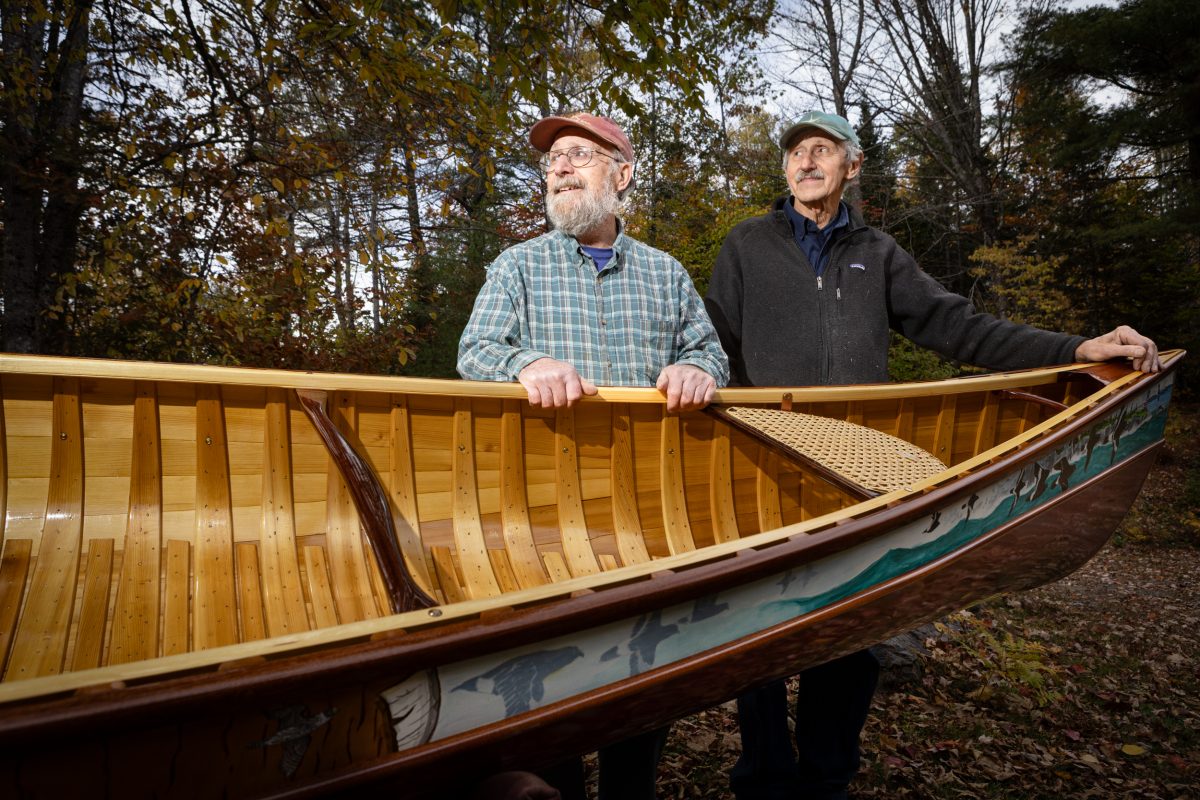
That’s because Atkinson is the home of this country’s last two professional wood-and-canvas canoe makers: Rollin Thurlow and Jerry Stelmok. The two men revived the lost 19th-century method in the early 1970s, then split up, becoming good-natured rivals vying to outdo one another in their respective workshops, four miles apart, in the same tiny town, for the next five decades.
Thurlow and Stelmok have been perfecting their art all along, fashioning some of the most beautiful, light and agile canoes to ever grace Maine’s dark waters. This year, to mark their 50th anniversary in the trade, the old friends finally made another canoe together. The sleek, 17-and-a-half-foot Peregrine has golden cedar ribs and gorgeous paneled paintings by Selmok outside its hull depicting migrating caribou, fish and birds.
I was headed down that lonely Atkinson road last month to watch them hand Peregrine off to the man who won the canoe through a sealed-bid auction. The winner was driving all the way from Washington, D.C. to collect his prize.

I also wanted to talk to the two masters about the history of their craft and its uncertain future. Thurlow and Stelmok are both 77 and neither has an apprentice waiting to take over. That means the traditional art of canvas-over-wood canoe-building could end when they finally call it quits — at least as a commercial enterprise capable of providing these canoes to the public.
Stelmok, the grandson of a Lithuanian immigrant, grew up on a dairy farm in Auburn and was always fascinated by canoes. “I couldn’t think of anything else when I was 14 years old,” he said. “They’re beautiful to look at and they’re just perfect. You can take them anywhere. You can carry them. You can paddle or pole them. You can row them. Some are even rigged for sailing.”
He wasn’t much older than 14 when he bought his first one, an 18-foot, wood-and-canvas Old Town that had belonged to a summer camp on the Kennebec River. “It cost $75,” Stelmok said, standing in front of the craft. He keeps it in a room just off his main workshop, which is inside a former wooden-toy factory. His parents weren’t keen on canoes. Selmok remembers many happy hours paddling that first one alone on Lake Auburn.
Thurlow, an Air Force brat, mostly grew up in Orono, where his father, a Lincoln native, eventually settled down as a teacher. He first learned to paddle in the Boys Scouts, at their adventure camp in Matagamon, in the northeast corner of Baxter State Park. “I went there for several summers and later became an instructor,” he said, “and that was all with wood-and-canvas canoes.”
After high school, at the height of the Vietnam War, Thurlow attended Maine Maritime Academy while Stelmok went to the University of Maine. That’s when they met, through their girlfriends, who later become their wives and are also still friends today. After college, each man did a stint in the Navy before meeting again at a wooden-boatbuilding school in Lubec in the early 1970s.
While other students focused on sailboats, Thurlow and Stelmok rekindled their love of traditional canoes. One of their instructors was Clint Tuttle, who’d established the Island Falls Canoe Company a few years earlier using designs from the storied E.M. White canoe company. That firm, founded by Edwin White in 1889, was a pioneer in the production of wood-and-canvas canoes, a growing business on the Penobscot River around Bangor early last century.
Inspired by Wabanaki designs, Maine-manufactured canoes were at first constructed from cedar ribs staked on the ground, then covered with a birchbark hull sealed with animal fat, evergreen resin and charcoal. But by the end of the 19th century, large, unstripped birch trees were already hard to find.
It’s unclear which canoe-builder first came up with the idea of using paint-and-resin-impregnated canvas instead of birchbark, but E.M. White and several other local canoe companies ran with it, making Maine the center of the trade for 50 years. Other innovations followed.
Birchbark canoes were made right side up, but Maine makers constructed theirs upside down, nailing steam-bent cedar ribs over wooden forms, as a cobbler would do with a shoe. Their forms also had an iron band for each rib, so when planks were nailed to the ribs, the bands turned the soft, brass nails around like fishhooks, clenching the two pieces together with a tight fit. Canvas — treated with proprietary mixtures of turpentine, lead and silica — was stretched over the hull, then sanded smooth and painted, often with patterns or wilderness scenes.
By the time Thurlow and Stelmok arrived at the boat school in the early ’70s, these techniques had all died out, replaced by fiberglass and aluminum. But in addition to White’s designs, Tuttle had come into possession of the company’s century-old canoe forms, complete with the crucial iron bands. He sold the two students the forms and his Island Falls Canoe Company name.
Starry-eyed, Thurlow and Stelmok moved to Atkinson in 1975, set up shop (nowhere near Island Falls, by the way) and began figuring out how to reproduce White’s elegant designs, looking for clues in old photographs, interviews and catalogs.
“There were still some old-timers around who knew how it was done,” Stelmok recalled, “but they were tight-lipped and not about to give away their secrets. They’d rather take them to the grave than tell us.”
There was another problem. Thurlow and Stelmok were ahead of the wooden-boat revival curve by about a decade. Undercut by space-age plastic models and isolated deep in the Maine woods, there simply wasn’t enough demand for their handcrafted canoes. Within two years, the pair split up and took on other kinds of work to stay afloat financially, though neither could quit making wooden canoes altogether.
And because they never gave up, by the mid-1980s both found successful niches in the market. Stelmok held onto White’s forms and the Island Falls Canoe Company name. Thurlow set up Northwoods Canoe Company, with his own designs, just down the road.

Remembering how hard it had been to get information when they started out, the pair co-authored a book in 1988, The Wood & Canvas Canoe: A Complete Guide, that’s become a Bible for hobbyists and has never been out of print. They both also accept a few students every year for one-on-one instruction, people who’ve traveled to Atkinson from across the country and as far as Australia and Japan. Their student waiting lists are at least two years long these days.
“This town is the epicenter of the world for wood-and-canvas canoes,” said Jim Voss of Palo Alto, California, who was halfway through a 10-day workshop with Stelmok when I arrived. “And Jerry and Rollin literally wrote the book on it.”
Four miles away, with autumn leaves crunching underfoot outside Thurlow’s workshop, Peregrine’s new owner (who asked to remain anonymous) got ready to load his prize atop an electric SUV. Running his hand along the glowing cedar gunwales, gazing with wonder at Stelmok’s painting, he admitted he was having second thoughts about putting it in the water.
“I’m a fan of craftsmanship. This work is so beautiful, it should be in the Smithsonian,” he said. “We live in a culture where speed is the ultimate goal, and this canoe reminds us that it doesn’t have to be that way.”
Neither Thurlow nor Stelmok has gotten rich in the canoe business, and there have been some very lean years. “The market is actually on a decline,” Stelmok said. “These days, all the young people want is stand-up paddle boards and kayaks they can use for two hours and then throw outside behind the garage. They don’t go on two-week canoe trips. They don’t want to take care of something. Our canoes are heirlooms. I mean, who would want to pass down a plastic canoe to their grandchildren?”
Being made from natural materials, wood-and-canvas canoes need attention and repair on a regular basis, but they can last several lifetimes. If the canvas fails, it can be repaired or replaced with a little effort. Each of Stelmok’s and Thurlow’s canoes sells, at minimum, for $4,000. The boats require at least 100 skilled hours to construct, not counting weeks of paint and resin drying time, and contain about 6,000 hand-pounded brass nails.
“We don’t take shortcuts,” Thurlow said, “because doing things right is the right way to do things.”

For now, both men have all the work they can handle. Thurlow’s waiting list stretches into 2028. Stelmok just got a 10-canoe order from a summer camp on the Guadeloupe River in Texas that needs to replace historic boats lost in last July’s tragic flood. Neither plans to retire anytime soon.
“Having worked for myself my whole life, I don’t have a big 401k, so I have to keep some income coming” Stelmok said.
Talk of retirement just makes Thurlow sigh. “If I retired and really closed down the shop and turned off the lights and never came back in, that would really be sad,” he said. “I don’t see myself doing that. I will keep doing it until I physically can’t do it, I think.”
Perhaps someone will step forward and show an interest in learning the trade and taking over one of their operations. But neither man expects that to happen, and they’re OK with it.
“I wouldn’t encourage anyone to take up this kind of a life. It’s too difficult,” Stelmok said. “Just like my parents didn’t encourage me to stay in the small dairy farm business.”
With their books — each has several other instructional titles to his name — their videos and their educational work, wood-and-canvas canoes will continue to be made and cared for in the future, even if nobody is making them as a career, Thurlow believes.
“I don’t think it’ll ever die out like it was before,” he said. “And even if it does, somebody will come along, like Jerry and myself, and find an old canoe in their great grandfather’s barn, and say, ‘What is that? And how do you build it?’ And get interested in it, and they’ll rediscover it.”