Buckle up, kids, because this is the wildest That’s My Dump! story we’ve found yet…
It begins in the 1760s, before Portland was Portland, Maine was Maine, or America had any states, united or otherwise. According to Deering: A Social and Architectural History, by Bill Barry and Patricia McGraw Anderson, a young blacksmith named Isaac Sawyer Stevens was helping members of the Brackett family clear land from the woods west of town when love struck. In 1767, Isaac married Sarah Brackett and they built a home on Stevens Plains, where the sprawling Evergreen Cemetery was later established along Stevens Avenue in Portland.
A decade later, when Isaac left to join the rebel army fighting the British crown, Sarah was left without means to maintain the place, so she “opened her home as a tavern,” Barry and Anderson wrote, serving travelers along the stagecoach route from Falmouth (later Portland) to the Sebago Lakes region and beyond into the White Mountains. This became known as Stevens Tavern, a hub for fun on the famously flat Plains, where horse racing and militia musters regularly drew crowds. Later renamed Uncle Billy’s Tavern, it continued to host good times through the Civil War.
By the 1920s, the structure was already dumpy. A second dwelling unit and a shed had been built behind the original home-tavern. A card for the property prepared for the city’s tax assessor’s office in 1924 reported that the family of then-trustee George H. Sampson was living in one “tenement” and the other was being rented for $12.50 per month. Two lines are provided on the form to describe the “Condition of Repair,” in which the inspector simply wrote, in pencil, “Poor.”
Fast forward half a century and the subsequently abandoned two-story wooden Colonial is scaring neighborhood kids and students at what became Catherine McCauley High School across the street. Workers at Pat’s Meat Market and Roy’s Shoe Shop in Deering Center told me children didn’t walk by that old decrepit house, they ran, and only the bravest dared to run up and knock on its haunted door before sprinting back to safety on the sidewalk.
In 1995, the property was bought by Philip Beaumier for $36,000. Then in his late 60s, Beaumier had served as a Marine during the Korean War, sold used cars, and had numerous real estate investment properties around town. A city inspection card from this period notes the building has four rooms (two of them bedrooms), one and a half baths, but “no heat or provision for heat,” no electricity, pipes that freeze and smoke damage.
There’s also a scribbled note, dated May 12, 1998, that reads, “for sale,” lists a local phone number, and “$120,000.”
Therein lies the spark of this historic tavern’s fiery demise. Because Beaumier no longer owned the place in May of ’98, having sold it two months prior to a fellow property shark named Oren “Buddy” Ahlquist for $48,000.
“It was garrison-like,” Ahlquist said of the old tavern during an interview with The Bollard this fall. “It had windows like you’d put a gun out of.” The addition in back was “modern,” he said, with tile floors and sheetrock, but the original Stevens Tavern had been gutted save for a gorgeous painted spiral staircase.
Ahlquist knew a thing or two about dumpy properties, having purchased a 17-unit apartment building in 1997 on Oxford Street, near the city’s homeless shelter and a soup kitchen, that became the poster child for Portland slum life five years later. The city had recorded scores of housing and health code violations there, including rat and cockroach infestations and sewage clogging toilets and pipes for weeks, forcing tenants to discard used toilet paper in wastebaskets. Police made nearly 60 visits to the property in one year “for problems ranging from theft to suspicious activity to intoxicated people causing problems,” the Press Herald reported. A tenant compared the hallways to a “war zone.”
Alhquist blamed his tenants. “The soup kitchen is right across the street and it’s really hard to get people to take care of the place,” he told the paper in the summer of 2002. “I try to screen the best I can, and there are people who come in that building and vandalize the place.”
Mayor Karen Geraghty held an afternoon press conference in front of Ahlquist’s Oxford Street building that July, calling its units “some of the most depressed apartments I’ve seen in Portland.” Ahlquist was there, but had cannily dressed as a workman in grubby clothes and thus escaped the TV and print news reporters’ notice, he revealed to us. It should also be noted that Ahlquist owned a rental property on Grant Street at the time that had no violations on record.
Anyway, back to March of 1998, when Ahlquist was trying to buy the Stevens Tavern from Beaumier. Ahlquist described Beaumier, who died in 2008 at 79, as having short gray hair, being “skinnier than me” (Buddy’s quite lean these days), and “crazy, absolutely fuckin’ bat-shit crazy. Like nobody you would fuckin’ dream about.”
“He had a Manson look to him,” Ahlquist added, a wild intensity in his eyes and a propensity to say outrageous things off the cuff. When Ahlquist met with Beaumier and his attorney at the time — future Portland City Councilor and Mayor Jim Cloutier, who’s currently a Cumberland County Commissioner — to finalize the sale of the Stevens property, Beaumier’s head and face were “all stove up,” Ahlquist said, with black marks and indentations from hammer blows he’d recently received during an attack in Evergreen Cemetery.
Ahlquist said he didn’t know the details of that attack, and Cloutier said he has no recollection of Beaumier or the meetings on Commercial Street held to seal the Stevens Tavern deal. In early May of 1998, a few weeks after the sale was finalized during a second meeting, Beaumier was stabbed in the driveway of his home on Forest Avenue by an assailant with whom he’d argued earlier that day over a business dispute, police told the daily paper.
Ahlquist said he and a partner who invested in the Stevens Ave. property planned to rehab it and rent it to a daughter of Ricky Yue, an owner of the two popular Wok Inn Chinese-American restaurants in Portland and South Portland. Those plans were abandoned when they discovered the house wasn’t connected to the city’s water and sewer lines, and there were other pressures at play.
In 1994, the Friends of Evergreen Cemetery, a nonprofit that helps conserve the 239-acre, city-owned burial ground, tried to convince the city to buy the old Stevens Homestead, which stood out like “a missing tooth,” a past president of the Friends group told the Press Herald. The estate of its then-most-recent owner had put the property on the market for nearly $80,000, and conservationists worried a new owner could “vinyl-side it” or demolish it to pave a “big parking lot.”
City Manager Bob Ganley wasn’t gung-ho to spend public money on the old watering hole in 1994, and talk of raising funds privately came to nothing, but after Ahlquist bought it, the Friends and the city got interested again. In early July of ’98, city officials announced their intention to condemn the property if Ahlquist refused to sell it to them, then seize it by eminent domain.
Faced with the prospect of bleeding thousands of dollars in a legal fight with City Hall, Ahlquist relented and sold it to the city later that month for $80,000 — $40,000 less than the note on the inspection card suggested he’d wanted for the place in May. The money came from a trust fund administered by the cemetery and was to be replenished by the sale of new burial plots.
Ahlquist told The Bollard he feels the city screwed him over by underestimating the property’s value. “All the comps were bogus,” he said, “because … there’s nothing around that area to compare it to. I could have fought it, but then I’m chewing up my profit, if I make any.” As it turned out, he and his partner each walked away with about $7,000, said Ahlquist.
A couple weeks later, on a windy late Sunday afternoon in early August, Ahlquist was in the shower when his girlfriend called up to him: “Stevens Avenue is burning!” He didn’t rush over there, but the paper had the story the next day on the front page of the Local section.
“Flames raced quickly through the vacant, 213-year-old wooden structure, blowing out windowpanes and sending huge coils of white smoke across the busy street,” the Press Herald reported on Aug. 10, 1998. “When firefighters arrived, they were hampered by winds gusting to 20 mph. … On several occasions, firefighters started to attack the fire from a ladder at the side of the house, only to be forced back because of fears the building might fall in.”
The historic 18th century home and tavern was reduced to ash.

Not long after, police were back at Ahlquist’s Oxford Street apartment building, this time to question him about the fire. According to Ahlquist, Beaumier had told the cops he’d seen Ahlquist at the property shortly before the blaze with a gas can in his hand. “He tried to throw me under the bus,” Ahlquist said of Beaumier.
“‘Hey, you know what?’” Ahlquist told the detectives. “I didn’t make as much money as I thought I was gonna do. But I didn’t lose money. … Then they figured it out.”
Sure enough, according to witnesses, it was Beaumier who’d been seen at the property with gas and kerosene shortly before the fire. He’d torched the historic building owned by the city, lied to police about its cause, and was charged with arson in March of 1999 — a Class A crime in Maine that carries a 40-year prison term, with no parole.
In late July of 1999, Superior Court Judge Arthur Brennan handed down Beaumier’s sentence: 60 days in the county jail, six years of probation, and a payment of $4,328 to cover the city’s cost to fight the fire.
“This is somewhat of an unconventional recommendation for a Class A offense,” Judge Brennan remarked from the bench, according to the Press Herald. He’d been moved to leniency by Beaumier’s attorney, Ed Folsom, who said his client had been psychologically damaged during his combat tour in Korea. (Folsom told The Bollard last month, “I don’t have anything I can tell you about Phil.”)
It seems Beaumier’s motive was insane jealously. He apparently believed Ahlquist had known before he bought the property that the city would pay him a large sum for it — like $120,000, for example — and mistakenly thinking the place was still owned by Ahlquist in early August, Beaumier decided to burn it to the ground to prevent him from reselling it at a handsome profit.
Deputy District Attorney Meg Elam had also swayed the judge with her arguments for a light sentence, which included the fact the city planned to raze the place anyway, and her belief that “Beaumier doesn’t pose much of a danger to society because of his age and limited criminal history,” the Herald summarized.
But, of course, he did. In early August of 2003, Beaumier’s name is in the paper again, this time for criminal threatening, for which the then-76-year-old paid a $200 fine.
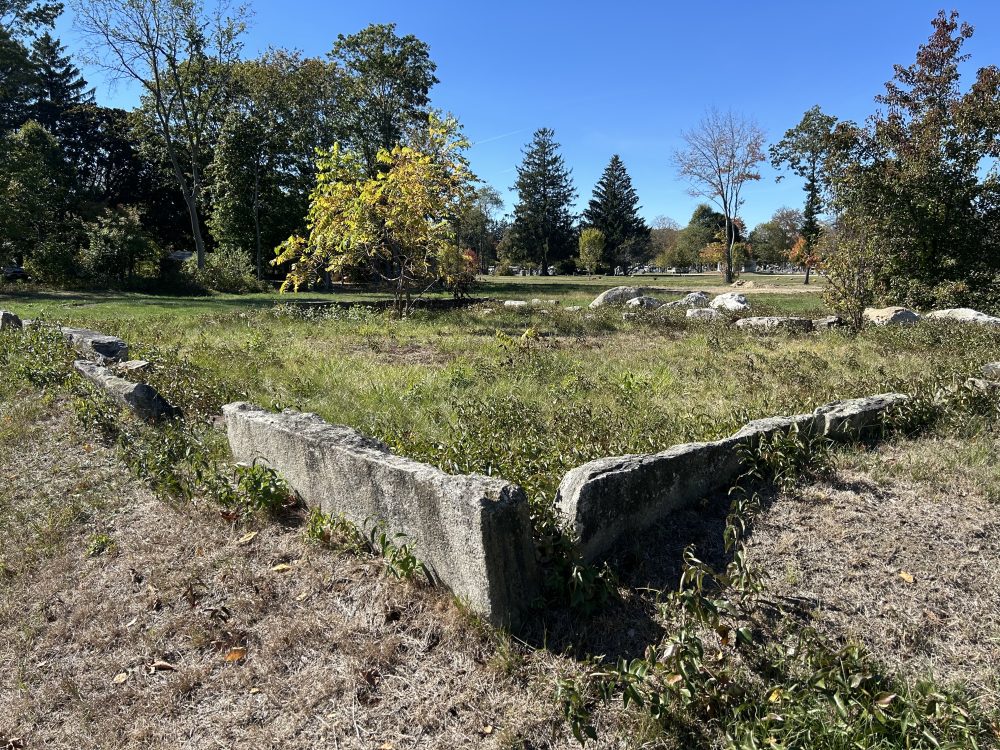
To this day, neither the city nor the cemetery’s Friends have done anything with this site. Its brick and stone foundation remains there, on a slightly raised rectangle of ground from which a black walnut sapling is growing, sans any marker to denote its historical significance.
City spokesperson Jessica Grondin told The Bollard last month, “Cemetery expansion plans, encompassing the creation of an additional 600+ graves and a road way, are in the final stages of being put out to bid. We are hoping to be able to break ground on that project in 2026. The Stevens Tavern Foundation [sic] will be preserved. Discussions with the Friends of Evergreen around placing an educational sign detailing the history of the foundation and the structure that once was, are ongoing.”