The Bangor Daily News
On May 4, 2022, after organizing and training in secret for close to a year, I and two dozen other reporters, photographers, editors and designers founded the first union in the history of the Bangor Daily News, a newspaper established in 1889. That morning, I watched on Zoom from my Portland office, nervous as hell, while my Bangor comrades marched to President and Chief Operating Officer Todd Benoit’s desk to deliver the news.
The delegation demanded recognition of our new organization, officially called the BDN Union, and asked to begin negotiating our first contract for fair wages and better working conditions as soon as possible. Within two weeks, management voluntarily recognized the union, thus sparing us the need for a protracted, federally supervised vote.
Like everyone in the BDN Union, I was elated by this first victory. But that joy didn’t last long.
The company soon hired a notorious anti-union attorney from Boston and began dragging its feet through two-and-a-half years of agonizing contract negotiations, hoping we’d give up and settle for less, or maybe even nothing. During that sometimes demoralizing period, many reporters quit the paper and the BDN Union struggled to hang together. But those of us who remained kept agitating, stayed organized, and eventually won a fair contract last November.
I was overjoyed again, but this feeling didn’t last long, either.
Three months later, this past February, Bangor Daily News bosses exploited a loophole in the contract, pleading economic hardship. They laid me off after 13 years with the paper — while simultaneously advertising two lower-cost reporting positions elsewhere in the company.
I suspect I was a victim of geography. Management had long wanted to shutter the downtown Portland bureau (I was the only one remaining in the office) and refocus on its traditional coverage areas in Eastern Maine.
So I’d begun organizing to improve an imperfect job and, after four years of struggle, I ended up with no job at all. You might think I’d be sour on the whole union thing, but you’d be wrong. I believe in unions more now than ever. I actually think all businesses should be worker-owned collectives with no permanent bosses. But that’s a story for another day.
The BDN Union preserved my position at least two years longer than I could have on my own. Our hard-won contract also afforded me a decent severance package that I would not have received otherwise. Most importantly, the union empowered me to be part of a dignified, collective effort that has improved our futures and will do the same for future BDN workers.

Step One: Stop complaining and organize
There’d be no BDN Union without web editor Christopher Burns. The idea originated with him, in early 2021, during conversations with a co-worker.
“Seeing the high turnover rates back then, seeing a lot of very talented people leaving,” Burns recalled when we spoke last month, “not feeling satisfied with the work, looking for a better opportunity, I figured a union could help improve things, rather than just sitting around and grumbling about what was wrong.”
I was the second person Burns recruited, because he knew that I, like himself, was a club member of the Industrial Workers of the World. I immediately agreed to join. My enthusiasm had been heightened after working for years without a raise and by two disturbing incidents during the COVID-19 pandemic.
In 2020, during widespread quarantines, I’d asked Benoit during an “all hands” meeting if the newspaper could provide masks or other personal protective equipment for those of us still out reporting on the streets. “You know, in the old days,” he snidely replied, denying the request, “the Scripps papers required reporters to provide their own pencils and notebooks.”
I remember thinking that if our newsroom caught wind of a boss at a similarly prestigious Maine company saying something that callous, it would’ve been front-page news. We bought our own PPE.
Later that summer, after filing photos from an hours-long racial justice protest in Portland, I got a call from my editor around 9 p.m. He asked me to go down to the police station, where cops in riot gear were firing pepper balls at protestors. I photographed the mayhem, was threatened with arrest, and filed those photos around midnight. I messaged my editor via e-mail, text and Slack, but didn’t hear back from him until 10:30 a.m. the next morning, when he casually told me he’d gone to sleep after sending me into harm’s way.
He didn’t even publish the photos. I was dumbstruck. It dawned on me that my work, my safety, my freedom and my life meant practically nothing to my bosses.
“For anyone who’s looking to organize a union, the thing they should remember is that management is always your best organizer,” said Burns, now the BDN Union’s council chair. “They will make your case much better than you ever can.”
By the summer of 2021, we’d formed a secret organizing committee of a half-dozen folks at the Bangor Daily News, eager to form a union and fight for better pay and working conditions.
Step Two: Don’t go it alone
If you want to form a union at your workplace, know that there are expert organizers willing and ready to help you every step of the way*.
By the time Burns reached out to me, he’d already been in contact with the Communications Workers of America (CWA), the parent union of the national NewsGuild and the local Maine NewsGuild, which has represented newspaper workers around here for a century.
CWA field organizers showed us how to gain support from fellow workers without tipping our hand to management. They told us it was important to secure the support of as many workers as possible before going public, like a politician counting votes before bringing a bill to the floor. They helped us set goals, reach them, and progress to the next task, but to be clear, they only pointed the way forward. We, the Organizing Committee, did all the organizing work.
“The CWA was definitely committed to helping us get to recognition and providing what support it could,” Burns said. “But as far as running day-to-day things, like how to organize the union, deploy our resources and set our bargaining priorities, those were really all up to us.”
By the time members marched into Benoit’s office and announced our union, nearly 90 percent of all eligible employees had signed their names to the demand for its recognition. A simple majority would have sufficed, though professional organizers advise that you secure supermajority support before going public. It was persuasive.
“I may not have agreed with the idea of forming a union, but I appreciated the fact many newsroom people saw the need for it so we supported the decision,” Benoit wrote in an e-mailed response to my request for comment last month. “I was surprised, mostly I think because no one from the newsroom had come to me before then to express any concerns about working conditions or what they would like to see done differently.”
Once we had union recognition, the CWA explained our new federal protections. They included two important concepts: status quo and Weingarten rights. I ended up needing both.
As contract negotiations got underway, the union officially entered a status quo period during which management was prohibited from substantially altering anyone’s working conditions without their consent. Federal Weingarten rights assure that during the same period, no union member is required to enter a meeting with management (at which they have a reasonable expectation of being disciplined) without a union representative present.
A few months into contract talks, I was called to a meeting with two upper-level managers. They informed me I was being transferred from Portland, where I own a home, to a new beat covering the coast from Wiscasset to Camden. I informed them that such a radical reassignment was subject to the rules of status quo, and I would not consent to it. In an adversarial tone, one of them responded that my choice was basically move or commute several hours to the Midcoast, or be fired. Whereupon I invoked my Weingarten rights to end the meeting, as I didn’t have a union representative with me.
Management backed off and dropped the idea.
“One person can easily be ignored or gotten rid of,” said Burns. “But when you have twenty or more people standing right there alongside of you, that’s a heck of a lot more difficult for them to deal with.”

Step Three: Stay the course
We knew contract negotiations would take a while, but nobody thought they’d go on for over two years. Our union’s bargaining committee did most of the hard work, meeting every Thursday night, then once or twice a month with management.
“There were definitely times I got discouraged,” said Lori Valigra, a BDN investigative reporter who served on that committee. “To do that on top of my regular work load was tough.”
I became a shop steward and a member of the “contract action” team, tasked with keeping up morale. It wasn’t easy. As negotiations stretched through one year and into the next, a significant number of senior reporters left the paper for greener pastures. This meant we had to recruit and educate each new newsroom hire into the ways of the BDN Union.
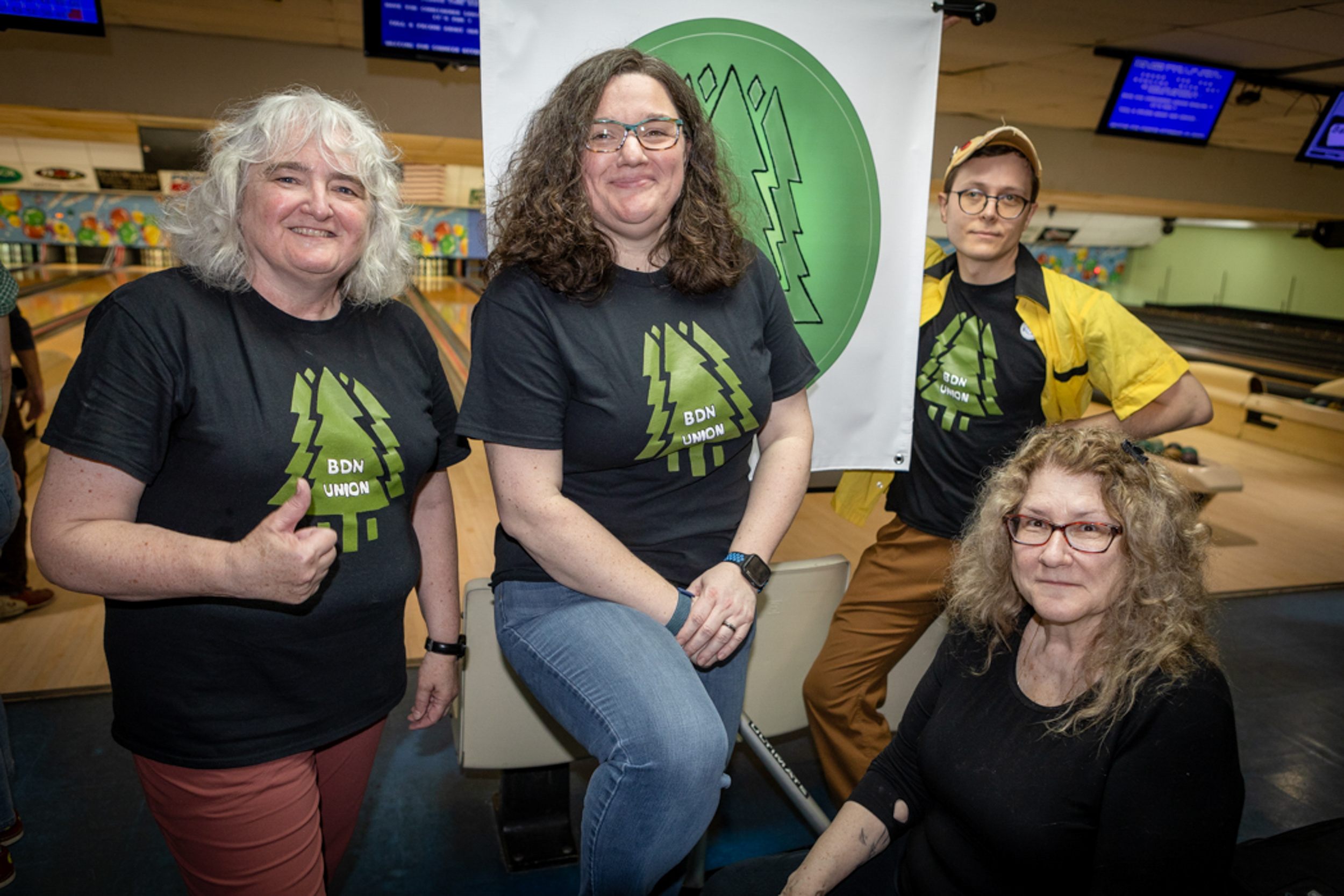
I also helped circulate petitions, send agitational e-mails and coordinate mass social-media campaigns demonstrating solidarity. Organizing should also be fun, so we held bowling parties for members and sent Benoit a mushy “happy anniversary” card when our union turned one, and then another when it turned two.
Meanwhile, the bargaining committee was getting zero counterproposals from management. This was a common tactic, the CWA told us: stalling and stonewalling to trick us into weakening our demands. But our committee members didn’t take the bait. Instead, last summer, we handed out fliers in Benoit’s neighborhood telling locals that BDN management hadn’t made a single counterproposal on wages for almost a full year. That got the bosses’ attention and they soon produced one.
Finally, last October, both sides agreed to a finished contract. It increased employee wages, closed some gender-based pay disparities, offered better health insurance and spelled out a workable grievance process. Best of all, the contract gave workers at the Bangor Daily News a say in shaping their working conditions for the first time, ever.
Membership ratified it in November and, naturally, threw a party.
Step Four: Keep organizing, forever
For the BDN Union, winning its first three-year contract is just the beginning of the story. Negotiations for the next one might start within two years. The union must stay sharp, organized and ready, because management most definitely will. Forward progress is not guaranteed.
“It’ll be important to find another handful of dedicated people who will hold it together,” Valigra said. “That’s what made it happen this time. People were committed to each other. It was a respect thing.”
Burns believes unionizing is a realistic goal for anyone who wants to improve their working conditions and compensation, as long as they’re willing to put in the effort.
“We have a lot more power in our work than we tend to think we do,” he said. “We tend to think of ourselves as more disempowered, putting up with shitty jobs, grumbling behind managers’ backs for a few years before moving on to the next shitty job. A lot of people in this country should come to the realization that they have power when they stand together.”
*To cite just one helpful source, visit the Emergency Workplace Organizing Committee’s site at workerorganizing.org.