
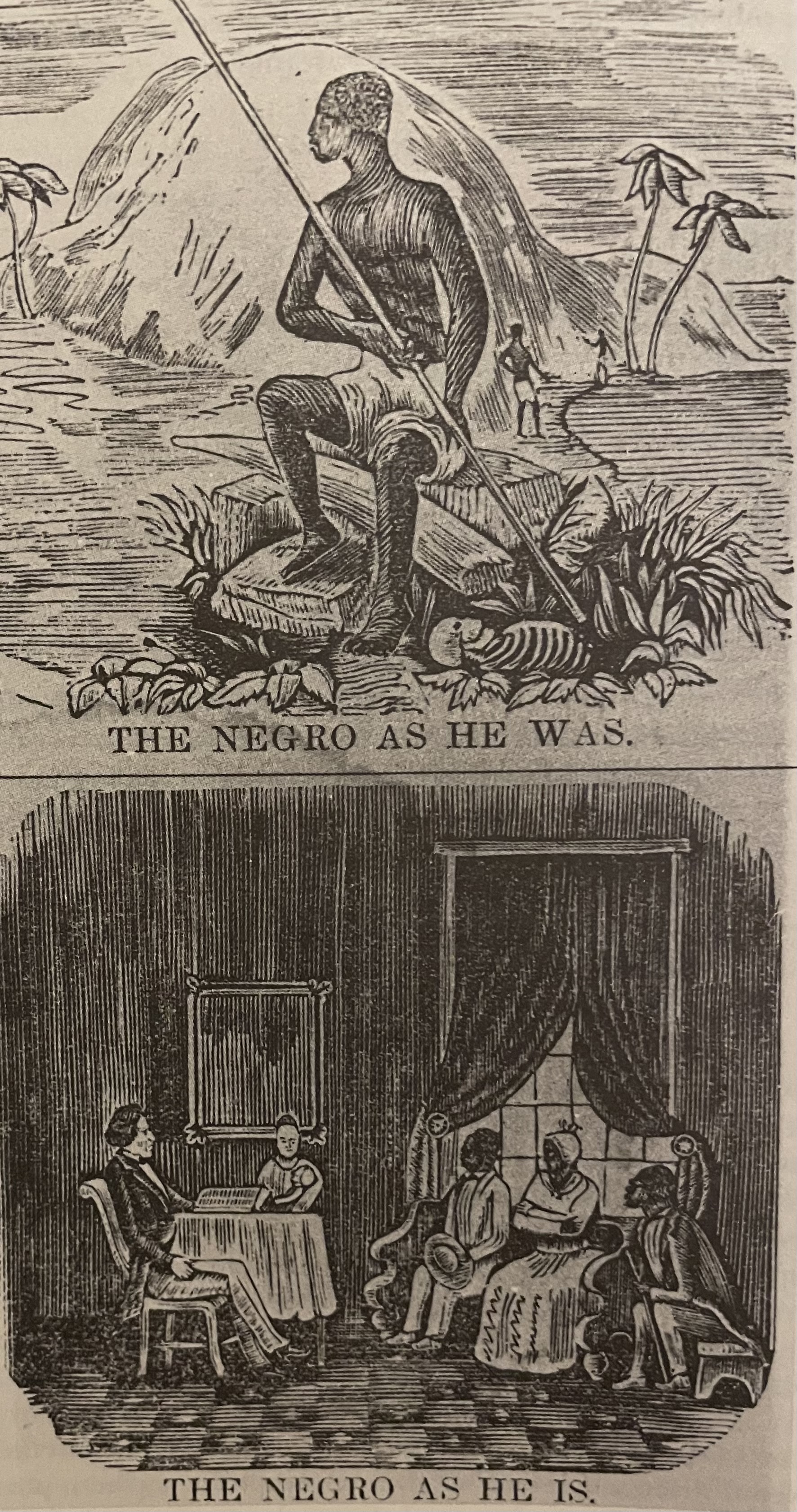
A pre-Civil War newspaper cartoon promoting slavery.
The Northern Anti-Abolitionist Counterrevolution
For several months between 1835 and 1837, a group of religiously devout abolitionist Mainers had a spirited debate by letters with a Presbyterian minister living in the South. The Rev. Rufus W. Bailey was born in North Yarmouth and had served as a pastor in Maine for some years before he moved to South Carolina for health reasons. After eight years down there, Rev. Bailey appeared to have totally bought into the slave system.
A former Congregational minister, Bailey was a learned man who graduated from Dartmouth College in 1813. He studied law under the tutelage of Massachusetts statesman Daniel Webster, was a professor of moral philosophy, and served on the boards of trustees of the University of Vermont and Williams College. Like most Mainers, he had never been enthusiastic about the enslavement of African Americans. That’s why his former colleague, Rev. Silas McKeen, pastor of the First Congregational Church in Belfast, and Bowdoin College mathematics professor William Smyth were shocked by Bailey’s responses to their questions about the “peculiar institution.”
Bailey claimed slavery was no longer oppressive and that slaveholders treated slaves like family. He compared enslaved people to an animal caught in the forest and kept in a cage. While he acknowledged it was wrong “to deprive even the meanest animal of liberty and happiness,” he added, “it would be more wicked still to let him loose among the dogs where a greater evil must befall him and double injustice be done.”
A far more humane solution, he argued, would be to send African Americans to Africa. “I can do much better for him,” he wrote. “I will return him to his native woods and restore him safely to his range of freedom.”
Bailey claimed that a fellow Presbyterian minister who owned 700 slaves was “entirely devoted to their religious instruction.” His friend even took the profits he received from the crops they harvested to buy them new suits to wear to his plantation church. Besides, Bailey added, the minister only required them to perform “perhaps one third the labor which a New England farmer commonly demands of his son.” In many ways, he argued, chattel slaves were better off than the free Northern workers who struggled with poverty wages and had no one to care for them when they were old and sick.
In Bailey’s letters, which ran in the Maine Missionary Society’s Christian Mirror newspaper, he insisted emancipation would eventually happen organically, “amicably” and “without violence or bloodshed,” and that fanatical abolitionists calling for “immediate emancipation” were only embittering and alienating Southerners. Their aggressive tactics, he contended, had delayed emancipation another 75 years, and if those radicals continued their efforts it would lead to a civil war.
“I am a yankee, so born, so bred, so abiding in my professions, predilections, and sectional pride of character,” Bailey continued, “yet I reaffirm what I have deliberately said before — and I do it with much consideration — ‘If I were the owner of a slave, I have no sentiments of morality or religion which would require or permit me to emancipate him at once, and in disregard of all circumstances.’ My interpretation of the law of love would forbid it.”
Bailey was part of a conservative counterrevolution of Northern clergy who opposed all forms of social radicalism, writes Larry E. Tise in his book, Proslavery: A History of the Defense of Slavery in America. These Northern conservatives saw abolitionists as “conspirators” against the American republic, using French revolutionary tactics to spread division, anarchy and disorder.
This fear of a Jacobin-like revolution in the U.S. went back to the 1790s, when Federalist conspiracy theorists claimed the French Revolution wasn’t launched by a grassroots movement for democracy, but was actually a carefully planned scheme devised by a union of the Bavarian Illuminati and Free Masons. By the late 1790s, anti-Jeffersonian preachers in New England spread Illuminati conspiracy theories alleging these same European elites were plotting a convert war to overthrow the young American republic. This atheistic secret society, warned pastor and geographer Jedidiah Morse, would “root out and abolish Christianity, and overthrow all civil government.”
In the Federalist tradition, Northern conservatives were deeply suspicious of Jeffersonian Democracy, favoring a more elite American Republicanism that tempered the excesses of the hotheaded masses. As radicals flooded Southern mailboxes with anti-slavery tracts in 1835, it was the children of those conservative ideologues who first rose to the defense of Southern slaveholders. Their main purpose in developing the idea that slavery was beneficial to the Black race was not to protect the economic interests of slaveholders, but rather to preserve order, social authority and national unity. These arguments came fully formed and packaged up for Southern plantation elites to deploy against anti-slavery radicals in the North.
Rev. Bailey’s letters were later collected in his 1837 book, The Issue, which Tise believes is the first full defense of slavery in the South after the emergence of the abolitionist movement. He described Bailey’s second book, The Family Preacher,as “one of the great applications of New England conservative ideology to a positive image of the ideal slave society.”
Bailey’s friends were befuddled that a good Christian Mainer could become so consumed by pro-slavery ideology. Bailey’s letters generated a deluge of angry responses from Northerners, including Rev. Elijah P. Lovejoy, the Maine abolitionist newspaper editor who was later murdered by a pro-slavery mob in Alton, Illinois (see Radical Mainers, June-Aug. 2022).
One response, published under the pseudonym Las Cases (a reference to the anti-slavery Spanish bishop Bartolomé de las Casas), sarcastically approved of Bailey’s comments about the benefits of slavery and advised “all hardworking farmers and mechanics and other poor people… for their own physical, intellectual and moral good, to take measures, without delay, securing themselves the blessings of involuntary servitude.”
It wasn’t unusual for Maine transplants to the South to become pro-slavery converts. More troubling for abolitionists like McKeen and Smyth was that many of their fellow Congregationalists agreed with Bailey’s arguments. In the same issue Bailey’s first letter appeared, the Christian Mirror’s editor, Rev. Asa Cummings of North Yarmouth, called the South Carolinian a “good Christian.”
Cummings went on to call “the noisy abolitionist … as intolerant as the slave holder, and [for] all his wordy benevolence, he is [as] unwilling to DO anything to better the condition of the slave as the slaveholder, whom he denounces as a brutal tyrant.”
Other than the Freewill Baptists and Quakers, most mainstream Protestant denominations in the North initially weren’t very supportive of abolitionism. Maine Baptists were generally against slavery by the 1830s, but they weren’t particularly outspoken about it until the Southern Baptists separated from the first national denomination, called the Triennial Convention, in 1845 over disagreements about slavery.
Although Methodist Church founder John Wesley famously detested slavery, Maine Methodists were very cautious in their approach to the inflammatory issue during their General Conference in Bangor in 1835. In a series of resolutions, they declared slavery a “great evil,” but contended that free states were “not responsible, politically or morally” for its existence in slave states.
Anti-slavery agitation, the Methodists continued, would only cause civil war, a slave rebellion, or the forced removal of the entire African American population. Therefore, they reasoned, it was not their place to denounce their brethren in the South, so long as the Southerners conformed to church doctrine.
Like the Baptists, it wasn’t until disagreements about slavery split the Methodist Church into northern and southern factions in 1845 that Maine Methodists began to denounce it more vocally. The exception was Rev. Charles C. Cone, a crusading abolitionist Methodist minister who faced down angry mobs as he organized Anti-Slavery Society auxiliaries in small towns throughout the state.
The Congregational Church, brought to New England by the Puritans, had a more complicated relationship with the politics of abolitionism, as its clergy were on both sides of the issue. Congregationalist Rev. Austin Willey of Hallowell, who served as editor for the Maine Anti-Slavery Society’s official newspaper, the Advocate of Freedom, recalled that the American Board of Commissioners for Foreign Missions and the evangelical American Tract Society, which disseminated Christian literature, were both staunchly opposed to abolition.
In his 1886 book, History of the Antislavery Cause in State and Nation, Willey wrote that the Tract Society even removed any anti-slavery sentiment expressed in the old English Puritan books it published. It was also understood, he wrote, that the Board of Commissioners discriminated against ministers who criticized it for tolerating slavery in its Indian missions, ensuring they would never get called to “any important church.”
Willey complained that ministers and church members in the 1830s and ’40s had been just as politically partisan as anyone else, and “cared more for their party than for their fellows in bondage, or for Christ and his religion.”
“Those were days that tried men’s souls, and in the strife men were driven to give up the Bible and become infidels because Christian men claimed that the Bible and Christianity sustained American slavery,” Willey wrote, referring in part to the anti-clerical sentiments of abolitionist William Lloyd Garrison. “But the ‘spirit of freedom’ became more and more active and effective in the churches, and the proslavery element could not quiet it.”
Andy O’Brien is a writer and communications director for the Maine AFL-CIO. You can reach him at andy@maineworkingclasshistory.com.


