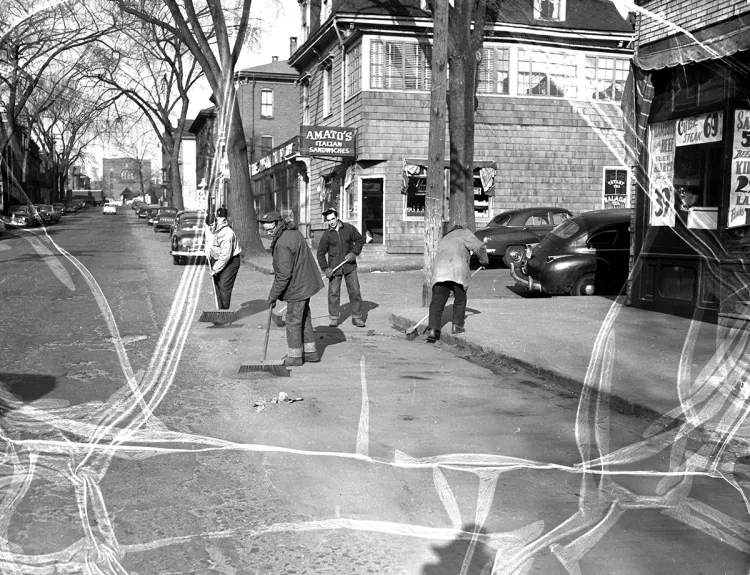
Youth sweeping the streets of Little Middle back in the day. photo/courtesy Steve Quattrucci
An op-ed by Steve Quattrucci
In the 1910s, my father’s parents emigrated from Italy to the United States and settled in Portland at the foot of Munjoy Hill, in a neighborhood they called Little Middle, where Middle Street meets India Street. From photos, old city maps, and the stories of my parents and grandparents, I have a good sense of what life in their neighborhood was like.
A century ago, there were rows of owner-occupied homes and apartment and commercial buildings lining Middle, India, Fore and Newbury streets, and the neighborhood was filled with life: small businesses owned by the Italian and Jewish families who shared the area, kids playing in the streets, and a strong feeling of community, where people felt safe and supported by one another.
All that changed when Portland, following the lead of much bigger cities, jumped on the so-called urban renewal bandwagon. In a few short years, starting around 1960, the old neighborhood was gutted. The construction of Franklin Arterial, which bulldozed hundreds of homes and shops in its path and severed Little Middle from downtown, is often blamed for this decline, but zoning decisions and development pressures were also major factors.
First, Jordan’s Meat Company was permitted to expand on a block bounded by India, Fore and Middle, replacing dozens of owner-occupied commercial buildings (including the one that housed my grandparent’s restaurant, the Balboa Café). The Village Café expanded into an entire block behind India Street, while the Federal Market did the same on the other side of India, replacing dozens more residences and small businesses (including a row of stately brick homes on Newbury Street) with one large lot (currently occupied by the Portland Food Co-op and a Walgreens). The neighborhood’s Italian and Jewish residents dispersed throughout the city, and a strong sense of community disappeared with them.
Additional expansions and lot consolidations followed, and today the Little Middle neighborhood is unrecognizable. Shreds of its original fabric can still be glimpsed between India and Franklin streets: tidy three-story brick buildings with ground-floor shops and offices and residents upstairs. But behind India, the streets are now cold urban canyons dominated by huge hotels, corporate office space, and condominiums.
As we sit on the cusp of the next era of urban renewal, “ReCode Portland” (visit recodeportland.me to read the Planning Board’s final draft of these zoning changes), are we sure ReCode is really going to strengthen our neighborhoods? Is it possible the “Mixed Use Corridors” contained therein are the Franklin Arterials of the future, walling off neighborhoods and replacing owner-occupied buildings with investor-owned properties like the ones in Little Middle today?
Please don’t get me wrong — I am proponent of dense development, but not the big-box, block-long, commercial and residential developments that have proliferated in Portland these past 50 years. Think about what was lost in Little Middle: blocks that once contained dozens of small lots, properties that were affordable for modestly prosperous locals, erased in favor of towering new buildings owned by investors and companies whose managers don’t live in the neighborhood, and whose interest in Portland begins and ends at their bottom line.
I urge Portland leaders to look carefully at how ReCode Portland addresses the issues raised here and to go even further: commit to rebuilding our city better and stronger on its original foundations of human-scale development. Restore the peninsula street grid to its pre-Franklin Arterial plan, and reverse the damage caused by past administrations by breaking up consolidated lots into smaller parcels (how about the Top of the Old Port parking lot and the abandoned “midtown” lot in Bayside, for starters?).
Build small, keep it local, and reap the benefits, Portland.
Steve Quattrucci lives in Portland and is an owner of Monte’s Fine Foods on outer Washington Avenue.