
The Destruction of the First Interracial Co-ed Academy in New England
When Henry Highland Garnet, Alexander Crummell and Thomas Sidney were between the ages of 13 and 16, they formed their own anti-slavery society down on Canal Street in the impoverished, crime-infested slum of Five Points in Manhattan. For several years, the three boys met every Independence Day and resolved that once they finished their education, they would go down South and start an insurrection to liberate their brethren in bondage. Their leader was Garnet, a tall, handsome young man with a sharp sense of humor and a fire in his soul.
As Crummell wrote, it was “most fortunate” that the Garnet family escaped slavery, despite Henry’s leg subsequently being crippled by a workplace accident, because there’s no way Henry would have remained a “submissive slave.” He would “surely have become a leader and fermenter” of a revolution.
When the boys were accepted to Noyes Academy in rural Canaan, N.H., it’s highly unlikely the school’s white administrators knew of their annual Independence Day conclaves. And when Crummell, Garnet and Sidney delivered speeches at a Fourth of July celebration in nearby Plymouth in 1835, they didn’t hold back. Their incendiary anti-slavery remarks were met with spontaneous, thunderous applause, according to witnesses. But their words also provoked rage among some local white inhabitants.
“At Canaan, 400 miles from home,” Crummell recalled the scene years later, “the whole community around for miles boiling over with bitterness, ready, in cold blood, to shoot down a few black boys who wished to become students…”
Most Canaanites had initially welcomed the establishment of Noyes Academy, as it also offered opportunities for the region’s white youth. But many staunchly opposed integration and were driven mad by rumors of Black teens seen walking arm-in-arm with white women. What really triggered the mob that Independence Day was how the three young student-activists eloquently linked the struggle to end slavery with America’s revolutionary principles of democracy and freedom.
That night, a man named Jacob Trussell fired up a raucous crowd of men from all over the area who had thronged the streets of Canaan upon hearing of the speeches at Plymouth earlier that day. Liquored up and armed with axes and clubs, the furious mob swelled as they approached the entrance of Noyes Academy determined to drive the white abolitionists and Black students out of town.
As about 70 men attempted to enter the building, a second-story window flew open and academy trustee and town magistrate Dr. Timothy Tilton threatened the mob with legal action if they attacked. When Tilton began writing their names — Trussell, Daniel Pattee, Wesley P. Burpee, et al. — the men dispersed, muttering and cursing as they slunk away.
The school had been spared, but its leading opponents called a meeting at a local church for the following Saturday. As one observer quoted by historian William Allen Wallace wrote, “The only point I could gather in their proceedings was that the ‘n——s’ was a nuisance, and must be removed from town.” Still, the opponents were worried they could face legal consequences if they demolished the academy.
Cooler heads prevailed and called for an official town meeting on the 31st of July to decide what “measures the town will take to expel the blacks from the town of Canaan.” By holding a formal vote of Canaan’s citizens, the leaders reasoned they could shield themselves from prosecution for mob violence. According to Wallace, they even consulted with attorneys, including a man named Ichabod Bartlett, to see if they could legally destroy the school. Bartlett’s response arrived too late to inform what followed, but he argued that although the town couldn’t legally vote to commit a felony, no jury in the state would convict the men, given the public’s negative attitudes toward abolitionism.
On the day of the town meeting, held at the home of Rev. Joseph L. Richardson, “men filled with rage, rum and riotous intentions” packed the room, wrote Wallace. A committee was appointed and it developed a plan of action to destroy the radical symbol of racial equality.
The committee’s final report accused Noyes Academy of “fraud and deception” and condemned it for continuing its “black operations … against the wishes of a large majority of its citizens.” It further stated that if the “colored boys and white females” continued to attend the same school, it wouldn’t be long before “we shall have living evidence of an amalgamation of blood” — a mixed-race child.
The citizens ultimately voted that it was the town’s duty to remove the “public nuisance” by hauling away the school and its Black dorm at the expense of the town. During the days that followed, an air of foreboding enveloped Canaan as “scandal, ‘damnable innuendoes,’” and “hell-engendered lies” were “eagerly received by the loquacious humor of this public,” wrote one local witness.
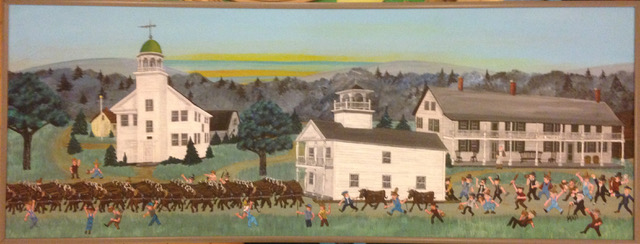
Then, on Aug. 10, 1835, more than 400 people returned to Noyes Academy. Sitting at his desk, a local man described seeing a neighbor walk by his window wielding an iron bar, followed by other men with axes, a wagon loaded with chains, and several dozen yoke of oxen. The streets were jammed with beasts of burden and drunken farmers hell-bent on removing the school for good.
Suddenly, Dr. Tilton appeared again. He literally read them the riot act forbidding such actions and commanded the men to leave. But they were not intimidated this time. One of the ringleaders, Trussell, stepped forward, picked up an axe and exclaimed, “Well, we have heard all that before, but it won’t pass with us today!” Then, turning to his men, Trussell shouted, “Boys, fall to here! If that man interrupts you any more, remove him.” With that, he grabbed the school’s front fence and began hacking away at it.
Sheriff Caleb Blodgett had decided to stay home that day, so there was no one to stop the mob when it attacked. Instead, the sheriff sent a man named Stephen Smith to observe, but not to disrupt, their destruction. A witness wrote that Smith stood by as the men wrecked the fence, thinking it “a pity” to see such a “beautiful edifice destroyed.” Noticing Smith’s idleness, one of the rioters instructed him to clear the fence debris away, which Smith did, though he supposedly regretted doing so.
A little past noon in sweltering heat, the men hooked up a team of 90 oxen to haul the school off its foundation, but the chains kept breaking. By 7:30 that evening, they had finally dragged the structure into the road and decided to call it a night. In the meantime, they sent for stronger cables, the type used to support the Lyman Bridge that crossed the Connecticut River into Vermont. As the Noyes Academy staff and students wept and prayed for their beloved school, a man from Enfield known as Joshua “Devil” Stevens set fire to the building, but failed to burn it down.
Inside the Black dormitory, the students had watched in terror as the angry mob approached. Garnet was “as fearless as a lion,” wrote Crummell, and immediately took charge. Although he was experiencing searing pain due to his injured leg, which would eventually have to be amputated, he set the other boys to work moulding bullets to defend themselves. At 11 p.m., they heard the rumbling of horses and a shot rang out. Garnet quickly pointed his double-barreled shotgun out the window and fired back at the riders as they flew past.
“At once the hills, for many a mile around, reverberated with the sound,” Crummell recalled. “Lights were seen in scores of houses on every side, and the towns and villages far and near were in a state of great excitement. But that musket shot by Garnet doubtless saved our lives. The cowardly ruffians dared not to attack us. Notice, however, was sent us to quit the State within a fortnight. When we left Canaan the mob assembled on the outskirts of the village and fired a field piece, charged with powder, at our wagon.”
The white men returned with their team of oxen the following day and this time the new cables held firm. They made steady progress throughout the morning, hauling the school building down the road before stopping at noon at the general store to demand a barrel of rum. The shopkeeper defiantly retorted that he would “sooner die than yield an inch to these fanatical villains,” but he has pushed aside as the mob went for the booze. After the rabble killed a cow and cooked it, the town selectmen paid for a feast for the men using funds from the town treasury.
While most supporters of the school decided it was best to stay out of the mob’s way, some made their feelings clear. One woman stood on a fence yelling at the ruffians until a man picked her up and dragged her, screaming, into the house, for fear the mob would pull her house down, too. When the rioters stopped to rest for water after pulling all day, another woman, “Mrs. F,” rushed out and cut the rope to her well’s water bucket, shouting that it “should not be polluted by the touch of such foul lips.”
Finally, Wallace recorded, the exhausted men left the building on the corner of the town’s Common, where “it stands, shattered, mutilated, inwardly beyond reparation almost, a monument of the folly and infuriated malice of a basely deceived populace.”
Next month: The Aftermath.
Andy O’Brien is a writer and communications director for the Maine AFL-CIO. You can reach him at andy@maineworkingclasshistory.com.


