photos/Jessie Banhazl
The second-most-famous* traffic stop in the history of the Kennebunks happened on a Saturday evening in July of 2014. Kennebunk resident Gavin “Scotty” Falconer, a kindly Korean War vet and former milkman who’d recently turned 84, was driving with his wife, Janet, on Fletcher Street, allegedly to get some ice cream in another town. A common cut-through between Route 1 and the Maine Turnpike, Fletcher Street has a stretch where the speed limit is just 25 m.p.h., making it an ideal trap for cops like Kennebunk Officer Matt Harrington, who pulled the octogenarian over and demanded his license, registration and whatnot.
That’s when all hell broke loose. After surrendering the documents, Scotty slumped over the steering wheel, not breathing, no pulse, dead. Janet’s screams interrupted Officer Harrington as he was writing a citation in his cruiser.
“He come runnin’ back, saw me there, and yanked me out of the car,” Scotty told WMTW’s Paul Merrill during an exclusive interview in his hospital room. “Ripped my beautiful pink shirt — but that’s alright; it was old, anyway.”
Harrington administered CPR, and a second officer soon arrived with a defibrillator to jolt Scotty back to life.
“Ya ever watch those old cowboy movies [in which] they brawl in the bar?” Scotty asked the TV reporter. “I feel like I was the guy who’s gettin’ beaten up.”
“I’m not a careless driver — don’t get me wrong,” he said. “I have a heavy foot.” In B-roll footage shown during the reporter’s voiceovers, a young female nurse is seen sitting at the foot of the bed, shaking with laughter as Scotty relates some joke or anecdote.
When Scotty regained consciousness, Janet had what Merrill called “a surprise” for him.
“You got a ticket,” she told her recently resurrected husband.
“I says, ‘Noooh,’” Scotty recalled on camera.
“Yeah, yeah. It was a warning,” Janet replied.
“I said, ‘Well, that’s alright. I can live with that,’” Scotty deadpanned.
Merrill burst out laughing, and Scotty broke out a smile. “At least you’re livin’, right?” the TV man ad-libbed.
“That’s right,” Scotty said, then repeated himself for emphasis: “That’s right.”
The following summer, Maine State Rep. William F. Noon of Sanford died of a rare form of cancer. That fall, Officer Harrington ran against Noon’s widow, Democrat Jean Noon, for her late husband’s House seat, and won by 36 votes. The immoderate Republican and LePage acolyte, who’s still patrolling the serene streets of Kennebunk, now wields power in the Maine Senate. Sen. Harrington (or, more likely, a GOP staffer) recently wrote an op-ed for the Portland Press Herald calling for tougher enforcement of laws routinely broken by homeless people, like trespassing and peeing or drinking in public.
Scotty went on to join a different legislative body, the Board of Regulars that meets weekly at Ryan’s Corner House, an Irish pub down the road from the low-slung ranch home he and Janet lived in. While Harrington and his colleagues in Augusta tried — and quite obviously failed — to come together and solve the problems of Maine’s people, the Board of Regulars has done a bang-up job making this tiny corner of the state a welcoming, safe and life-affirming place for all, as well as a much more successful business for proprietors Joe and Tracy Ryan.
The Ryans, originally from Limerick, Ireland, fled the Emerald Isle after the global financial collapse of 2008. Joe’s sister had a summer home in the area, and the couple opened the pub on Western Avenue, just across the bridge from Kennebunkport’s tony little village, in the spring of 2011.
“It took a while to get the locals in, because they were already established at other bars, like The Pilot House, but it eventually took off pretty good,” said Joe.
“People have been very welcoming. This is a great community,” said Tracy. “There was never a true Irish pub in the area. And it’s a pub, as opposed to a high-end restaurant.”
“Since the day I was born, I’ve been in the business,” Joe added. “And you either love it or hate it, but it’s in my blood. I just love all the aspects of socializing, the camaraderie, the meeting of people.”
The pub grub is top-notch, but no one would mistake Ryan’s Corner House for a classy restaurant. It looks like a modest single-family home, but it was built in the 18th century to be a barn, which explains why the wood-beamed barroom ceiling is so low. There’s a kitchen in the basement, space upstairs for private events, and a big front patio with a fire pit, around which patrons merrily and brazenly drink in full public view. A poster in the restroom depicts “The Urinals of Kennebunk”: snapshots of guys peeing in the woods or into the sea, and most likely trespassing, too — but unfortunately, for Officer Harrington, they’ve all been shot from behind.
On a foggy Friday night in October, the patio was lively and the barroom was packed. Steaming plates of fish and chips and tray after tray of Guinness pints zipped past, carried by agile and friendly staff. Ross Gregor Adam — a Scotsman, like Scotty — sang drinking songs from the Old Sod, accompanying himself on several instruments (simultaneously, through the miracle of looping) while the crowd sang and clapped along. It’s tight in the barroom, but the easygoing staff sets a relaxed tone, and the forced intimacy is a feature, not a bug.
“The space is so small, you get acquainted with everyone,” Tracy said. “I firmly believe this is one of the few bars where friendships for life have been made.”
The pub attracts an eclectic mix of townies, wealthy summer residents and tourists, including the occasional celebrity or New England sports star, but it’s the locals who make the place buzz.
“It’s amazing on a Friday or Saturday night when you can look around and you know every person’s name in that bar,” said bar manager Andrea Cusack, who’s worked at Ryan’s since it opened. “They’ve become family over the last thirteen years. I get to watch them grow up, and now they’re old enough to drink, getting married, and coming in with their children.”
It’s often said that political polarization is preventing the people’s representatives from coming together to solve our collective problems, like the ongoing crises of homelessness, drug addiction and mental illness. At the root of those scourges, and many others, is a deeper plague, described in the title of a report issued this year by U.S. Surgeon General Dr. Vivek H. Murthy: “Our Epidemic of Loneliness and Isolation.”
“When I first took office as Surgeon General in 2014, I didn’t view loneliness as a public health concern,” Dr. Murthy wrote in the report’s preface. “But that was before I embarked on a cross-country listening tour, where I heard stories from my fellow Americans that surprised me.
“People began to tell me they felt isolated, invisible, and insignificant,” he continued. “Even when they couldn’t put their finger on the word ‘lonely,’ time and time again, people of all ages and socioeconomic backgrounds … would tell me, ‘I have to shoulder all of life’s burdens by myself,’ or ‘if I disappear tomorrow, no one will even notice.’”
Half of all adults in the U.S. reported experiencing loneliness, and that was a survey conducted before the pandemic. “The mortality impact of being socially disconnected is similar to that caused by smoking up to 15 cigarettes a day, and even greater than that associated with obesity and physical inactivity,” the Surgeon General wrote. The risks of heart disease, stroke, dementia, depression and anxiety also rise significantly when one is alone too much.
Sen. Susan Collins has made addressing loneliness and isolation (especially among Maine’s disproportionally large elderly population) one of her signature political causes. But no politician or public health official ever advocates for one of the most time-tested, popular and effective solutions to this catastrophe: pubs like Ryan’s Corner.
To the contrary, businesses that sell the social lubricant of alcohol are heavily taxed and hyper-regulated (e.g., mandatory statewide closing time, banning young adults from gathering there during the most socially active and socially important period of their life). And in cities like Portland, bars pay much higher licensing fees to host music or games that draw people together.
In 2014, the same year the Surgeon General had his epiphany about loneliness, a Texan named Brian McGrath** strode through the pub’s doors and tacked two Treasury notes to the wall: a twenty and a hundred-dollar bill. Tracy said no one knows why he did that, but the practice of defacing U.S. currency and leaving it in the barroom for all to see caught on like a wildfire. Bills, mostly ones, cover the low ceiling and most of the walls. Upon them, patrons have scrawled their names or initials, and typically the date of their visit and the occasion: a birthday, an anniversary, a return trip to Maine.
“We started making kits for people to sign and hang up their dollar,” said Tracy. “People check their dollar or they send people to check their dollar to make sure it’s still here!” The tradition has turned the pub into a living museum honoring and celebrating the everyday folks who’ve stopped in for a pint or a shepherd’s pie.
A few years later, the Ryans further enhanced their pub’s connection to its community in another unconventional way. Pub patron Jeff Brown, the 75-year-old Chairman of the Board of Regulars, explained how it happened.
“Ryan’s used to close in winter,” Chairman Brown said. “We have the Prelude [winter carnival] down here the first two weekends in December, and then the Monday after that, Joe would have a ‘drain the pipes’ party for the locals, and we would come in and ‘drain the pipes.’ But that meant we had to stop drinking from December till the weekend before St. Patrick’s Day, and that just didn’t work for us.
“So, eventually we coerced Joe and Tracy into staying open, at great sacrifice to ourselves,” Brown joked. “We increased our alcohol intake to make sure that it was worth it for them, and I believe it’s been successful.”
“One day, we decided that we should form a board of directors and have regular talks to assist in the running of the bar,” the Chairman continued, then added that perhaps running was too strong a word: “to at least provide commentary and comic relief,” he said.
“They’re always willing to help us out,” Andrea, the bar manager, said of the board members, who number around 20. “Like, if we’re busy and we need a case of beer or a bucket of ice, they’re on it.”
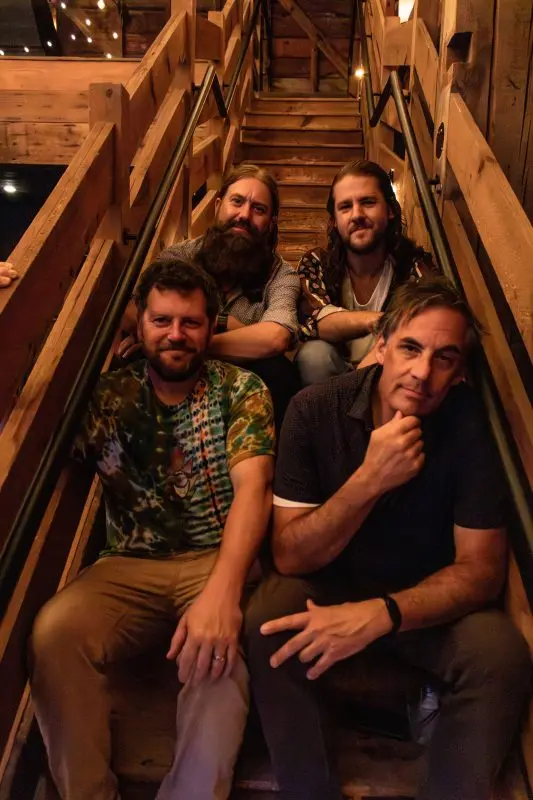
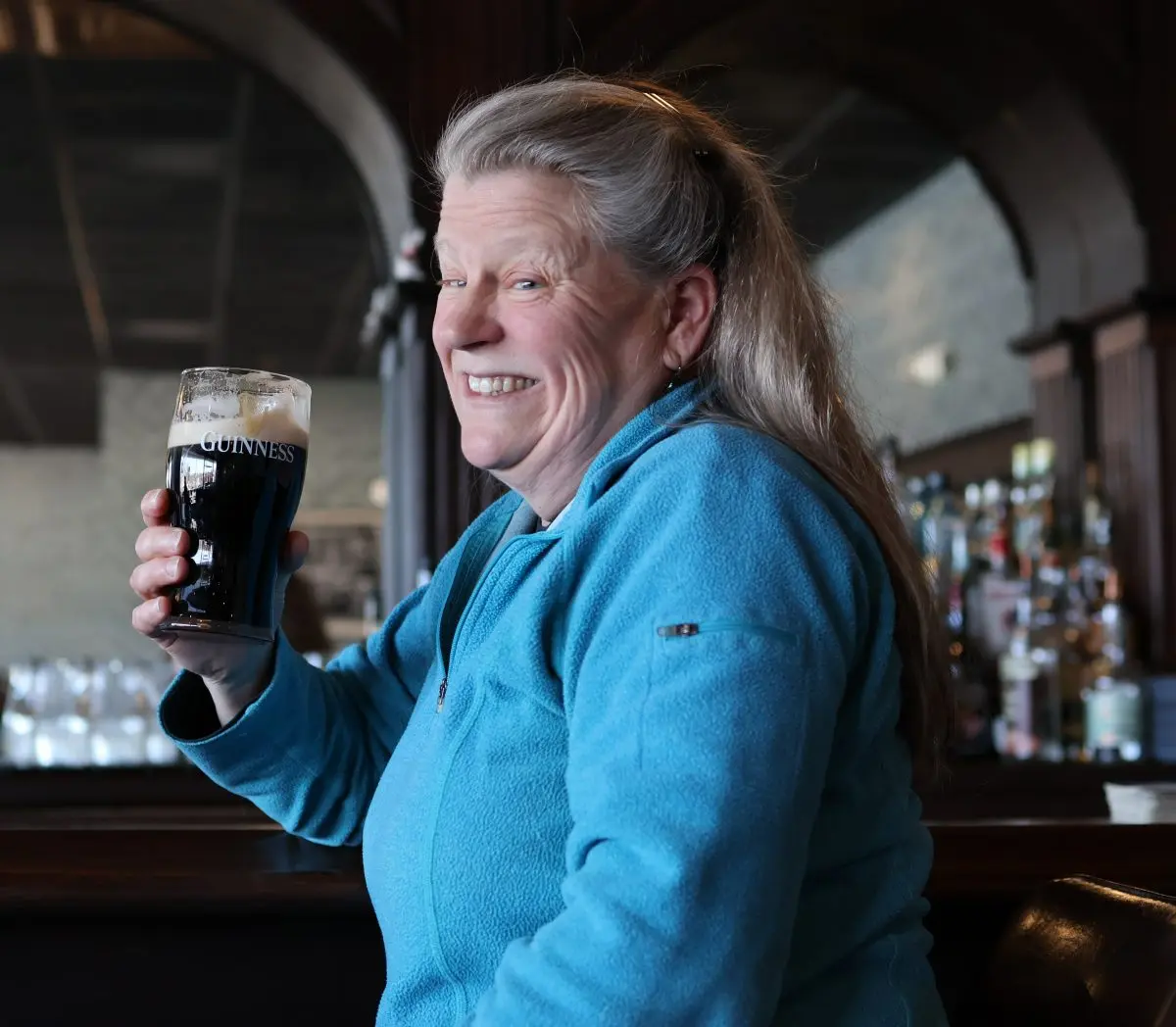
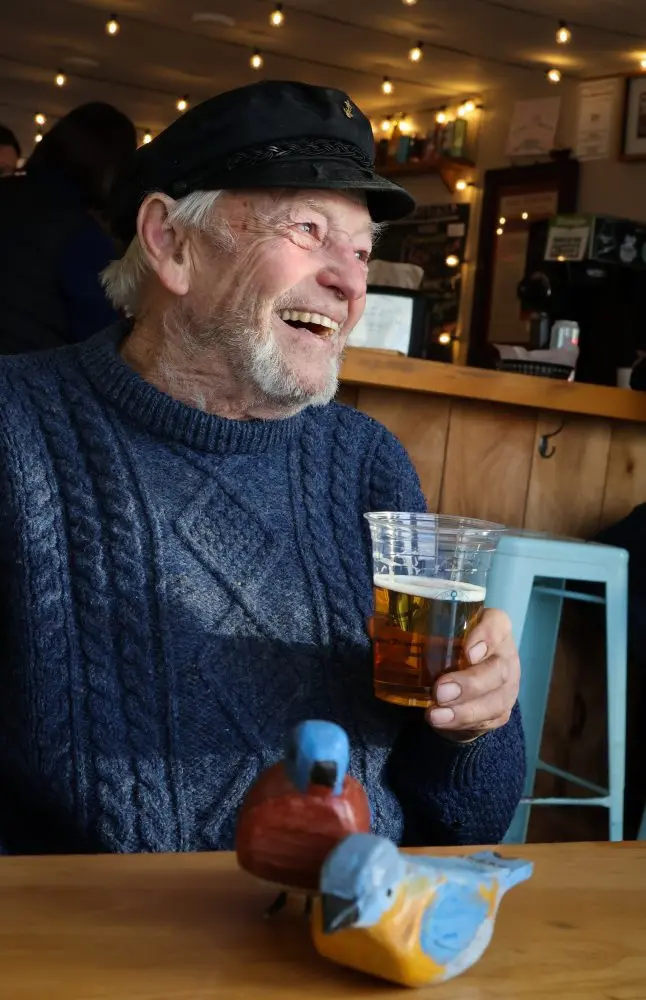
The board’s members range in age from early 30s to mid-70s. Among them are retirees (including an ex-cop), teachers, a semi-retired boat captain, finance professionals, lawyers, and a world renowned kaleidoscope artist.
“One of the ladies is the activity director, and she bakes everybody a special cake for their birthday,” Andrea said. “They all met at the Corner House, and they’ve become friends outside the Corner House. It’s so lovely!”
“This is my comfortable place to be single,” said board member Jennifer Stone. “It’s the most comfortable place in town, I feel.”

“Jeff was appointed chairman immediately. He has the gavel,” Tracy recollected with a laugh. “They’re great supporters. People want to be part of the board. It’s pretty original, actually.”
The board’s bylaws are simple, if not always easy to follow:
- Come to the board “meetings” on Sunday afternoons
- Fill the bar in the winter
- No talk of religion or politics
- Don’t spill your Guinness
“The board is always looking out for everyone. Jeff will make sure that if someone new is in town, he welcomes them,” Tracy said. Staying open during the slow months isn’t easy, she added, noting that the building isn’t winterized, “but we do it.”
“Now we do live music year-round, because the town needs life in the winter,” Tracy continued. “There will be forty to fifty people packed in here like sardines. Ross jumps and leaps around the room. It’s amazing. Everyone’s singing along. It’s electric.”
“I feel like the fellowship I have with the regulars there transcends the fact that I’m the guy that shows up and sings ‘Whiskey in the Jar,’” Ross said, chuckling. It’s not uncommon that at some point well into Ross’ four-hour sets, strangers will spontaneously engage in a communal dance ritual associated with islands far south of Ireland. “It’s the only place I’ve ever played where there’s regularly a conga line!” Ross exclaimed.

The whiskey shots flow freely for patrons and performer alike, and “the next morning, I’m walking into my day job with sunglasses on, rougher than a badger’s arsehole,” said Ross, who has a postal route in Portland’s Morrill’s Corner neighborhood. But back at the pub that evening, regulars and return customers tell him, “Great gig last night,” Ross said, recalling “families from Chicago or Texas and all around the world” that he’s entertained there over the past few years.
The one board member all the others kept mentioning was Scotty Falconer, who died last December at 92.
Scotty was a joiner. In addition to the Ryan’s Corner Board of Regulars, his obituary notes membership in the Masons and Shriners, as well as the Kennebunk-area Chamber of Commerce. He led Shrine parades as a bagpipe major and sold raffle tickets during car shows at Bentley’s, the great biker bar in Arundel. Born in Los Angeles but raised in Scotland, he often took jobs that brought him into contact with strangers, like shuttling people to and from the airport. A lifetime of this, plus a platoon of kids, grandkids and great-grands, provided Scotty with enough material to keep a barroom entertained for infinite winters, and then some.
Scotty had “no filters,” his fellow board members remarked. “All the girls loved him,” said Andrea. “We had one young girl — I think she’s a sophomore in college now — and when he passed away she looked at her mom, who is on the board, and she goes, ‘Well, who’s going to inappropriately compliment me now?’”
“Scotty was a hell of a guy. He’d be sitting at the bar and playing the bones all the time,” Ross said, referring to the percussive spoons used in Irish music. “Before he died, he left me his bones and a bottle of whiskey.”
“He used to tip people in two-dollar bills,” Ross recalled. “We kind of feel like that was his way of leaving a trail. You go somewhere and you see a two-dollar bill and you’re like, ‘Oh, Jesus, he’s been here!’ When Scotty died, it changed the dynamic a bit. I mean, not in a bad way or a good way. It just changed.”
For example, Andrea and many board members believe Ryan’s Corner is still one of Scotty’s favorite haunts — only now, literally.
“When Scotty passed, Joe and Tracy were out of town, but they texted me and said, ‘Hey, after Scotty’s funeral service, bring everybody back to the pub,’” said Board Chairman Brown. “So, Andrea and I were in here that morning, and she touched the C.C. [Canadian Club Whisky], which was what Scotty drank, and the food alarm suddenly went off from the kitchen. There’s nobody here but me and Andrea. And then about five minutes later, another alarm goes off and plays all twelve musical alarm settings. This never happened before, never happened since.
“Then we went to the funeral,” Jeff continued. “It was an open casket. All of a sudden, Scotty’s pacemaker alarm goes off from the casket in the middle of the service.”
“It’s just little weird things,” Andrea added. “Like, I was standing nowhere near these two glasses and all of a sudden they just came flying off the shelf. Strange stuff like that. We blame all that stuff on Scotty.”
Once a regular, always a regular.
•••
*The most famous, of course, being George W. Bush’s 1976 arrest for drunk driving in Kennebunkport.
**In the print version of this story, the late Mr. McGrath’s name was misspelled. Big thanks to his friend Patrick for alerting us to that error.
Ryan’s Corner House Irish Pub & Restaurant (17 Western Ave., Kennebunk) is open Thursday through Monday for lunch, dinner and drinks during the winter. Sara Hogan and Jessie Banhazl produce The Regulars, a monthly feature for this magazine. If you know an interesting bar regular, recommend them by e-mailing theregularsmaine@gmail.com. Bollard editor Chris Busby contributed reporting to this story.