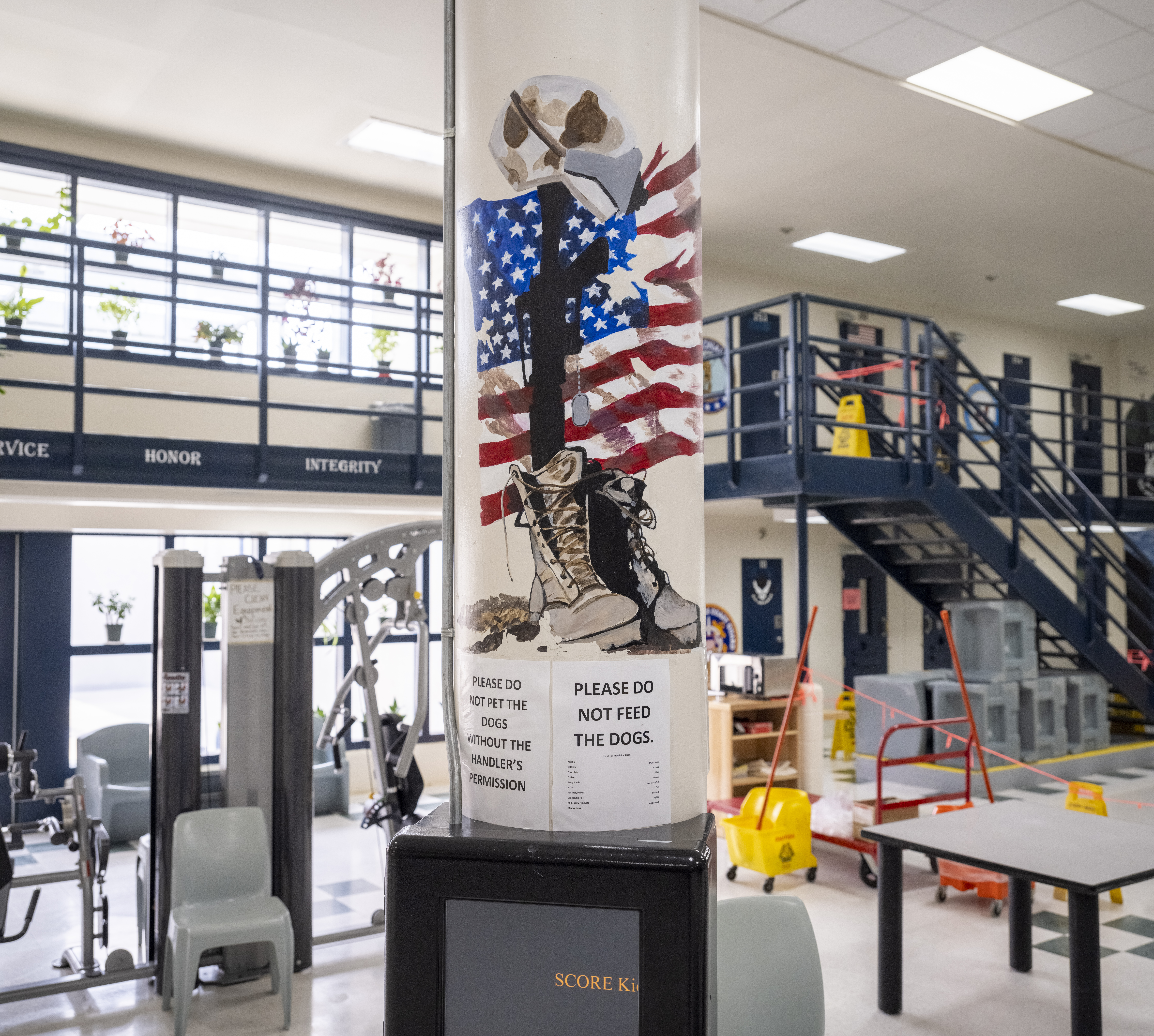
Inside Maine State Prison. photo/Trent Bell, courtesy Freedom & Captivity
A Restorative Pathway to Decarceration and Abolition
“Transformation in the world happens when people are healed and start investing in other people.”
— Michael W. Smith
Prisons don’t work. They don’t make communities safer, they don’t solve social problems, they don’t effectively address mental health challenges, poverty or substance-use disorder, and they don’t stop violence. Instead, they compound these problems.
One reason prisons don’t work is because of their origin. Take a minute to Google the question “does prison have its roots in slavery?” and you’ll quickly find that today’s sprawling prison system served as a means to extend the practice of slavery in the wake of its partial abolishment by the 13th Amendment, passed in 1865. Slavery through imprisonment is still Constitutionally legal due to the “Exception Clause” to that amendment: slavery shall be abolished “except as a punishment for a crime.”
What does this have to do with Maine? As much as we might like to ignore or deny this truth, Maine has a long history of supporting and profiting from the transatlantic slave trade. Through the Missouri Compromise of 1820, Maine became a state — one where slavery was illegal — in exchange for Congress allowing Missouri, a state where slavery was legal, to also join the union, so as to maintain a balance of slave and non-slave states. The Atlantic Black Box project shows how Maine’s economic growth depended on the slave trade, and Samuel James’ “99 Years” podcast forces Mainers to face the ways political and business leaders enacted policies and laws to ensure Maine remained a majority-white state to this day. Incarceration extends and augments these historical trends.
Today, Maine has six state prisons in addition to 13 jails in 16 counties. As of last December, there were 1,654 people in Maine prisons: 1,506 men and 148 women, including 89 people on the Supervised Community Confinement Program (SCCP). More than 5,400 Mainers are on probation or parole.
The racial disparity in Maine prisons is among the worst in the nation — Black Mainers are incarcerated at a rate over nine times that of whites, based on each group’s share of our population, according to The Sentencing Project. This is not the fault of the Maine Department of Corrections (DOC), which is working to enact substantial changes within Maine’s prison system. But this reform effort must struggle against a toxic culture founded in an institution designed to subjugate marginalized peoples.
We appreciate the dogged determination of current Corrections staff and leadership to change that culture. The Maine Model of Corrections has rightfully been gaining national attention. From its Language Matters initiative and efforts to implement restorative-justice practices, to its adoption of Norway’s “principle of normality,” DOC leadership is aiming to create a prison environment that is safer, as well as more humane and professional, for residents and staff.
Changing a culture takes time, energy, effort, collaboration, and then, yet more time. It’s complex work that proceeds in fits and starts. But there are steps that can be taken today within prisons and jails to turn them into spaces of healing and rehabilitation, rather than punishment and harm — steps that can eventually lead us toward decarceration and, ultimately, abolition.
In last month’s issue of The Bollard we presented steps that can be taken to achieve real public safety BEFORE incarceration occurs. This month we present the MIDDLE part of this three-part series, addressing life behind bars. In next month’s issue, we’ll present steps than can be taken AFTER incarceration to keep our communities truly safe.
MIDDLE
Build a restorative culture inside. Prison culture is characterized by suspicion, distrust and constant surveillance. In the name of “safety, security, and the orderly management of the facility,” everyone who steps inside this system is immediately warned that manipulation, exploitation and unprovoked violence are ever-present threats. The harmful practices of prison culture — separation, dehumanization, othering — are deeply entrenched. Thankfully, here in Maine, the shift toward uplifting the inherent dignity and worth of each human being in the system (staff, residents and administrators) has begun.
Prisons are traumatizing places both for those who live there and those who work there. Most residents arrive at prison already deeply traumatized. Many staff members come to work at prisons following stints in the military or law enforcement that leave traumatic memories. Incarcerated people and staff alike need opportunities to engage in meaningful trauma-healing work, which are woefully lacking at present.
There are cognitive-behavioral classes, parenting and emotional-literacy classes, recovery-oriented programs and trainings, as well as numerous and growing educational opportunities within Maine’s carceral system. But without sufficient opportunity to address and heal trauma, education won’t be enough to ensure success inside or after prison. There is still a deep concern that sensitive information people reveal about themselves in programs will be used to harm them outside of those spaces. That aspect of prison culture also needs to change.
- Expand trauma-healing programs for residents. The only two programs Leo has seen inside that explicitly address trauma and its impact on people’s lives, behavior and decisions are Houses of Healing and Jericho Circle. With the growing acknowledgment that men suffer from trauma, in addition to the impact of living in a culture that conditions men to suppress any non-masculine emotion, there needs to be an expansion of trauma-informed, healing-centered programming.
- Implement trauma-healing programs for staff. Staff need a space to engage in trauma-healing work, especially those who’ve labored on the inside for years. We need staff champions who understand the need to address the dehumanization and alienation caused by working within this harmful system. Opportunities for staff to connect with and support one another should also be expanded.
- Implement restorative, community-building circles. Intentional spaces need to be created where staff, residents and administrators come together to engage in true dialogue. Circle practice predates every Western custom we have. It’s a ready-made way to build community, one that brings people together by deemphasizing positional power, which otherwise divides us. Two main social hierarchies exist within carceral spaces: hierarchy of crimes and hierarchy of positional power. Leo has developed a framework for circle sessions that can be adjusted and implemented in nearly any hierarchical institution (including schools and corporations).
- Establish generative dialogue circles. Beyond building a sense of community, the power of circle practice can be extended into action through what are called generative dialogue circles, by which the process informs new policies and restorative practices.
- Implement restorative conferencing on the inside. The DOC has been expanding its capacity to offer Victim/Offender Dialogue conferencing, which is laudable. But there also needs to be restorative conferencing among those on the inside. With the understanding that punishment is a passive process that does not meaningfully change behavior, accountability must take priority. In collaboration with the Restorative Justice Institute of Maine, the Maine State Prison Restorative Practices Steering Committee developed a 20-week restorative and transformative justice course. This peer-led course provides a firm foundation for the implementation of circle practice, the adoption of a restorative mindset, and a reframing of discipline that highlights the difference between punishment and accountability, showing how people can be held responsible for the harm they cause in a way that facilitates healing, instead of causing more harm. This curriculum should be implemented in jails and prisons throughout the state as an officially recognized certification course for staff, residents and administrators.
- Build a team of RJ practitioners to address harm. Train staff and residents in restorative justice practices and processes, ultimately building a robust team of RJ practitioners to hold community-building circles and support RJ conferencing processes on the inside. Once up and running, the RJ team could take the place of the disciplinary “board” (currently one person, who is judge and jury in such matters), making decisions about responses to harm that promote accountability and repair over punishment (e.g., removing from residents’ records any disciplinary write-up not related to interpersonal harm). As appropriate, each RJ process would be co-facilitated by an incarcerated and non-incarcerated person.
- Support creative staff-resident collaborations. Although this is already part of the DOC’s Maine Model of Corrections, overcoming the antagonistic foundation of staff-resident relationships is integral to shifting prison culture to a more restorative one. In practice, this looks like collaborations to create programs, envision and lead new initiatives, and team up to figure out ways to make everyone’s day-to-day lives and work shifts better. Also, nothing brings people together quite like food! Arts, cultural, educational and sporting events open to residents, staff and administrators can be planned to include a communal meal.
- Expand the “principle of normality” throughout facilities. The “principle of normality” that guides Norway’s Correctional Service is described by its Deputy Director General of Corrections as one by which “No one shall serve their sentence under stricter circumstances than necessary for the security in the community, and offenders shall be placed in the lowest possible security regime. During the serving of a sentence, life inside should resemble life outside as much as possible.” The seeds of this idea have been planted in the Earned Living Unit of Maine State Prison and the Normalization Unit in Maine Correctional Center. This model should grow to include every carceral unit to the greatest extent possible without legitimately compromising security and safety. Even where higher security is warranted, decency, compassion and respect need to be the norm for all interpersonal engagement. When it comes to behaviors and expectations, rules should be based on these questions: Is the behavior normal in outside communities, and is it harmful? If the behavior is normal and harmless, there should be no punitive consequences.
- Allow residents to personalize their living quarters. People take better care of places into which they have invested time and energy. When incarcerated people are allowed to personalize their living area — by painting, decorating or displaying pictures and artwork — they’re more likely to take care of their space. Encouraging residents to perform regular upkeep of their living quarters would also take pressure off staff and residents every three years, when the American Correctional Association inspectors come around.
- Demilitarize staff uniforms. The majority of incarcerated people have endured trauma related to police. Militaristic uniforms are triggering. Carceral institutions should get rid of paramilitary garb and replace it with polos and khakis, or something similar, to reduce interpersonal tensions.
- Base Corrections Officer training on supportive, rather than militaristic, techniques. Norway’s correctional system also employs what are called Contact Officers, CO’s trained to maintain safety by establishing rapport and trust with residents. Like guidance counselors in schools, Contact Officers help inmates get the resources, information and connections they need to succeed during and after incarceration. The DOC already has a head start moving toward this model, and further progress is strongly encouraged.
- Encourage the universal use of first names. Stripping someone of their first name is one of the innumerable ways the prison system dehumanizes people. Using first names can afford everyone opportunities to reaffirm their humanity and personhood in ways that are otherwise denied to all.
- Establish a process for residents to decide how the Resident Benefit Fund is spent. Every DOC facility and county jail has a Resident Benefit Fund generated from the fees charged for phone calls and commissary purchases, disciplinary charge fees, and transaction fees applied when supporters deposit money electronically into inmates’ accounts. This fund should be spent according to what the residents determine will be most beneficial to them. This has been happening to some degree at Maine State Prison, through the Resident Advisory Council and the openness of administrators to solicit proposals by residents. The fund should also pay for care packages for everyone entering these facilities: decent hygiene products and toiletries, food, coffee or tea, shoes and shower shoes. Talk to a longtimer and they’ll tell you this was common practice “at the old joint.” Not everything old is bad. Bring this practice back throughout Maine’s jails and prisons.

Normalize professional development. People who come to prison are not incapable of becoming professionals. Through our respective journeys, we have learned that many incarcerated people lived full lives and held multiple careers before ever stepping inside a cell. Their potential for future success is incredible, yet largely unrealized. Instead, the expectation is that inmates want to distract themselves from reality: watch TV, play video games or cards, work menial jobs, read as many sci-fi and fantasy novels as possible — anything to pass, or waste, time. The carceral system is designed to cultivate prisoners’ lethargy, to sap their motivation for personal growth.
The DOC is invested in changing this, but efforts need to be expanded to include professional training, pathways to certification and licensure, and opportunities for networking and development in preparation for release.
- Initiate or expand formalized peer-mentorship training. Everyone needs mentorship at some point in their life. Within carceral spaces, mentorship occurs naturally and spontaneously, though it may not always be welcome or supported. Maine State Prison currently runs a certified intentional peer-support training for residents that could form the basis of a hugely beneficial infrastructure of formalized mentorship. Staff should also be offered this training and compensated for completing it, further facilitating the shift toward the aforementioned Contact Officer model from Norway that’s proven transformative for the security of that country’s correctional system.
- Shift policy to allow peer crisis intervention. Self-injurious behavior, including suicide attempts, is prevalent in carceral systems. Who is better able to support and intervene in crisis situations among our peers than fellow residents? Rather than relying on force or the power of carceral authority, incarcerated people should be trained to de-escalate situations that have not yet turned violent.
- Initiate or expand professional training opportunities. A determined prisoner can work their way through all of the professional-development programming available to them within the first two years of their incarceration. After that, opportunities to gain professional certification must be made available. Maine State Prison currently offers opportunities for professional certification in the fields of intentional peer support, master gardening, beekeeping, construction, and ServSafe food service. We call for the expansion of these opportunities into other fields, as well. A few basic construction courses are being taught at Maine State Prison through the National Center for Construction Education and Research, but NCCER offers over 80 programs, so there’s plenty of opportunity to expand this initiative. Likewise, the collaboration with Habitat for Humanity could be expanded, and other vocational programs could be implemented or improved, such as welding, barbering and hairdressing, auto repair, and cabinet/furniture-making. Good work is already being done through the prison’s Industries program and Sunday cabinet-making classes. But if we are going to help meet the pressing and unprecedented demand for tradespeople on the outside, there is no better time than now to grow these universally beneficial programs.
- Allow incarcerated people to become Vocational Training Instructors (VTI’s). Roughly 30 percent of Maine’s prison population is serving sentences longer than 10 years. After completing certification courses early on in such sentences, these residents should have the chance to become Vocational Training Instructors (VTI’s) and be allowed to help others. Training skills will be useful upon their release, and until then, teaching others a trade helps longtimers develop a greater sense of meaning and purpose to sustain them during their incarceration. This will improve security inside institutions and reduce recidivism. To help further reduce recidivism, incarcerated VTI’s should also be paid free-world wages.
- Open opportunities for residents to work for outside organizations. Facilities with internet capability should have a framework for residents to be able to work remotely for any business or organization willing to hire them. They should be paid fair wages, with only court-mandated fines, fees, restitution or victim compensation withheld. These opportunities build agency and responsibility into the carceral system so people can pay taxes and care for their families while also making a dent in their financial obligations (currently not possible given the menial wages workers inside are paid). This should also extend to career opportunities for incarcerated people to work outside through contracts, consulting, teaching, social work, counseling, etc. If people are going to successfully re-enter society, there needs to be interaction with the outside world before that time comes. Employment outside, at fair wages, is one meaningful way to support safe re-entry.
- Expand access to higher education inside. All incarcerated people should have access to higher education. No Maine taxpayer money has paid for college education on the inside. Instead, funding has come from private philanthropy, like the amazing Doris Buffett and her Sunshine Lady Foundation, or from federal sources, like Second Chance Pell, and soon the fully reinstated Pell Grant program. One of the strongest factors in reducing recidivism is increasing education level. In Maine, less than 1 percent of those residents who attended college while incarcerated re-offended after release. Between a fifth and a third of all adults in DOC facilities have not completed high school! We need to invest state funds in education programs inside prisons and jails, including vocational, skills-based, liberal arts, STEM, IT, paralegal, and health care courses, so every incarcerated person has access to a better future.

Enhance community and family connections. One of our most basic human needs is belonging. We need to feel connected to the people around us. We feel this in our neighborhoods, in our schools, in our workplaces, and we feel this need in our prisons.
- Build inside-out connections. There are many ways to build connections between people on the inside and those outside: integrated college courses, inside-out reading and discussion groups, mentoring, professional development programs, public speaking engagements and community discussions. We are only limited by our imagination and our courage when it comes to creating these connections.
- Change the narrative about incarcerated people. The prevailing narrative concerning incarcerated people needs to change. Rather than revel in the idea that offenders are “rotting” in jail or prison, we must recognize that many incarcerated people have a great deal to offer our communities. Those who have created the greatest interpersonal harms are often the most committed and passionate about fostering healing in the same place they caused harm. Stories of individuals striving to be better, to do better, to serve more — these are the stories that need to be told.
- Expand victim-offender dialogue (VOD). When people cause harm, they should be held accountable to the people they harmed. It should be their responsibility to repair the harm they caused. The current system does not allow for that. VOD is currently the only restorative justice option available in the adult criminal legal system after a person has been sentenced, and it can only be initiated by victims. VOD should be expanded so an incarcerated person is able to reach out to the Victim Services Department to take responsibility for what they did and request the initiation of a VOD process.
- Create surrogate avenues for VOD. Traditional VOD is not always safe or appropriate between the actual parties involved. We need avenues for surrogate victims and offenders that achieve at least partial healing. This would require creation of a database of people who have been the victims and offenders of specific crimes. People who are ready to take accountability for the harms they caused can be paired with those harmed in similar ways. Conversely, surrogate harm-doers can stand in and answer the questions of victims of similar harm.
- Fully revamp visitation. When a person is sentenced to jail or prison, there’s generally no consideration given to the impact on their family. Visitation needs to address this familial burden. Families should not suffer due to a relative’s incarceration. Visitors should be allowed to bring food, to sit down in a comfortable place and eat and enjoy being with their incarcerated loved one. In acknowledgment of the considerable distance many visitors need to travel, visitation should be allowed for multiple hours, with unrestricted access to restrooms for visitors and residents. Residents should also be able to purchase toys, games and books for a designated children’s area, where kids can play with other kids during visitation periods.
- Make conjugal visits available. Incarceration wreaks havoc on marriages and other romantic relationships. Within the confines of jails and prisons, there is absolutely no expectation of privacy. The very idea of engaging in an intimate conversation with the person you love evokes fear when a total stranger is within earshot at all times. How can a loving relationship thrive without intimacy? Conjugal visits are necessary. There must be visitation spaces that support privacy, intimacy and romance if loving relationships and intact families — so crucial to rehabilitation and re-entry — are to have any chance of surviving incarceration.
- Set up educational parenting visits. Parents don’t stop being parents when they’re put behind bars. The yearning to teach, comfort and guide our children does not end. Jails and prisons should provide space, materials and time for parents of all genders to help raise their children in person, and when in-person contact isn’t feasible, technology can help (e.g., parent-teacher video conferences and parent-child video chats).
- Implement a restorative conference–type process with family members. The VOD model can also be adjusted to provide a restorative-conference process between an incarcerated person and their family. Research in Maryland and Massachusetts, where such processes have been introduced, shows that even one session of this type can reduce recidivism rates by 6 percent, with additional conferences resulting in reductions of similar magnitude.
- Make phone calls free. The DOC has significantly reduced the cost of phone calls over the past several years. They removed connection surcharges and reduced the rate from 33 cents per minute to 9 cents. But, as was shown during the last session of Maine’s Legislature, the rates are still high — often prohibitively so — in county jails throughout the state. Families are burdened with a host of extra expenses when a member is put behind bars; remaining connected to their loved one should not be another hardship.
- Make video visits free. A major concern that also came up last session was the lack of regulation of the pricing of video visits. This failure has allowed the duopoly of Global Tel Link and Securus Technologies to charge exorbitant fees for video visits elsewhere (e.g., a 20-minute video call costs $5.95). A recently passed federal law gives the government new authority to cap these rates. But in the future, all communications across the walls must be free of charge. Since we know community safety comes through community-building, we need to dismantle all obstacles that prevent these crucial connections.
- Grant all residents access to e-mail. We live in the digital age, but communication opportunities in carceral facilities have not kept up with the times. The technological infrastructure in Maine’s prisons and jails needs to be upgraded and expanded to grant e-mail access to all residents for personal, professional and educational purposes.
- Open mentoring opportunities between adult and juvenile facilities. A deeply painful experience for older incarcerated people is seeing young people enter the system. They recognize the unhealed trauma and lack of support suffered by these inmates and see opportunies to give guidance. They should be allowed to provide this help.
- Support full civic engagement as Maine citizens. Maine is one of two states that allow incarcerated people to vote, but we can do much more to keep prisoners civically engaged. Jails and prisons should open opportunities for residents to testify at state and local legislative hearings and otherwise provide input informing public-policy decisions. Civic engagement has also been shown to reduce recidivism.
- Open public institutions to the public. The DOC has also made good strides opening prisons to the public, but more can and should be done, especially in county jails. This can take the form of more arts and cultural presentations, educational and professional workshops, and participation by outside groups in meetings held inside.
- Bring back regular furloughs. Under Maine statute, the DOC’s commissioner can furlough inmates who have served at least half of their sentence. At the expert discretion of DOC Commissioner Randall Liberty, and in tandem with efforts to enhance connections between residents and those outside, this freedom should be granted more often. People who are deeply connected to their families and communities are extremely unlikely to cause harm to their loved ones or neighbors.
- Allow incarcerated people to teach across the walls. Given the growing number of college-educated incarcerated people, opportunities should be created to allow them to teach and facilitate classes, programs and community discussions with outside participants about relevant topics, such as restorative, transitional and transformative justice, trauma and its healing, personal development and emotional literacy, and creative expression. With DOC support, we successfully co-taught a college course last year, we’re collaborating on the Freedom and Captivity Curriculum Project, and we contributed to the Transitional Justice Course that Leo coordinated last fall. Building community bridges across the walls through co-learning is remarkably effective for those on both sides.

Support healthy living. Chronic illness is a byproduct of incarceration. Among other common maladies, arthritis, asthma, cancer, diabetes, heart disease, hepatitis C, high blood pressure, and strokes are prevalent. In addition to physical health issues, mental illnesses (diagnoses and otherwise) are at epidemic levels in carceral spaces. The most common of these include anxiety, depression, substance-use disorder and bipolar disorder. As of last December, 985 out of 1,654 incarcerated residents were prescribed psych meds!
- Improve medical and mental health services inside. Receiving proper medical or mental health care in carceral spaces has been an ongoing struggle. Jails and prisons tend to be built in remote areas, making it extremely difficult to recruit qualified (let alone sought-after) medical professionals. This leads to chronic understaffing, which causes unnecessary suffering and serious risks to residents’ long-term health. Medical and mental health care on the inside needs to be strengthened, and these services need to be more transparent and more responsive. If the medical providers currently under contract to provide care are unable to adequately meet the challenges, residents should have the option to receive care from other vendors.
- Restructure treatment of substance-use disorder. Although it’s controversial, medication-assisted treatment (MAT) for opioid addiction has proven to be effective in lowering overdose-related deaths in jails and prisons (and among the general public). The DOC has been praised for its rollout of MAT throughout its facilities, which has reduced overdoses inside prison and post-release. And yet concerns remain that MAT on its own fails to treat the underlying problems that cause addiction. More effective and intensive drug and alcohol counseling paired with MAT would help.
- Introduce more healthful food. From the time he was Warden at Maine State Prison, DOC Commissioner Liberty has rightly been commended for his efforts to introduce more healthful foods in carceral kitchens. The introduction of the Master Gardener program, and now the Master Food Preserver course, has been instrumental in increasing the amount and variety of produce cultivated on prison properties. There’s still plenty of opportunity to expand the prison program and extend it to county jails, and efforts to make healthier options available for sale at the prison canteen should also continue.
- Bring back the real care package system. Once upon a time, families with incarcerated loved ones were able to bring them home-cooked meals, baked goods and fresh fruit. That’s no longer the case. We’re not asking for the chance to bake a metal file into a cake! Rather, with the expansion of grocery-delivery services, it’s now easy for families to place an order at a local grocery store and have healthy food delivered to a jail or prison. The rules should be updated to make such deliveries acceptable and commonplace.
- Install actual stoves. One of the valued amenities of Maine State Prison’s Earned Living Unit is the stove upon which residents can cook the food they grow. Making stoves widely available, and providing more opportunities for residents to learn how to cook (and teach others the same), will make residents healthier, more self-sufficient, and give them skills they can use on the outside.
Move toward decarceration. As we have emphasized, the DOC is doing a lot of things right. But we also have to face the fact that prisons have become holding tanks for a carceral system that’s been out of control since the 1970s, when the number of people sent to prison, as well as the length of sentences, began to explode. Empirical evidence now shows that long prison sentences do not deter crime, but do cause enormous social harm, cost taxpayers millions of dollars, and have no positive impact on community safety. A restorative pathway to decarceration and abolition must include measures that address and undo the misplaced policies that sent too many people to prison for insanely long periods of time.
- Establish a re-entry plan at the time of admission for every resident. Re-entry and reintegration must be the focus for every person who goes to prison, beginning at the time of their sentencing. A clear outline of what programs exist, how to be successful, and what steps will move residents toward release should be clear from day one.
- Make security classifications transparent. Security classifications determine numerous aspects of a resident’s life inside: access to communication technology, living units, programming, activities, work, furloughs, and more. We need to have clear direction as to what residents need to do to earn a lower security classification and ultimately move toward community confinement.
- Prepare documentation prior to release for every resident. A surprising number of residents lack the basic documents required for normal life outside. Prior to their release, caseworkers must ensure every resident has obtained a state ID, birth certificate, and Social Security card, and is prepared to begin the process of getting a driver’s license, bank account, health insurance, phone, e-mail and other necessities.
- Enact Second Look and Second Chance policies to review all sentences after the first 10 years of incarceration, as recommended by the American Bar Association.
- Retroactively cap sentences for crimes committed by “emerging adults.” Recent scientific studies suggest that “emerging adults” — young people between the ages of 18 and 28 — are still developing neurologically, and as with teens and children, this developmental stage can result in poor choices. This is reflected in the age-crime curve, which shows a peak of criminal activity in the late teens and early twenties, followed by a swift decline in later years. Incarcerating a single 18-year-old with a virtual life sentence costs the state $2.8 to $3.7 million.In recognition of these findings, the Maine Legislature passed LD 847 two years ago, which would have provided young adults with options to avoid involvement in the criminal legal system. The bill was vetoed by Gov. Janet Mills, but should be reintroduced and passed, and retroactive sentence reductions should also be explored.
- Instate compassionate geriatric release. Why keep someone in prison when they are no threat to society? The cost of medical care for elderly people in prison is enormous. Allow elderly prisoners to return to their families. While “Maine provides compassionate release to incarcerated individuals with severely incapacitating or terminal medical conditions,” according to state policy, it does not provide for early release of the elderly.
- Reinstate parole. Maine abolished parole in 1976. In 1982, the law allowing the DOC to petition a sentencing judge to reduce the term of incarceration for those deemed to have made sufficient “progress toward a non-criminal way of life” was repealed. In 1997, the ability of inmates to return to court to argue that their convictions or sentences were unlawful was limited to one year post-conviction. Executive clemency is now the only remaining avenue that would allow incarcerated individuals with long sentences who pose no risk to society to carry out their sentences under community supervision, rather than behind bars. And yet executive clemency has never been used. Every incarcerated person should become eligible to be considered for parole after serving a third of their sentence.
- Close prisons as their populations dwindle. Develop a five-year and a 10-year plan for closing prisons and retraining CO’s for better, more meaningful jobs.
We know the formidable challenges of shifting carceral culture toward repair, healing, accountability and personal growth. And yet we believe that we, as a society, collectively have no other choice. Prisons – even those as forward-thinking as those run by Maine’s DOC — are institutions designed to punish, stigmatize, disappear and humiliate human beings. Why would we imagine that subjecting people to such an institution would enable them to rehabilitate themselves and return to their communities as healthy, stable, productive citizens?
If we are to live in a world where prisons exist, we need to be thinking good and hard about what we want them to do, how we want them to contribute to public safety, how we want them to help repair harm, and how we want them to treat those who will eventually be returning to our neighborhoods. We invite you to reflect on our suggestions and consider which ones you might be willing to work on. How can you be part of the solution this year?
Leo Hylton is a recent Master’s graduate of George Mason University’s Jimmy and Rosalynn Carter School for Peace and Conflict Resolution, currently incarcerated at Maine State Prison. His education and work are focused on Social Justice Advocacy and Activism, with a vision toward an abolitionist future. You can reach him at: Leo Hylton #70199, 807 Cushing Rd., Warren, ME 04864, or leoshininglight@gmail.com.
Catherine Besteman is an abolitionist educator at Colby College. Her research and practice engage the public humanities to explore abolitionist possibilities in Maine. In addition to the Freedom & Captivity initiative, she has researched and published on security, militarism, displacement, and community-based activism and transformation, focused on Somalia, South Africa, and the U.S. Her recent work has been supported by fellowships from the American Council of Learned Societies, and the Guggenheim and Rockefeller Foundations.