Remembering Portland poet Jay Davis
The Roads in February
In Maine, the roads this time of year
are tossed and lifted and dropped
by the cycle of hard freeze followed
by thaw that’s no less hard.
And so with potholes and heaves and jolts the road
I’m driving on seems to chatter and squirm
and shift away from under the wheels,
taking away my direction with it
as if direction were a choice I take lightly.
When there’s danger just driving to the store
on an impulse for gas or beer or chocolate,
then choices need to be made carefully.
Last month it occurred to me I no longer aspire
to be happy and passionate and gay so much
as resolute and productive, follow a predictable plan,
and the roads crumble, the wheels go thump.
— Jay C. Davis, 2006, from The Hard Way
You couldn’t miss Jay Davis, shambling down Congress Street in the late 20th century sun, six and a half feet of long bones inside a suit jacket, pressed button-down and trousers, wobbly legs hitching and swinging, a kempt shock of white hair on his head. Maybe you saw him standing outside Free Street Taverna, smoking an American Spirit, gabbing with a fellow poet or a painter or a Moroccan photographer, his green Rolling Rock bottle sweating inside. That’s where I befriended him, around 1998, when he was co-hosting a weekly open mic at the Taverna with the poet and baker Doug Bither of Doug’s House of Toast fame.
Have you ever almost died by accident and felt that noradrenaline rush that makes you giddily happy to be alive? In his late teens, Jay was struck with Guillain-Barré syndrome, a rare and deadly neurological disorder that causes paralysis, and spent 18 months in a recovery hospital. Decades later, he still seemed like a guy who felt lucky and grateful to live another day. In conversation, the goateed corners of his wide mouth would stretch into a wolfish grin, poised to spring into laughter, and we laughed together all the time.
Jay was approaching 50 back then, a distinctly older member of our social circle of thirty-somethings and the only white-collar professional (a computer database specialist) among us. As the bio on the website of his publisher, Westbrook-based Moon Pie Press, reads, Jay “studied poetry formally up to and during his freshman year in college, and then took 20 years off, before starting to write seriously again after he turned 40. In his own words, ‘The time off didn’t seem to hurt my writing much.’”

That’s classic Jay Davis humor, wry and self-deprecating, a wit that infuses his verse, as well. In a blurb for his first chapbook, 2004’s Whispers, Cries, & Tantrums, Portland poet Tanya Whiton said his poems were “intelligent without being pretentious, and vividly observed without being cynical.” Jay’s “wry, broken-hearted vision transforms the stuff of ordinary life into a series of vivid, humorous, and compassionate snapshots of the soul.”
Whiton was among the first wave of Portland performance poets, a member of the slam team (along with Taylor Mali, Russ Sargent and Elizabeth Peavey) that competed in national competitions and built a lively local scene in first half of the 1990s. By the end of that decade, they’d mostly moved on to other pursuits and Jay picked up the torch, eventually starting a monthly slam at another downtown venue, The Skinny. He frequented the readings at the Oak Street Theatre organized by The Café Review, a quarterly poetry journal that also published Jay’s work, and the open mic beneath Brown Street in the old Geno’s, organized by poet Peter Manuel and hosted by yours truly.
I remember a bit from Jay’s poem “Shorts” that really cracked up the crowd at Geno’s one night. It’s subtitled, “Geography,” and it goes:
My home, though I don’t necessarily like
the locality, if preferable
to living in the Gray area
Together with Manuel and poet Dennis Camire, Jay formed an act called Trinity that toured New England, most notably appearing at The Cantab Lounge in Cambridge, where they impressed the legendary South Boston slam poet Jack McCarthy. Jay’s daughter Liz recalled her dad bringing her along to his readings at little libraries all over Maine in those days.
“In his best work, he reconciled the two poles of poetry: the academic page and the performing stage,” Camire said of Jay during an interview last month. The spoken-word collection A Big Bang of Bards, produced by Camire and Manuel in 2000, features 21 local poets, including Sargent, past Maine Poet Laureate Betsy Sholl, and Café Review founder Steve Luttrell. Jay is honored with the first two tracks, reading “Lizards” and “Double Negatives.”
“Jay was a rock star,” said Moon Pie Press editor and publisher Alice Persons. “People came in droves” to hear him read, she said, because his work appealed to people who didn’t even like poetry much. Moon Pie published three chapbooks of his verse, but Persons said she had to push Jay hard to do this, as he had no interest in being published and never sent his poems to national magazines or journals.
One of the first poems that made people notice Jay, Camire said, was “Potatoes.”
Potatoes
A family of potatoes lives under my sink.
They huddle there like wretched immigrants
in the hold of my kitchen, eyeing anyone
who peers down there with suspicion.
Despite the language barrier, they persist.
The more industrious put down roots.
They wear the same brown shabby coats
they brought from the old country,
though one or two are wrinkled now
from sleeping in them every night.
When the cupboard door is closed
I sense them in there, huddling closer,
muttering in their dark dialect, comforting
one another, whispering their dreams.

Jay’s poem, “Knives, or the Way to a Man’s Heart,” from Whispers, was read on National Public Radio by Garrison Keillor in 2005 as part of The Writer’s Almanac series. Jay’s lifelong love of cooking, and his politics, are on full display, and you can see how the poem’s been constructed with lists and punchlines for maximum slam power.
Knives, or the Way to a Man’s Heart
It’s been a great couple of weeks for staying
home and sharpening my knives,
and each one has a perfect edge now.
All this honing has really whetted my appetite.
I feel a keen hunger, for freshly
chopped and diced and
julienned and sliced and
shoestringed and French cut and
coarsely chopped and minced
meat and vegetables,
filets of fish and beef and chicken,
carrots, celery, blanched broccoli and
fresh onions, garlic, peppers—sweet and hot—
strawberries, peaches, all the tropical fruits,
parsley, thyme, rosemary and
every variety of fresh herbs.
Strop, strop, chop chop.
If you open a box and drop in
100 mice with one piece of cheese
and one small hole to escape,
and wait for the scratching to stop,
one mouse only will exit the hole,
cleaning his claws against his glossy coat,
grinning in the spotlight, mugging
for the paparazzi and nibbling his cheese.
Sociologists will call him alpha,
and Psychologists will call him self-actualized,
and Calvinists will call him resolute and pious.
Dieticians say he’s non-lactose-intolerant,
and I suppose Political Scientists will call him the Voters’ Mandate.
Gamblers will call him Lucky,
and what I’ll call him is the Capitalist.
The experiment will come to an end
and the glorious multi-nominal mouse
will have his head snipped off
and disposed of by a blonde lab technician
with sterile rubber coated fingers,
who’s interning for the summer
and hates this part of her job the most
and just looks forward to going home,
where her boyfriend will be precisely now
starting to prepare a special dinner
for the two of them—
vegetables and meat,
knives flashing, water steaming,
and oil searing in the pots and pans,
in the kitchen that’s every bit as hot as Hell.
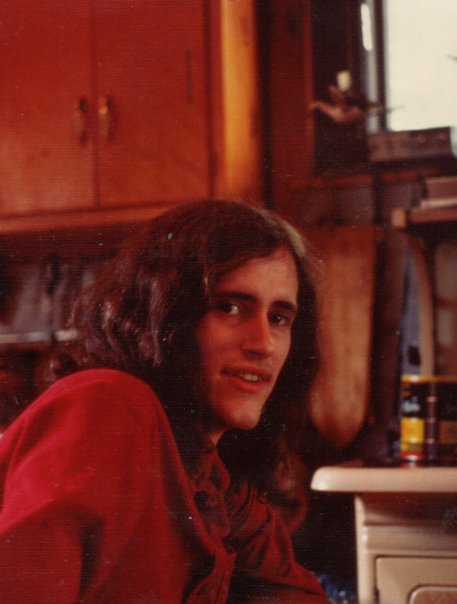
Jay knew from experience how important it is for writers to support other writers. He grew up in Claremont, N.H., with his twin brother, Jeff, and their younger brother, Mark, later spending time in Rhode Island after his parents split. The family was poor and dysfunctional, a circumstance that led the great novelist Russell Banks, who had a similar childhood, and his wife, Mary Gunst, to bring Jay into their home in 1970, when he was 16 or 17.
“Here he was embraced by some of the best up and coming young poets and novelists of his day,” according to an obit written by his friend, the poet and nature photographer Lindy Whiton. She added that in the fall of 1973, following his lengthy convalescence and still hardly able to walk, “Jay hitchhiked from the Banks’ house in Northwood to Marlboro College in Marlboro, Vermont, one afternoon and convinced the College to enroll him as a student.” He earned a degree in Religious Philosophy, but really just wanted to be a writer, his daughter Kelley recalled.
“I can’t explain how much this man changed my life. With a laugh, a handshake and a few kind words,” wrote Portland poet Nate Amadon, who started the Port Veritas series of readings and open mics during the next wave of live poetry in Portland. “I remember the moment I walked into the Skinny, the moment I met Jay Davis, the fear that hit me as I waited to take the stage and the love I felt when it was all over. Jay shaking my hand, told me ‘that was fucking amazing. Keep coming back.’”
“He was the rock, that started the ripple, that touched quite literally thousands of poets,” Amadon wrote last month.
Jay continued to give readings into the mid-2010s, and helped spread the poetry scene into places like Mama’s Crow Bar in the Munjoy Hill neighborhood, where he had an apartment. Like most of our friends from those good old days, my circumstances changed and I’d moved out of town by then. I rarely saw Jay, our social circle reduced to birthday wishes on Facebook and the like.
Jay and his first wife, Mimi, married in 1980 (they also had a son, Collin), but split up later that decade and shared custody, with Jay living in Sanford to be closer to the kids in Alfred. Money remained tight. Kelley recalled Jay saving pocket change in a ceramic piggy bank for a family trip to Disney World. When they finally got there, Jay saw the beautiful blue-lit fountains spouting so impossibly high and wept like child. He was a crier, Kelley said, a deeply sensitive soul.

Jay returned to New Hampshire in 2017 to live with his twin brother, and passed away there last month at the age of 72. A memorial gathering is being planned for this spring. In the meantime, pick up one of his chapbooks from Moon Pie Press, or check out a poetry open mic at Lincolns or Novel, or open that notebook you bought with the intention of writing some verse. As Jay proved, it’s never too late to start.
Writing It Down
I sat down to write a short story
about death. It was an autobiography,
and I kept writing it for so long
it wasn’t short anymore, and it wasn’t
even a story. This was a big problem!
So then, it occurred to me that
no one had ever written a 900 page
autobiographical epic poetic tragedy,
at least none that I had ever seen
or read, so I set about re-writing
the whole ludicrous novella in rhyming
heroic couplets. This was going to take
years, with so few active verbs that
rhyme with New Hampshire, divorce,
and methamphetamine. And I’m always
surrounded by distraction. My thesaurus
is dog-eared and broken-spined with trying
to tell me what all this history means.
And the history keeps happening; I can’t
write it down fast enough!
I don’t want anyone to read this work in progress,
but I want everyone to know I’m working on it.
It’s self-titled. It will be available only at
independent bookstores, or on 12-inch vinyl.
Millions of readers worldwide will ignore it.
Even the critics will fail to notice.
This would be a complete waste of time,
except that it’s built my vocabulary,
and I don’t know how to summon
the strength to stop its inertial roll.
My next book, I swear it, will be self-help.
A moneymaker. Letting Go & Just Gathering Moss.
I’ll know how it ends before I start writing it.
I’ve already written the conclusion.
It will end with “So there!”
From The Hard Way, 2006