Louise Philbrick
Age: 60
Hometown: Falmouth
Professions: Financial services analyst, artist
Bar of choice: Ruski’s Tavern
Drink of choice: Vodka Seltzer with a whisper of cran
“If you’re not a douchebag, you’re welcome at Ruski’s.”
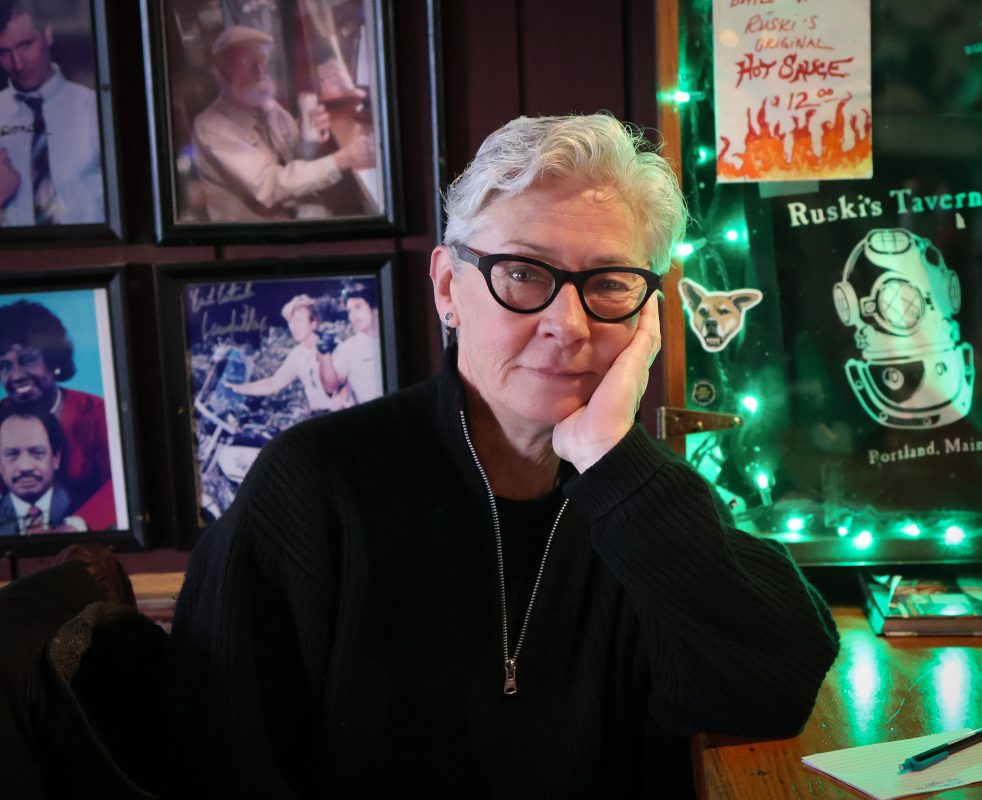
So says Griffin Meara, who’s been tending bar and serving tables at this cozy tavern in Portland’s West End for 20 years. A true “neighborhood bar,” Ruski’s serves big portions of unpretentious food, boozy beverages and friendly banter to bikers, bankers, mail carriers, cops, service industry workers, Maine Med nurses, night-shifters, retirees, and every other non-douchebag who walks in the door. Beer and Boston sports memorabilia crowds the walls alongside funky art and photos of national and local celebrities like the late Portland artist Bill Harrison, who was a regular [see “The Man Who Drew Too Much,” Feb. 2016]. The sassy staff is always ready with a wisecrack or a word of advice.
Inside this world, we found Ruski’s regular Louise Philbrick. It was a snowy Sunday morning, just past 8 a.m., and almost every bar stool was occupied.
“Louise is so good at making people feel welcome and comfortable while she’s here,” said Monica Whaley, a bartender who’s owned Ruski’s for two decades with her husband, Josh Whaley, who works in the kitchen. “We appreciate her because she’ll talk to anyone, even the people we don’t want to — ha!”
How long have you been coming to Ruski’s?
I lived on the corner of Park and Spring when I started coming here in 1990. I had my studio apartment in the basement of the building. I called it my “Jeffrey Dahmer” basement studio, where I could see people’s ankles going by! I would spend hours and hours in there, and then kind of go back into humanity by stoop-sitting — a big sport in Portland. I’d sit on my stoop watching people go by, and then, when I was sort of ready to engage, I would walk down here to Ruski’s. I’ve been coming here ever since.
What drew you to Ruski’s?
It was close and open at weird hours. The food is really good. I love breakfast for dinner, always have. Stiff drinks and the price was right. But it was the community in the end.
I come in with an index card and a pen, make my list, organize my thoughts. Typically, I come in and there’s a gang, and we catch up. I was single for a really long time, and I always felt safe here. Even before Whaley and Monica owned it, when Steve and Rosie [Harris] owned it, there were some really tough broads that worked here, and they had eyes on the back of their heads. I can come in and interact with people or do my own thing. I’ve gotten the entire place to sing “Happy Birthday” to I-don’t-know-how-many people, and everyone’s on board. I’ve come here for Thanksgiving. I’ve come here for my birthday. I’ve come here before funerals and after funerals. There’s a ton of history there and an intimacy to it that’s surprising and really lovely.
What do you order to eat?
Something called “The Louise” that’s not on the menu. It’s a bowl of chili with a poached egg and a side of guacamole. I always pay attention to the specials board, because that’s a [chef and kitchen manager] Greg [Arnold] thing. He cares a lot about what he’s making and the preparation of it.
Where are you from?
I grew up in Falmouth, moved away, went to boarding school and then never came back. My father grew up here [in Portland]. It’s funny, the thing that drove me away is the thing that brought me back. It’s probably true for life, you know, identity. I wanted to blaze my own trail, so I lived and worked in New York City. Then I lived in Connecticut and worked in New York City, and then the migration [home] began.
What did you do for work at the time?
I sold steel plates for bridge building and ship building applications. That was a pretty cool job. I did that for a long time. I have an affinity for language and speak French fluently, so the jobs that I ended up in were related to language, primarily. I can get by in Spanish. I speak some Swedish and Chinese. I can understand Italian.
I worked for a shipping company in Greenwich, Connecticut, that was owned by these two really quirky Swedes, and I was like a token American in the office. The important jobs were taken by Swedes and Norwegians, and I got sick of not understanding, so I was like, I’m gonna learn Swedish so I know what’s going on. It’s a funny language, and a lot like music. I knew I was making progress when they started shutting doors.
What brought you back to Maine?
I was married, and I moved back to Portland when I got divorced. I was like, If I got hit by a bus right now, what would my regrets be? So I went to USM for art school. I had always been in business, so it was kind of a lark. I didn’t want to do it to make a living, I just wanted to go. At the time, I worked for IDEX. It was in ’90 or ’91, just after they went public. I was taking night classes, and I missed like seven classes because of my job. And so I was like, Screw this. I matriculated and did an art program and loved it.
What kind of art did you make?
Mixed media. I used a lot of doomed instruments, like old pianos. It was super design-y; I’m very math-oriented. When you take it apart you can see how often the piano was played, or if somebody spilled something. I did a lot of welding when I was in school, and my landlord did not take kindly to the concept of oxy-acetylene tanks in the Jeffrey Dahmer basement. I worked a lot with lead and would stitch lead. I became known as “piano woman” in Portland.
Are you still making art?
I’m trying to get back into it. I’ve made “rage craft” because of the present administration. I’ve done a couple of commissions. I’ve been in my current job now for nine years, and I need to have more brain space to do more art. It’s time to get back into it.
Know an interesting bar regular? Send them our way at theregularsmaine@gmail.com.