Upper Narrows
Over the Prairie
Repeating Cloud
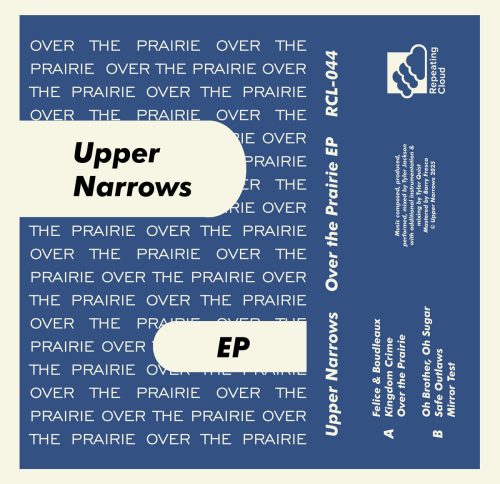
Upper Narrows is the synth-based solo project of Portland indie-rock bandleader Tyler Jackson, last heard here (with partner Dana Guth, of Little Oso) in the trippy trio Finger Food, whose debut EP won Maine Album of the Summer two months before the season even started. Accordingly, let’s call thisEP Album of the Autumn and see if anything comes along to challenge it for that meaningless title. Because in the U.S. of A., everything’s a contest for the biggest nothingburger.
Thus Over the Prairie, a collection of six songs mostly about selling out, getting sold out, and getting the hell out of the game. It begins, beautifully, with “Felice & Boudleaux,” a reference to the songwriting couple Felice and Diadorius Boudleaux Bryant, who rose from rural poverty by writing a long string of indelible country and pop hits in the ’50s and ’60s. The opening melody sounds like it should be grand entrance music brightly blasting from trumpets, but instead it’s a noticeably flat, fat and bloated synth tone, which tells you something right there. Then the beat drops, and suddenly you’re in a shimmering sonic dreamland of plinking xylophone notes and ticklish tickings, beguiled.
“Darling, don’t you know / Felice and Boudleaux / wrote songs of the soul / (‘All I Have to Do Is Dream’),” Jackson wistfully sings. “The property line twine / It trips you up, it’s true,” but affordable living awaits “in orbit .. over the copper hills” among “silvery swarms keeping you warm and still.” Color me floored by this song.
We’re back on this dirty planet with the next number, “Kingdom Crime,” signaled by a funky, earthy organ line courtesy of local keyboard sorcerer Tyler Quist, who also lent a hand with the mixing. “The zone takes care of its own / and they choke you on your own dime,” Jackson observes.
The title track is one of Jackson’s most ambitious songs to date (that date beginning about 17 years ago with the first Foam Castles releases and on into the groups Endless Jags and Golden Rules the Thumb). It’s a meditative, seemingly minimalist piece that, like nature, reveals its quiet wonders slowly, and sometimes, as here, eerily. A real achievement.

Side B of the cassette version (released by Portland label Repeating Cloud) starts with the poppy “Oh Brother, Oh Sugar,” in which the narrator resigns himself to selling his “soul” and becoming “a little troll / sweet talkin at the sugar shack.” “Safe Outlaws” breaks into a sick rock bass line, a club beat, and a sample from some cowboy show in a scene that calls, to my mind, young fans shivering outside the State Theatre, arguing about music (maybe I’ve just been spending too much time at DTL lately).
“Mirror Test” again tests Jackson’s songwriting chops — as he winkingly notes, Yoda-like, on this track, “pretension is strong in the song that goes on too long” — and proves, in over four minutes, that he’s onto the next level shit these days, composing pieces with perfect lyrical and musical command and restraint. “I really thought you should know / that reflecting sun just like snow / is usually worth the hassle / if you’re freezing in your castle,” he reassures us as we brace for the next Maine winter sans LIHEAP or sanity, though usually is a chilling word to toss in there.
“We’re not friends,” Jackson flatly states to start the second stanza, then asks, “What does it mean when you dream of finding money?” (After all, dreaming is all you have to do to attain your heart’s desire, right? That and a dollar, the lottery ads promise.) “Some of it is real,” Jackson hints, “buried in the soccer field.” (Go Hearts!) Meanwhile, “crooked mimes try to pay the chauffeur / when they’re feeling like the lazy loner.” Why must these crooked and lazy pretenders try to pay their driver now? Has money become meaningless as “the wind is barreling down their street”?
I think we might find answers to these questions some day real soon.