Portland’s most celebrated folksinger marks 25 years making outsider Gospel music
Look, I don’t want to excite or alarm anyone (especially any doomers in D.C. who believe The Book of Revelation is prophecy), but it’s quite possible the messiah has come again and is cleaning rooms at the Hyatt down in the Old Port.
Or, if not the messiah, at least a messiah or holy prophet sent here to drop divine knowledge upon us mortals. Just to be on the safe side, you may want to clean up your act, pronto. Like the bumperstickers say: “Jesus is Coming! Look Busy.”
Here’s my evidence:
Born of a saintly mother who commands the highest respect of her church? Check. This guy’s mom, Chilton Knudsen, was the Episcopal Bishop of Maine.
Attracts a dozen (or more) devoted disciples with simple and heartfelt messages of love and compassion? Check. Dan Knudsen — that’s his earthly name, pronounced with a hard K — is “Portland’s greatest musical storyteller,” said Grammy-winning songwriter and rock star Dave Gutter during a performance with Dan last month, to cite one of the many local musicians who’ve sung his praises and his songs.
Claims to be of divine origin and working to save this world on behalf of a higher power. Check. I’ll again cite one example of many, the chorus of “For The Church And The World,” from Dan’s 2019 album, Beyond The Grave: “I have prayed for the church and world / I was made for the church and the world / It’s in my body, mind and spirit.”
Single and childless. Check, though Dan’s trying hard to change that.
OK, so the evidence is a bit thin — no documented miracles, yet — but it’s a helluva lot more proof than we’ve got for the existence of that rabble-rouser from Galilee, and Dan offers the benefits of actually being here and trying to save us through his grace every day.
“The world has gone wild and things seem to be getting crazier all the time all across the U.S. and the globe,” Dan observed before playing his first song last month at Blue Portland Maine in a songwriters’ circle convened to celebrate his 25th year on the scene. “But there are lots of things we can all do, many steps that everybody can take, towards healing. And tonight we take one of those steps together, because I’m here.”
The sparse crowd, I among them, whooped and clapped.
“That’s what I’m here for,” Dan cheerily continued, “to bring joy back to the music community and the community in general, at large.” He took a long pause. The room was silent. Then he strummed a bright, slightly crunchy chord on his 12-string acoustic guitar. “Alright, let’s get this party started.” Silence. “Alright, here’s the title cut of my new album. It’s called ‘Ray of Hope.’”
Maybe miraculous is expecting too much. Would you settle for merely magical? I’ve got lots of those anecdotes, too.
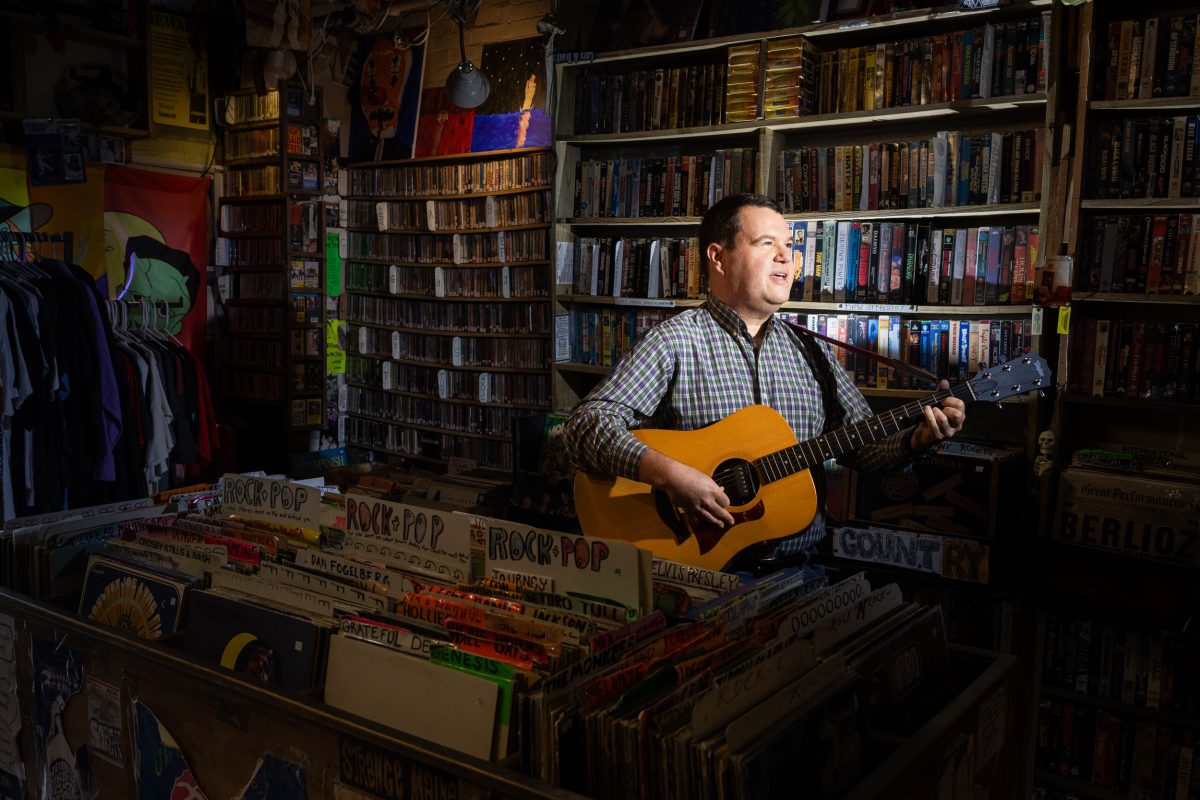
For example, the morning after Dan’s show at Blue, I interviewed him at a coffeeshop across the street and stopped into Strange Maine a couple hours later to interview proprietor Brendan Evans, who’s hosted scores of Dan’s shows in his second-hand music and video shop since the dawn of this millennium. Among the few newitems in stock at Strange Maine are the home-burned CDs with grainy photocopied covers that comprise Dan’s substantial discography.
“I sell Dan K. CDs that are fifteen, twenty years old to people who weren’t even born yet when they came out,” Evans told me from behind the cluttered counter. “There’s just not a lot of local musicians who still have that kind of broad appeal and timeless quality.”
“His songwriting isn’t challenging, and his lyrics are so simple and straightforward, but you can’t listen to one of his albums without your jaw dropping at some point, and you’re like, Whoa, didn’t expect that,” Evans continued. “He’s sort of like the resident outsider musician of Portland, but at the same time, I think there’s an aspect to his music that’s less challenging than outsider music usually is, that can appeal to a really broad range of people, and his sincerity comes through. That’s why his music works so well.”
A young woman who’d been browsing approached the counter. “Are you guys talking about Dan Knudsen?” she asked. Her name is Erin Ames. “I worked at Blue for a short stint, and I’d never heard of him before, ever, and at first he drove me nuts,” she told us. “I was like, Oh my God, he’s so annoying. And then I realized who he truly is.
“He reminded me almost of like the Kermit the Frog of Portland,” she continued, “because there’s something in him that we all want in ourselves, you know? And it made me cry, because I feel like we can all relate to him. He’s always making music, he’s always performing, he’s always putting his heart and soul [into it], and he’s just himself. He’s not trying to be anybody else. … He’s just living.
“Sorry,” Ames added, “I had to say something. I love Dan. He’s just a lovely soul and he’s free in himself, which — yeah, we all want to be a little bit free.”
Coincidence? Perhaps. But the time-stamped AI transcription of this interview proves that about 10 minutes later, in walked the man himself. Dan was on his way to work from his modest condo in Parkside, wearing his nice dark brown hotel uniform, his famous fanny pack (now a larger style he calls a “tactical converter pack”), and carrying a plastic bag containing a couple CDs with which to replenish the shop’s stock of his oeuvre, plus two Star Wars toys he hoped to sell, including a wampa action figure with blood on its chin, possibly hand-painted. Evans paid him for the CDs and gave him two fives for the toys. It was two days before Dan’s fifty-first birthday.
I’d been at his fiftieth, a daylong potluck supper at his place, and two other disciples were there when I made my appearance: the psychedelic sci-fi metal guitarist Glade Swope and Jason Lambert, who records catchy folk and oddball R&B as Suns So Far…. Dan played us a demo track from Ray of Hope, his ninth studio album — not counting two “Best Of” volumes (each featuring two previously unreleased bonus tracks), the 2006 full-band recording Live at Strange Maine,and two tribute albums also containing bonus material.
Swope, Lambert and Evans have all contributed songs to those tributes, as have local luminaries as diverse as Fogcutters big-band jazz vocalist Megan Jo Wilson, roots singer and guitarist Eric Bettencourt (recording as Giraffe Attack), punkers Mouth Washington and sound collagist id m theft able. Dominic Lavoie and Todd Hutchisen, who guests on pedal steel guitar and recorded Ray of Hope at Acadia Recording Company in Bayside, are among the nationally recognized Maine artists who’ve helped Dan spread his music to the world.
“The first thing I ever thought of when I saw Dan was, Oh my God, he reminds me of Daniel Johnston,” said poet Michelle Arcand, who hosted the weekly open mic at Dogfish Bar & Grille on Free Street in Portland for many years. “Somebody who’s so endearing. … It’s like these simple songs in some way, and yet they’re so emotional, so deep, you connect to them so well.”
“He’s not just a man and a musician, he’s sort of an institution in town, because to know him is to love him,” she added. “He’s unapologetically himself, always, and so you get it all, and there’s such beauty in the honesty of that. People aren’t that honest in the world, and it’s what kind of tears it apart, in my opinion, or breaks this world apart. To have that purity is a beautiful thing. … There’s an innocence to these songs, and you want to sing along, and he gets you going.”
No musical artist has performed in Portland more often this century than Dan; it’s not even close. In addition to perhaps 50 Strange Maine solo shows, we’re talking multiple open mic appearances every week for more than 25 years at venues including Granny’s Burritos, Free Street Taverna (his first appearance after moving here from the Chicago suburbs; it later became Dogfish), the Fine Arts Theatre (where I first saw him in ’99; now Geno’s), Acoustic Coffee/Goats Head Soup, Slainte, Empire Dine & Dance, Blue, RíRá and The Thirsty Pig.
Nowadays when Dan leaves a venue, his departure must be announced in kingly fashion — as in, The King of Rock and Roll: “Ladies and gentlemen, Dan Knudsen has left the building!” — whereupon he waves to those assembled and walks out the door to applause. Maine country-and-western star Joel Thetford hosted an open mic at The Thirsty Pig and was unaware of this tradition the first time Knudsen showed up. Dan set him straight. Thetford said that’s the only time he’s ever seen him angry.
And we’re not counting all the church events, private parties and bonfires Dan’s played around here. Among his followers, known as Danfans, Eliot Weaver is one of the most fervent. “I have so much love for Dan,” he said. “He’s one of the most genuinely good people I know. He has such an incredible intuition for songwriting. … He’s just spitting out gold all the time. He doesn’t really have any bad songs.”
Weaver recalled hanging out at a backyard barbecue years ago when someone mentioned Dan’s music. “You want some Dan Knudsen?” Weaver asked. “I can get you Dan Knudsen,” and he made a call. “Ten minutes later, he’s literally standing outside the gate,” Weaver told me. “Fifteen minutes later, he’s ready to perform.”
In the liner notes to the first tribute album, released at the end of 2007, writer and musician Rick Wormwood (who contributed a track with his band, The Rumbling Proletariat) listed 15 observations about Dan, such as “Dan would never hurt you” (a reference to his anti-domestic-violence anthem “I Won’t Hurt You”), “Dan wrote the best song ever about sharks” (“The Sharks Are Gone”) and “Dan writes songs of such innocence that it defeats the cynacism [sic] that otherwise discolors my own art and worldview, and I don’t think I am the only one that he gets to in that way.”
Wormwood further testified: “Nobody, and I mean nobody, works harder pushing their music than Dan Knudsen. Ten seconds after you meet him he’s trying to sell you a CD. If pimping had another name it might be Dan Knudsen, because Dan is all business, all the time.”
In addition to CDs, Dan has merch galore: t-shirts, posters, the “Love of Your Pets” coffee mug with a blurry snapshot of his late cat (from which I’m sipping as I write this), the reusable shopping bag promoting his sci-fi song “Mass of Slime.”
“He’s the best salesman I’ve ever met in my life,” said Arcand. She recalled the night when California folk-pop star Brett Dennen, in town to play a concert, stopped into Dogfish for a bite during the open mic and heard Dan’s mini-set. “He bought every CD,” Arcand said of Dennen. “Every single CD.”
“The Dan Knudsen juggernaut will not be stopped,” Wormwood predicted 18 years ago. “People ask me all the time. … A fevered populace with just one burning question on their minds, they come up to me and say, ‘Hey, Wormwood, you know Dan Knudsen, right? Let me ask you, what’s he keep in that fanny pack?’
“Well, you know what?” Wormwood continued. “I’ll tell you what he keeps in the fanny pack. The magic. That’s where Dan keeps the magic.”
In early 2007, Dan was interviewed for The Bollard by Blainor McGough, who subsequently founded Mayo Street Arts in Portland. That talk, with audio of Dan’s answers, has been reposted to our Substack (bollardhead.substack.com), along with links to past album reviews. Here’s the interview I did with Dan at Novel in downtown Portland last month.

Let’s talk about how you got your start here in the late 1990s.
It wasn’t until 2000, after I got a new day job that I was happy with, that I started recording my first album, Sun Song. … It was in October or November of ’99, and the first recording session I remember having for Sun Song with my dad [the late Mike Knudsen] was in his basement studio at his and my mom’s house in Bath, where they lived at the time. He had analog equipment, which was basically a four-track recorder and a couple of microphones. The first session I had was actually on Valentine’s Day, and that was when I recorded “Somewhere on the Sea.”
Did you move to Maine to be closer to your parents?
Yes. … I decided to move with them. Even though I wasn’t living with them, I wanted to stay living near them.
And also I like the beauty and quiet of the environment here. … I feel comfortable and safe here in this community because, especially, the majority of the people are not nuts.
I understand your dad was also involved in music.
Yes, he was a musician and a record collector. … But my favorite thing he did was compose piano rags, and that was touched upon in my song, “For a Ragtimer,” that I wrote for my dad, which is the closer on the Early For The Road album, which was my seventh studio album. It was from 2017, and so I wrote that song for him because music is in my blood.
One of the things that first struck me when I saw you performing at the Fine Arts was that a lot of hipsters in the audience didn’t seem to get where you were coming from. Some were rolling their eyes or snickering. What’s your impression of your early reception in this town?
That didn’t really matter to me at the time, because I was just doing my thing, you know, my style of music. And I remember you had said in the first article you wrote about me, that review of Sun Song in the Casco Bay Weekly,[that] if I knew I was out of place, I made no indication of it. Maybe I just didn’t realize it, because I didn’t care. I didn’t know what the other musicians and the members of the audiences and the venue owners and all of them considered to be their kind of music that they were expecting to have played at their venues. I didn’t know, I didn’t care. Because I guess I was destined to be an outsider from then on, and I have been ever since.
How do you explain the appeal of your music to so many other local musicians?
I guess I have my own style that’s like a genre within itself, because it is very purely and uniquely my own. And I have used elements of many of my favorite legendary music groups and artists among the big names, some of them folkies, some of them soft rockers, some of them rock-and-rollers, and some of them metalheads. There are elements of some of their works in my songs, and you can kind of hear echoes of them, because a lot of my songs were derivative of some of their songs. Because that’s the way a lot of modern music is now; it’s derivative of old music, and it’s really hard — in fact, almost impossible — to find anything new that’s completely original.
Also, my songwriting touches on such a wide variety of topics, lyrical themes [that] include the beauty of nature and the outdoors, and the friendship and romance of relationships, and being good to other living things — especially members of groups that are vulnerable and marginalized, such as women, children, animals, and now, on my latest album, it’s also the LGBTQ community and elderly and disabled folks.
It kind of started with my second album, Grass, Grain, & Appleseeds, when I begin to pivot my music and songwriting between simple folk and pop music philosophies to more difficult, complex, hot-button topics like my religious and political views, and social issues. And, of course, my usual science fiction/fantasy topics.
How do your songs make the world a better place?
Well, the thing I love about music in general, not just my own, is that it’s meant to bring people together, whereas politics and religion are more divisive, they divide people. So what I aim to do is get my music out and not cloud it with too much Democrat or Republican or whatever, but just a little bit of that. I don’t like to talk too much about religion and politics, because it drives people crazy … and gets in the way of getting things done.
What are your thoughts on the current state of the world?
I think things have gotten worse before they get better, which I believe they will. I’m pretty optimistic that will happen. I’m not having too much trouble with that. I mean, especially with certain issues, like climate change and global warming. It was like, thirty years ago, not as many people were doing as much about that as they are now. … This is a bad moment we’re living in, but it doesn’t have to be forever, and I don’t think it will be. I certainly don’t agree with a lot of things that are going on, but I believe that as a race, humans will survive. I really believe that. I have a lot of faith in mankind, that we will overcome and adapt, whatever it is. … We have a lot of smart people in the world that will make good stuff out of bad.
Why did you decide to release Ray of Hope now?
What scares me right now is how people are more vulnerable now, especially those in marginalized groups, and they’re being targeted more, and they’re more likely to become victims of acts of hate, crime and violence, and that has no place in this country or the world, I don’t believe. For a long time I thought that society had become much more loving and accepting and forgiving, and now it’s like we’ve been set back from that. You know, I thought we had that covered, but the hate is coming back.
Is religion still a big part of your life?
Yeah, because I still continue to attend the same church to this day that I began attending when I first moved here. Since I was brought up in the church, I still have my deep respect for that. That’s not lost on me, and that hasn’t been dimmed by time by any means.

Roughly how big is your fan club these days?
I suppose it may be from hundreds to thousands, like several hundreds to several thousands. I know it’s not millions of people, because part of the outsider musician mythology requires that you write songs that become unacknowledged masterpieces over the years. You don’t write songs that millions of people like and buy, because that’s not part of the sentimental picture, regardless of how comfortably the music sits within the genre’s parameters.
Have you ever been interested in trying to get a record contract?
No, because that never mattered to me. People who are into that pursuit, pursuing a recording contract, those were never my people. And since my stuff is so unique. As you said in your review article of Beaches and Zoos back in 2005, me as a songwriter and musician, and my material, are “impervious to the pernicious influence of popular musical taste.” You’ve explained that yourself, and I’ve always been in agreement with you on that. There’s just no market in the corporate mainstream for my stuff, like on corporate radio. Also … I’m very disillusioned by these idiots who make up the majority of the big names and what they call music today. And also, having a regular, normal job by day and making music by night, getting the best of both of those worlds is just too darn fun.
I recall you worked for years at the YMCA in Parkside. What was that experience like?
I was really happy with it during the first couple years. … It wasn’t until the early 2000s rolled around, like after the 9/11 attacks, that things started to get kind of crazy. And then when the mid-to-late 2000s rolled around, I was happy again, just about as much as I was during the first two years that I worked there.
But then during the last couple years I was there, there was a fire that started on the sidelines that I noticed, and I had to walk away — or at least I should have, before it consumed me. Because sometimes our dreams of a lifetime become unbearable once the cost becomes too high, and it was like the longest-running job I worked that was low-paying, high stress, and very taxing and lacking in compliments and thanks and praise from the management. But I stuck it out for fifteen years because there really wasn’t much else at the time.
I think I’m at a point in my life where I have the freedom to choose jobs that I feel hold more meaning and purpose for me. But after fifteen years of service at the Y, back in 2014, there was a big corporate sweep going on upstairs, and they had to trim the fat. So they let me and a lot of other people go near the end of that year, and it was at Christmastime that I got cut.
Even though my album Early For The Road touches on all this with songs that deal with my professional angst, like the title track and “Clock of Cloudiness,” some of the energy from my previous album, Beyond The Grave, emanated from the anger and frustration and stress that I was dealing with working at the Y.
During those years — especially back in the 2000s and the early 2010s — that was a very stressful time for me. I was doing constant micro-touring around Portland, being a regular mainstay at some of those open mics I mentioned and playing every single week and hardly ever missing one of the shows. I was also drinking more back then. I was eating excessively and partying kind of hard, because I felt during those years that in order to be authentic, you had to live that kind of lifestyle, when the real truth is, that I know now, if you keep it up for too long, all you’re gonna end up is sloppy or dead.
Now you’re working at the Hyatt Place in the Old Port. Must be quite a contrast to the scene at the Y.
I would say yes, because I believe there’s more happiness and positivity in the hotel environment. It’s higher end, and the Y has all these people that are struggling, and I struggled with them at the time I was working there. I definitely don’t miss those younger, wilder days, because my life is so much better now. It’s improved, and I’ve become a better man. Within a few years I’m going to be ready for house ownership and for finding romantic love and getting married and settled down to a family life, and also car ownership, because things keep getting better.
I don’t fear the future, because I have those goals, which are really not goals — they’re actually wishes for right now, because I don’t have any specific plans in place for them just yet. A goal without a specific plan is what we call a wish, yeah? But I call them wishes and I call them hopes, as well as dreams and visions. As I say in that line in my new song, “Ray of Hope,” we should still continue to hold onto those, even though things are getting crazier all the time, all across the U.S. and the world.
It’s a scary, weird time we’re living in, but as I said, there are things we can all do and steps we can take, lots of them, towards healing. And whenever I do a show, that’s when we take one of those steps together towards the healing process, so we can heal ourselves and each other and the world. And I believe that God will help us do that, and that He’s gonna heal the world. I just like to keep that hope alive, as I express in that song, in this world that appears to be going down, just falling … getting dragged down. We want to keep a state of optimism. Of course, not everybody’s gonna share my optimistic appraisal of the situation, but I’m hoping that many people still will.
In your view of life, is there a devil at play?
Yes, I believe that is a factor. In my philosophy class in the college program I enrolled in … what I learned is that this earth is the physical body world where we’re here to go on, like, soul searches, and that involves getting our butts kicked. I believe that’s what’s happening right now. The things that are going on in the world today? God is letting them happen because he wants to teach us to be kinder and more compassionate and caring towards one another and the natural world. That’s what comes out in my songwriting. So we’re getting our butts kicked because we’re on a soul search, and it’s God and, you know, the other guy, the devil.
What are some of your favorite songs that you’ve written?
That’s a great question, and here are some great answers. … I would say those are “Sun Song,” “Rain Falls Outside My Window,” “Heart of Country and Western,” “Ministers of Faith,” “I Won’t Hurt You,” “Lost Airways,” “What Were You Doing?” — which is one of the bonus tracks from my second tribute album — and finally, “Early For The Road.”
I know one of the crowds’ favorites, and one of my favorites as well, is “Can’t Stop The Cops” [a bonus track from the first tribute album].
I don’t even remember the last time I sang that song, and I don’t really do that one much anymore, and I haven’t in years, I don’t think, because I can’t really feel for it anymore, because it’s lost some of its relevance. It hasn’t aged well, because the police forces have become a broken system that are in need of reformation. There’s a lot of corruption and a lot of distrust in that department of government, and the government in general, different areas of it.
You’re still single these days?
Yes, my current social status is still listed as single and childless, but I am currently reading a book that’s like a handbook or a guidebook that was written by my friend Sue Vittner, who has had experience as a life and love coach, that type of professional, and she’s also a massage therapist by day and an artist by night, visual artist. She wrote this book called From Your Vision Board to Your Bedroom, and it talks about how to use the laws of attraction to find your ideal romantic partner and true lover and mate. It gave me some good ideas as to why I haven’t found that special someone yet, so I know why that is, and it’s because my life is still considerably unbalanced and I’m not fully satisfied with my life. There are some areas that I feel pretty good about and others I don’t, that need work and, you know, some cleaning up — not just my bedroom, but myself and my life — and so I’m working on that using that source.
Outside of music and work, what are your hobbies and interests?
I’m a lifelong health and fitness fanatic, and after my father passed away, I just began to adopt a more disciplined wellness regimen. So I like to spend time in the gym and outdoors, doing a lot of walking and some running. I will jog, but I just do a little bit of that, and I’m trying to consume less alcohol, less meat, fewer carbs, and follow tips along those lines, because I don’t want to deal with my stress by drinking heavily or eating excessively or partying hard. Like I explained earlier, we went through that. And because I want to have more focus and more discipline and more self-respect. I believe that musicians sound better when they’re sober and healthy and fit and lean and all this and that, because that way they can rock harder than ever.
Dan Knudsen’s music is available at Strange Maine in downtown Portland, Portland-area Bull Moose stores, and online at danknudsen.bandcamp.com.