Press Herald union workers finally reach out to underpaid comrades
Long known as Maine’s highest-paid and best-organized daily newspaper crew, unionized workers at the Portland Press Herald recently invited their poorly paid comrades at sister publications throughout the sprawling Maine Trust for Local News empire to join them before beginning contract talks this fall.
The union, formally known as the News Guild of Maine, made the announcement on Aug. 19, saying its expansion plan would add 49 new members to their local shop, which already represents roughly 150 newsroom, design and distribution workers at the Press Herald and the Morning Sentinel in Waterville.
The Guild’s expansion plans mark the first time the union has reached out to workers at other papers since Maine media and mail-marketing mogul Reade Brower began amassing the news conglomerate almost a decade ago. Brower sold his four daily and 17 weekly papers to the Local News Trust in 2023.
“When Brower purchased the Press Herald in 2015, he threw away our union contract, so we had to focus on rebuilding our own union rather than expansion,” Tom Bell, a former Press Herald reporter, and the Guild’s president at the time, told me. “It makes a lot of sense for the workers, and also the company, for the newsrooms in all the publications to be represented by one union. It will reduce friction among the staff of the publications, increase efficiency and boost morale.”
Workers now invited to join the Guild include non-union folks at The Times Record in Brunswick, the weekly Advertiser Democrat in Norway, and the Sun Journal in Lewiston — as well as previously unionized workers at the Kennebec Journal in Augusta, who currently belong to a separate national News Guild local.
Union journalists at the Bangor Daily News, which is not owned by the Trust, as well as workers at Dale Rand Printing in Portland, are represented by separate bargaining units within the News Guild of Maine. Union printers at the Press Herald’s South Portland facility are represented by the International Brotherhood of Teamsters union.
The Guild isn’t expanding just to be more inclusive. Union power is based on strength in numbers and workers bargaining with one voice. With everyone on board, the Guild hopes to have a beefier position as contract talks get going this fall. This is especially true after the latest round of layoffs, in March, which eliminated 50 union jobs at the Press Herald in print production, distribution and advertising.
Also, news content is shared among all Trust publications, which means photos and stories produced by employees with widely disparate paychecks are given equal play, appearing side by side. That begs the question: If the Trust can get content cheaper from its smaller publications, why would it take care of its more well-paid workers at bigger ones, like the Press Herald? This gives unionized workers at the Herald added incentive to offer Guild membership — and the raises they hope will result — to their colleagues at smaller publications.
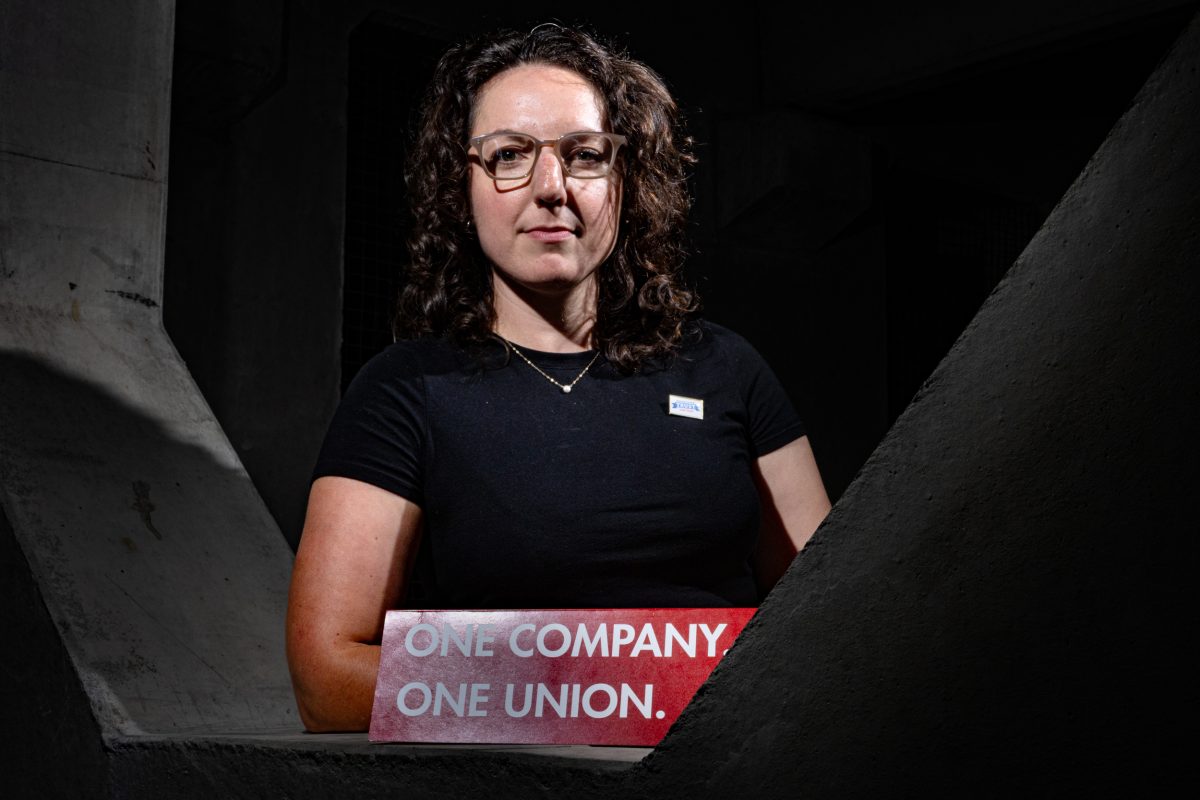
“Of course, we’re all stronger together. That is the whole idea of a union,” said Megan Gray, current president of the News Guild of Maine. “But if we want to talk about this in terms of wages, it’s also about protecting the value of our work. If the Press Herald pays me $56,000 a year but can pay someone else $35,000 a year to do a similar job, then they’re saying that this is what we think your journalism is worth — and that pisses me off.”
Starting pay for a reporter at the Press Herald is $28.75 per hour. Meanwhile, Paul Bagnall, a journalist with nearly a decade of experience, gets just $18 per hour at Brunswick’s Times Record. Yet his work appears right next to Gray’s on the Press Herald’s website.
According to a Massachusetts Institute of Technology online calculator, Bagnall falls well short of the minimum $23.22 per hour living wage threshold for Maine. Now 34, Bagnall covers Bath and Freeport for The Times Record, but said can’t afford to live in either town. He’s currently calling Lewiston home, where his parents help him make ends meet.
“I really hate that,” Bagnall said. “I would like to pay for everything myself.”
Bagnall used to cover parts of Aroostook County for the Bangor Daily News and was involved in a successful union drive there in 2022 (as was I; see the June 2025 Rise of the Locals for that story). He eventually becoming a shop steward (as did I), but the BDN laid him off last year anyway (they laid me off last February). Bagnall remains committed to the cause.
“I know what unions are and I know what unions represent,” he said. “I know they advocate for better workplaces, not just pay and benefits, but also employee retention.”

That’s a key issue. According to the Guild, lower-paid journalists like Bagnall are seen by management as expendable, and no effort is made to keep them for more than a year or two. That’s bad for both employees and local journalism.
“It’s impossible to have any rapport with the local community if the reporter gets changed out every six months to a year,” Bagnall said. “I’d like my job to be a destination and not just a stepping stone.”
Gray agrees. “The whole stated goal of the Maine Trust for Local News is to sustain local journalism,” she said. “That means paying people a sustainable wage, making it sustainable to do this work.”
The Guild was established as an affiliate of the Congress of Industrial Organizations on July 6, 1937. That was 16 years after the Press Herald was formed through a merger with the Portland Daily Press.
Since then, the union has only gone out on strike once, in 1953. That year, 100 workers from the editorial, maintenance, proof-reading department and mailroom walked the picket line. The Guild’s current contract forbids striking.
Stephanie Manning, publisher and managing director at the Maine Trust for Local News, said the Guild’s expansion demands came as no surprise. “We expected that it would happen eventually,” Manning said. “And frankly, we hoped that it would. It’ll be a lot easier to manage one organized [Guild] group, plus our Teamsters. That’ll be beneficial for the company and beneficial for the employees.”
That said, Manning and the management team have refused to voluntarily recognize the new union structure, thus making the Guild go through a monthlong, National Labor Relations Board-supervised vote among the 49 non-union employees.
“We believe in the democratic process,” Manning said. “I just wanted our employees to have the opportunity to make sure their voices were heard.”
The vote, done by mail, should be completed by the end of September. Though it’s another hurdle to get over before negotiations can truly begin to replace a contract that runs out at the end of this year, Gray isn’t worried. She said more than 70 percent of eligible employees had already signed union cards as of Aug. 19. Still, they’ll have to formally vote.
“As usual,” Gray observed, “people in the union have to do all the work.”