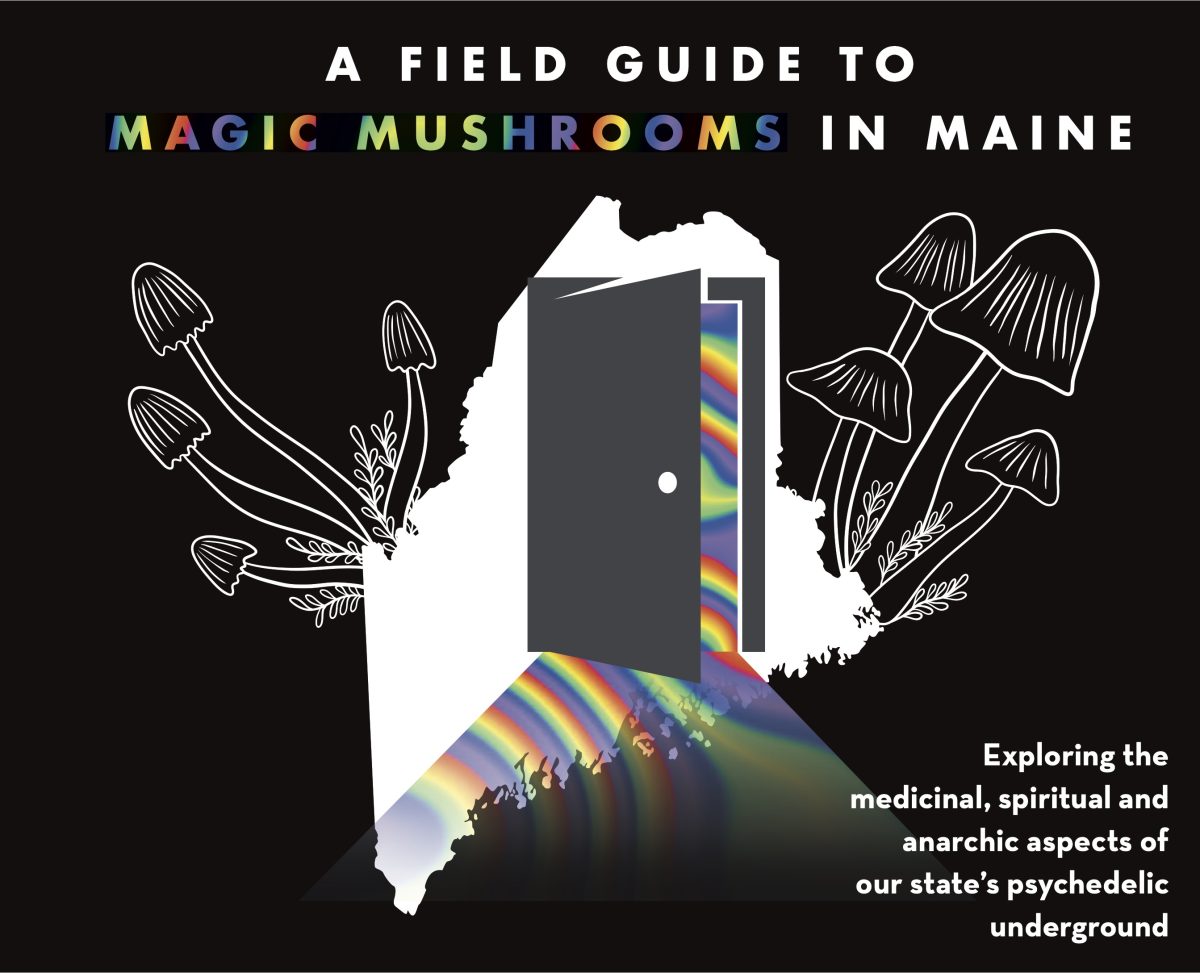
illustration/Nathan Galvez
One hundred and eleven summers ago, a man foraging for food in Oxford County had an extremely curious experience after he and his niece ate about a pound of mushrooms — wild fungi he’d identified as belonging to the genus Panaeolus — for noontime dinner, fried in butter. His account, dictated to A.E. Verrill of Yale University about a week after the event (anonymously, at the forager’s request), was published in the Discussion and Correspondence section of the Sept. 18, 1914, issue of Science under the heading, “A Recent Case of Mushroom Intoxication.”
Mr. W. is described by Verrill as a “middle-aged, vigorous man, strictly temperate in his habits” and “a good botanist,” who’d “made a special study of fungi.”
“Noticed first that I could not collect my thoughts easily, when addressed, nor answer readily,” Mr. W. recounted. “Could not will to arise promptly. Walked a short distance; the time was short, but seemed long drawn out…”
His niece by marriage, Mrs. Y., “was in about the same condition,” but soon Mr. W.’s brain fog lifted “and things began to seem funny, rather like intoxication.” He and Mrs. Y.’s father, Mr. Y., who’d eaten no mushrooms, took a walk outside, whereupon Mr. W. was astonished to observe how a “field of redtop grass seemed to be in horizontal stripes of bright red and green, and a peculiar green haze spread itself over all the landscape.”
Mrs. Y., at this stage, “saw nearly everything green … and the tips of her fingers seemed to be like the heads of snakes.”
About half an hour after their mushroom meal, Mr. W. and his niece “had an irresistible impulse to run and jump, which we did freely,” he told Verrill. “Soon both of us became very hilarious, with an irresistible impulse to laugh and joke immoderately, and almost hysterically at times.” Mr. Y. “said that some of the jokes were successful; others not so, but I can not remember what they were about.”
Returning to the house, Mr. W. said he “noticed that the irregular figures on the wall-paper seemed to have creepy and crawling motions, contracting and expanding continually, though not changing their forms; finally they began to project from the wall and grew out toward me from it with uncanny motions.
“About this time I noticed a bouquet of large red roses, all of one kind, on the table and another on the secretary [desk],” he continued, “then at once the room seemed to become filled with roses of various red colors and of all sizes, in great bunches, wreathes and chains, and with regular banks of them, all around me, but mixed with some green foliage, as in the real bouquets. This beautiful illusion lasted only a short time.”
Mr. W. then felt a “rush of blood” to his head, along with “marked congestion,” prompting him to lay down. “I then had a very disagreeable illusion,” he told the Yale man a week and a half before the start of World War I.
“Innumerable human faces, of all sorts and sizes, but all hideous, seemed to fill the room and to extend off in multitudes to interminable distances, while many were close to me on all sides. They were all grimacing rapidly and horribly and undergoing contortions, all the time growing more and more hideous. Some were upside down.” The faces were colored red, purple, green and yellow with a flaming intensity Mr. W. likened to fireworks. He sent for the local doctor.
This illusion also subsided, though objects in the room continued to display “far more intense or vivid colors than natural.” Standing up, Mr. W. had “the unpleasant sensation of having my body elongate upward to the ceiling, which receding, I grew far up, like Jack’s bean-stalk, but retained my natural thickness. Collapsed suddenly to my natural height.”
Noticing the parlor organ, Mr. W. attempted to play it, curious to “see the effect,” but said he “could not concentrate my mind nor manage my fingers,” which later appeared “small, emaciated, shrunken and bony, like those of a mummy” while he lay awaiting the doctor. By contrast, Mrs. Y. said her hands and arms “seemed to grow unnaturally large” during this stage of their trip.
Mr. W. subsequently had the impression that he could discern the thoughts of Mr. and Mrs. Y., and another “very hilarious phase” followed before the effects gradually diminished, having lasted about six hours. He reported “no ill effects … no headache, nor any disturbance of the digestion” afterward.
•••
Mr. W.’s narrative is one of the very first and very few accounts of a psilocybin experience published in English prior to the mid-20th century. It seems not to have sparked much interest among the public nor scrutiny by authorities, despite the fact Verrill compared the mushrooms’ effects to those of hashish, opium, and “the symptoms described by Dr. Weir Mitchell, when he took Mexican mescal pills, as an experiment.”
Psilocybin entered the wider American consciousness only after Life magazine published a photo essay in 1957, “Seeking the Magic Mushroom,” by amateur mycologist Robert Gordon Wasson. Its popularity during the countercultural revolution of the following decade — along with the earlier discovery of LSD, which Wasson also helped facilitate — prompted a global government crackdown that continues to this day.
The Controlled Substances Act, signed by President Richard Nixon in 1970 to launch of the modern War on Drugs, made the naturally occurring compound a Schedule I drug, like heroin and marijuana, considered unsafe for use even under medical supervision. Since Nixon, personal-use psilocybin possession has been punishable by up to a year in federal prison, even for a first offense.
In Maine, psilocybin is a Schedule X drug — a classification that also includes the psychedelics ibogaine, DMT, mescaline and ketamine. Mushroom possession remains a Class D crime in Maine that carries up to a year in jail and thousands of dollars in fines; sharing or selling mushrooms is called furnishing or traffickingillegal drugs in Maine and may be prosecuted as a felony.
As with marijuana, the growing gap between the public’s understanding of psilocybin’s many benefits and minimal risk, and the government’s intolerance for mind-altering fungi, is compelling lawmakers in some states and cities to call a truce in their war on mushrooms. Citizen-led ballot campaigns created legal pathways to psilocybin use in Oregon and Colorado earlier this decade, and New Mexico’s lawmakers joined them this spring.
Maine’s Legislature voted to decriminalize adult possession of less than an ounce of certain psychedelic fungal species earlier this year, but the bill failed after a second vote on an amended version. The push to legalize or decriminalize psychedelics is expected to resume at the State House, perhaps as a citizen-initiated ballot measure like the one that first legalized medical marijuana here in 1999.
In 2023, Portland’s City Council directed its police department to deprioritize enforcement of laws against possession of plants and fungi with psychoactive properties, including psilocybin, ayahuasca and ibogaine, but the measure “didn’t really have any teeth,” noted Aaron Parker, interim director of the grassroots group Decriminalize Maine, because it was merely a recommendation, not a law or policy change. Still, over 20 other U.S. cities (including eight in Massachusetts) have taken similar stances.
Meanwhile, mounting evidence of psychedelics’ healing properties is making Maine’s criminalization of psilocybin and similar natural medicines look increasingly senseless and cruel. Paired with professional therapy and guidance, psychedelics have shown huge promise in the treatment of PTSD, anxiety, depression, obsessive-compulsive and substance-use disorders, and chronic pain, as well as the comfort of patients and families grappling with terminal illness.
In June, Texas Gov. Greg Abbott signed a bill to start clinical trials of ibogaine’s effectiveness against drug addiction. Last month, the Food and Drug Administration green-lighted a clinical trial examining psilocybin’s effectiveness as a treatment for veterans and first-responders simultaneously suffering from PTDS and alcoholism. And Health Secretary Robert F. Kennedy Jr. told Congress this summer that efforts to approve psychedelic therapies are being fast-tracked by the Trump administration.
In popular culture, books and documentaries like science writer and professor Michael Pollan’s How to Change Your Mind have helped give psychedelic healing mainstream credibility. The practice of microdosing mushrooms — regularly ingesting psilocybin in amounts too small to induce hallucinations — has also made them seem much less scary.
Psychedelics have never before been so widely appreciated and accepted in this country, yet they remain as verboten as meth.
During testimony on the mushroom-decriminalization bill this spring, Maine Drug Enforcement Agency Commander Scott Pelletier said his force is focused on busting fentanyl, methamphetamine and cocaine traffickers, not magic-mushroom cultivators or suppliers, though MDEA agents may charge people they encounter with a Class X drug violation if mushrooms are incidentally discovered.
Republican State Rep. Robert Nutting, a retired pharmacist, expressed “compassion” for people helped by psilocybin, and added, “I also feel some comfort knowing that, evidently, the police are not running around stopping people from using psilocybin for their own personal use.”
So, in Maine, the possession, sale or sharing of psilocybin by adults is not a crime actively investigated by law enforcement, but it’s still a crime. Within this legal gray area, a gray market in psychedelics has emerged and is growing all over the state.
I recently explored some of this territory, connecting with local psilocybin advocates, providers and therapists whose work, also like mushrooms’, still mostly takes place underground.
The Fungi Festival
As last May turned to June, hundreds of mushroom foragers, growers, professional therapists, psychedelic guides, alternative healers, artists, writers and fungi-curious newcomers gathered at St. Joseph’s College, in Standish, for Maine’s fourth annual Fungi Festival. Psychedelic varieties were not the focus, but they did neatly link the festival’s official promotion of “All Things Fungi, Plant Based Healing & Evolving Consciousness.”
On Friday, before the festivities reached full swing, several of Maine’s most active and public-facing psilocybin advocates formed a discussion circle in Xavier Hall, a historic stucco building overlooking Sebago Lake. Festival organizer Jonathan Leavitt quieted the chatter of familiar acquaintances. “We need to put ourselves out there,” he declared. “We need to be public.”
The decriminalization bill hadn’t yet met its fate, but Leavitt urged the group to look beyond that. “We need to envision how we are going to move plant medicines forward in Maine and the Northeast. How are we going to collectively channel our energy?”
Outside the hall’s heavy wooden doors, mushroom vendors and organizations were filling the campus courtyard with pop-up shade canopies, organizing their wares and free samples. Amid the earthy artisanal booths, many tablers promoted psilocybin, including two mushroom-centric churches, a veterans’ group, and spore and substrate suppliers. Educational materials about microdosing were tucked behind Lion’s Mane tinctures and Reishi teas.
Donna Gareis offered me a warm Dixie cup of microdose tea at her church’s pop-up tent. “The mushroom helps us reconnect with our inner healer,” she told me. “That’s how we used to survive, was by listening to our inner healer, but we have kind of lost touch with that in modern life.”
Gareis, who has a background in law and biology, created the Church of Our Earth under a legally defensible religious framework. She shows confidence in wry humor: “My parents still call me a drug dealer,” she cracked. In her church’s practice, a microdose can range from non-perceptible amounts to a gram (one fifth of a full dose), which most people will feel.
During the early days of the COVID-19 pandemic, Gareis served as a psilocybin caregiver, providing mushrooms to patients referred to her by physicians and nurses. “I was loving seeing what it was doing for everybody, but I was also really worried about the legality,” she said.
Gareis, who’s also a trained death doula and hospice volunteer, was especially concerned for her older patients, some of whom were taking psilocybin to help with end-of-life transitions. “Nobody needs to be harassed by the government when they’re in their seventies,” she said.
Three years ago, Gareis met a female faith leader in Massachusetts who incorporated toad venom (active ingredient: DMT) into religious sacraments, and thereafter she saw her caregiving in a new light. “I noticed that some people who were coming to me for anxiety [or] depression would then come to me and be like, ‘I feel like I’m connecting with God,’ and others would be like, ‘I feel like I’m connecting with something bigger than myself.’ I was like, Wait a minute, maybe this is it — this is actually a spiritual movement.
Church of Our Earth members meet on special days designated in the pagan Wheel of the Year calendar to talk about their microdosing journeys and discuss the latest scientific research on psilocybin. Other microdosing church activities include yoga, hiking and summer bonfires. “That’s my hippie jam,” Gareis said of these group events.
“Our inner healer tells us the stuff we need to do, and a lot times we don’t hear it because it’s hard work,” said Gareis. “But the mushroom gives you the power and the energy and friendship to walk a path with it and figure out how to get to a better place.”
“We have lots of informal services planned throughout the summer, and I’m always happy to chat with anyone, especially about incorporating supportive plant allies into end-of-life transitions,” Gareis told me. Church of Our Earth accepts new members and can be found online (churchofourearth.com). Gareis hopes to open a space for the congregation in downtown Portland sometime this year.

Medical microdosing
C.J. Spotswood, a psychiatric nurse practitioner certified in psychedelic-assisted therapies and research, is a reliable intermediary between the psychedelic world, professional medicine, and lawmakers. I met with him this spring after he’d finished a long day of lobbying in Augusta.
Spotswood does not prescribe psilocybin to patients, but he does help educate people about it. “I come from a harm-reduction model,” he said. “If someone is going to go do this on their own, I want them doing it safely.”
Toward that end, Spotswood wrote The Microdosing Guidebook in 2022. Subtitled, “A Step-by-Step Manual to Improve Your Physical and Mental Health Through Psychedelic Medicine,” the book has sections for patients and providers, workbook pages and an extensive list of references. He also recommends the Multidisciplinary Association for Psychedelic Studies’ (MAPS) website (maps.org) as a starting point.
Spotswood has a calm, professional, family-doctor demeanor that helps dissolve the stigma surrounding psychedelics. But on the topic of microdosing’s benefits, he becomes visibly animated with excitement.
A woman suffering from dementia had sold her home and all her possessions to pay for nursing home care. “She expected to then go to this nursing home and die,” Spotswood recalled. “She started microdosing, and within a couple of weeks she made a full recovery.” The last Spotswood heard of her whereabouts, she was on a backpacking trip across Europe — “by herself!” he exclaimed.
“Another example,” Spotswood added without pause: a man who lost use of the left side of his body after suffering a stroke. “He ended up going through standard treatment, doing all the medications, the PT,” said Spotswood, and after a year of this, his medical team said there would be no further improvement. “His wife didn’t like that answer, and neither did he. … He started microdosing, and within a couple of weeks he regains full use of that side of his body.”
In another case, a woman suffering from PTSD and chronic pain was able to get herself off opioids through microdosing and is now pain-free.
Spotswood is weary of the argument, heard during debate at the State House this year, that “more research is needed.” Many of the conditions he’s seen microdosing cure or help people manage have no FDA-approved trials in the works, including burning mouth syndrome, chronic regional pain syndrome, dementia, and stroke recovery.
“It takes forever to get the FDA to do anything,” he said. “Veterans die [by suicide] every day. We have all these other health-care needs, and many people are not getting the help they need. Why wait?”
Veterans of the Psychic Wars
Lena Ramsay was an addiction therapist with a healthy skepticism about tripping. “I was always under the mindset that mushrooms and psychedelics were something that had an adverse effect on you, and I was very much not open to that for many years,” she told me via Zoom from her home somewhere deep in the Maine woods.
Then she made a late-career shift to serve with our military police in Afghanistan. “After a horrible deployment in a combat zone, I did not see life outside of that,” Ramsay said. “I had a TBI [traumatic brain injury], a broken back and broken ankle.”
“I went through two years of being in VA medical services and they had thrown every different kind of medication at me — opioids, Adderall to stay awake, Valium to calm down — and I was starting to experience really bad seizures with all the medication I was on.”
Feeling desperate, Ramsay allowed a trusted friend to help enroll her in a three-day retreat involving ayahuasca, a plant originating in the Amazon that, like psilocybin, is a naturally occurring tryptamine-based psychedelic. (Ethnobotanist Terrence McKenna called psilocybin and ayahuasca “entrances into sentient intelligence,” their difference being “in tone but not in truth.”)
As is commonly recommended before embarking on an ayahuasca retreat, Ramsay first weaned herself off all her medications. “Day one was miserable,” she recalled. “Day two was even more miserable. And day three — I felt like I had never felt before. … I felt a sense of relief, like, Wow, this is a dramatic change. My emotions — regulating them, PTSD, life being doable again.”
The retreat was an example of Psychedelic Assisted Therapy (PAT), which combines the use of psychedelics with structured psychotherapy before and after the journeys. Experienced practitioners know psychedelics don’t numb physical or emotional pain. Instead, they expose the mind to aspects of the self and the universe that our survival-oriented brains don’t normally perceive during waking hours. Healing happens through confrontation, not escape, and can be challenging.
Ramsay continued to work with ayahuasca and followed the retreat with a psilocybin microdosing regimen. “Psilocybin is not a magic pill. Neither are any of these psychedelics,” she stressed. “You need that therapy component with it. You need a network of support, and you need people that have been through it.”
Ramsay felt blessed with her recovery, but realized psychedelic medicines were not accessible to most vets. So she went public with her story and founded the Facebook group Veterans Psychedelic Network in 2021.
“My goal primarily has been just in educating the public, getting veterans together to tell their stories of healing, broadly, when it comes to the psychedelic movement,” she said. “There’s a lot of people talking about psychedelics, but you don’t often hear from veterans. … I want to make sure we’re part of this conversation. We’ve got real stories, real healing, and people need to hear that.”
Psychedelic-allied organizations like Ramsay’s are routinely censored by social-media companies; she said her Facebook pages and Instagram posts have been taken down on multiple occasions. Websites like MAPS’ are better sources of reliable information than social-media platforms anyway, she added. (Meta, which owns Facebook and Instagram, apparently doesn’t hold their paid advertisers to the same standards; out-of-state companies selling mail-order psychedelic mushroom products began popping up in my feeds during research for this story.)
Yeshua Adonai is a U.S. Marine combat veteran and former U.S. Department of State diplomat. After a life-altering spiritual experience in Berlin in 2007, he committed himself to the path of “healing, transformation and sacred service.” He now works in Maine as a psychedelic guide and transformational coach, but does not supply prohibited substances.
Many of Adonai’s clients engage in deep, ongoing support for several months or even years. He also provides a free Ceremony Readiness Guide through his website (aboutyeshua.com), and posts daily on social media about harm reduction, safe and responsible use, and the ethical and spiritual dimensions of psychedelic practice.
In addition, Adonai hosts monthly educational events at the downtown Portland shop Botanically Curious and other venues, and is actively involved in psychedelic policy reform and advocacy at the federal, state and local levels — “working,” he said, “to expand access, uphold integrity, and ensure safety across the evolving landscape of psychedelic healing.”
Growing Underground
To meet up with a psychedelic guide I’ll call Ms. S., I first had to contact her via the encrypted messaging app Signal. We then met on the breezy patio of a coffee shop to discuss her small group’s work. S. gets most of her clients through word-of-mouth. “There’s no business cards, no website,” she said of her practice. “People reach out to us because someone they trust says, ‘These people helped me.’”
S. didn’t specify whether she hosts psychedelic healing sessions in her home or at a separate location, but I gathered she has a curated indoor space that includes a shrine. “Some people call us guides,” she said, “but it implies a kind of authority, or that we’re leading you somewhere.” That’s the wrong impression. “We’re just creating a container and being present with you while you do your own work with the medicine. … The mushroom is the guide and we’re facilitators.”
S. emphasized several safety measures she considers essential for the practice. She is always sober when facilitating, she screens clients before sharing psilocybin, and she helps them with preparation and post-journey integration, but leaves therapy to other professionals. “You can’t just do the journey and leave someone hanging,” she said. “There has to be integration.”
S. also pointed out that psilocybin isn’t the best medicine for everyone. People with serious conditions like PTSD should study all the options before going straight into a psilocybin experience, she said. The synthetic psychedelic MDMA, for example, has the effect of softening one’s fear response to upsetting memories in a way other psychedelics do not.
“Vet your guide,” S. advised. “There are people out there who want to be seen as shamans, or want power, or are just in it for the money. That’s not what we’re doing. … There’s no certification for this work, but there is accountability. People talk. If someone’s not safe, the community will know.”
S. recommends those interested in psychedelic therapy first educate themselves through events like Fungi Fest and workshops provided by the Good Medicine Collective in Portland’s West End. Among the Collective’s members is The Riverbird Clinic, Maine’s first legal ketamine-assisted therapy provider.
“Know your cultivator,” was Leavitt’s advice. “Be sure that the person responsible for getting your food or your medicine lives down the street from you. … The best thing we can do is facilitate that direct relationship between people and their food and their medicine within small geographic areas.”
Alternately, grow your own magic mushrooms. The spores of psychedelic varieties contain no psilocybin and are thus perfectly legal to buy and sell in 47 states, including Maine. Companies like Portland-based North Spore sell substrates, grow kits and other supplies to get you going. Beginners are typically advised to start with classic, easy-to-grow Psilocybe cubensis varieties like Golden Teacher before moving on to more novel, odd-looking strains like Jack Frost, Albino Penis Envy and Enigma.
I met with one spore vendor who sells psychedelic varieties to local caregivers and teaches psilocybin-potency testing; they requested anonymity given the current legal climate. Likewise, I found a Montreal-based company with operations in Southern Maine that sells magic mushrooms in microdose-ready amounts delivered via chocolate bars, tinctures, capsules, gummies, coffee, tea, and even mocktail mixes. All their products are slickly designed, professionally packaged and shipped to your door via U.S. mail, but they declined to go on record for this story.
“You have to be careful what products you get online,” a chocolate and tincture vendor told me. “Many chocolates sold online over the past few years were found to contain research chemicals instead of natural mushrooms.”
Leavitt, the Fungi Fest organizer, takes a refreshingly anarchic approach to the whole scene.
“I’m a person who believes in rewilding psychedelics and rewilding consciousness,” he said. “Some people will really suggest that you work with someone who has been part of this for awhile, and you try to really set yourself up to have a positive experience with it. And the thing about it is, that’s not what mushrooms and psychedelics are here to do. They’re not here to hold your hand. They’re here to shake the core, you know? To spin you, to turn you.
“Go into it,” Leavitt continued. “Embrace that. Imagine those possibilities. Imagine that something has the potential to spin you in a healthier way, to provide insight into yourself, into the world, into our consciousness. And then take a leap of faith. These things are not things to be afraid of.”
A Merry Prankster figure who also presents satirical plays and concerts under the stage name Johnny Crashed, Leavitt was part of Maine’s long battle to legalize cannabis, so he’s seen these State House debates before and wasn’t surprised when lawmakers chickened out at the last minute on the mushroom-decriminalization bill.
“Traditionally, legislators have always been years, if not decades, behind what the public has already become cognizant of,” he told me. “We’ve already made a decision around things like psilocybin and plant medicine. We’ve already used them to the benefit of humanity for thousands and thousands of years. So these folks [in the Legislature] are just getting in the way, as they tend to.”
“There’s so much room in this world to integrate this into people’s lives and to be producers and growers and distributors and facilitators and trip guides,” Leavitt added. “Nobody’s waiting around for the legislators to figure this out. We’re doing it already. It’s substantial here in Maine, and regardless of how any of these bills come out, it’s going to keep growing.”