State Theatre Stagehands
During last year’s concert season on Portland’s Thompson’s Point, the non-union company that books shows there and at the State Theatre on Congress Street, Crobo LLC, needed extra hands for a post-show load-out, so they called in reinforcements from the local branch of the International Alliance of Theatrical Stage Employees union (IATSE Local 114).
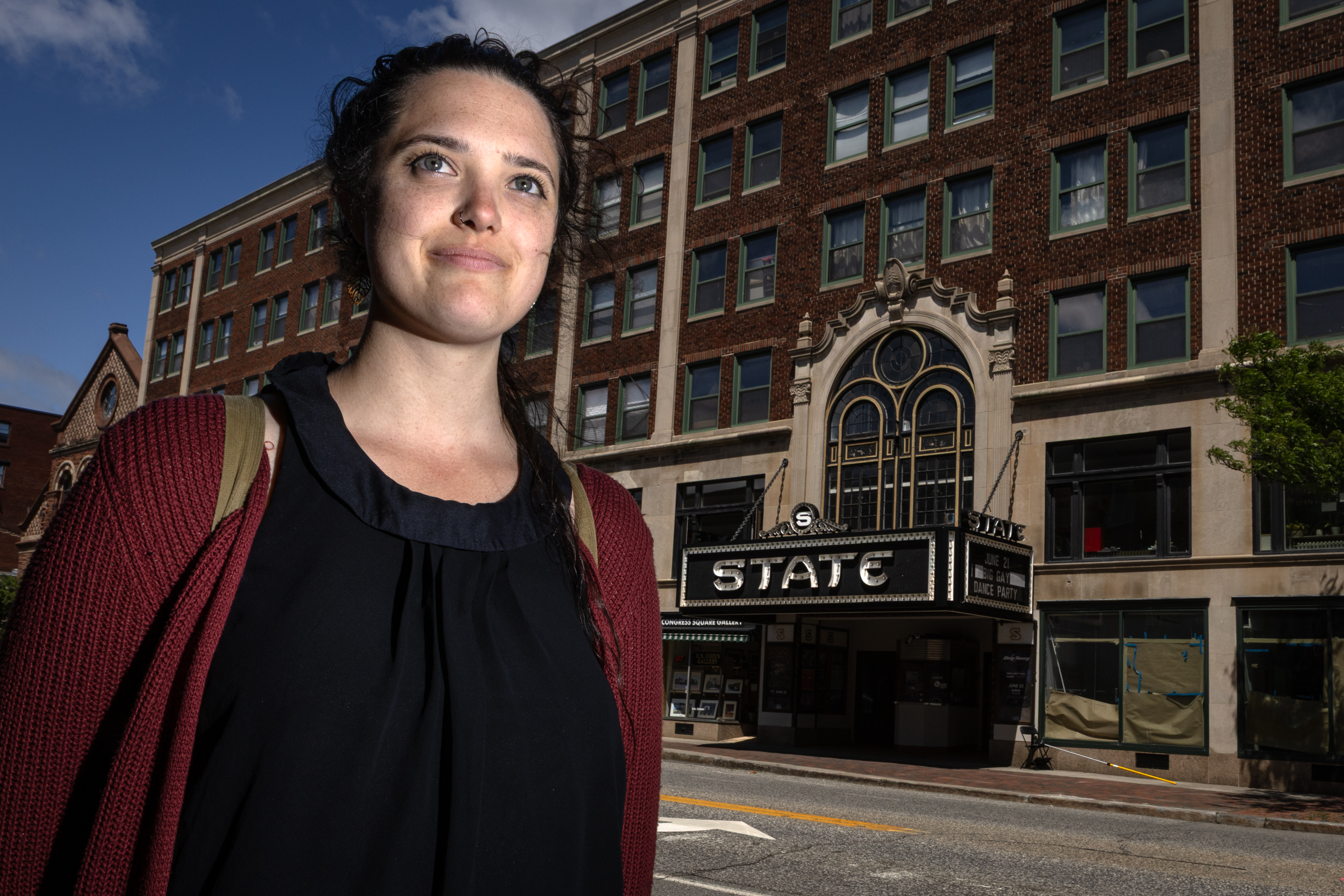
State Theatre stagehand Allie Taylor was working at the Point that night. It was bad enough, Taylor said, knowing Local 114 members were earning about $12 more per hour for doing the same tasks: coiling cables and pushing wheeled equipment cases off stage. But then management announced that only non-union workers would be allowed to load the trucks. This was a big deal.
Loading the trucks is the most dangerous part of the job. The heavy, bulky boxes have to be lifted and stacked by hand, high overhead, all the way to the top of the trailers. Plus, being on wheels, there’s always a chance they’ll roll out of control and injure someone, especially if the trailer isn’t exactly level.
Management, aware that Local 114 members’ contract guarantees them extra hazard pay for such dangerous work, told Taylor and her non-union colleagues to take over. She realized they were cheaper and, without union protections, more expendable. At first, Local 114 members didn’t want to step aside, but they relented. It wasn’t their gig.
“It was, to say the least, awkward,” Taylor said.
The State Theatre’s stagehands had already been secretly discussing forming a union, but this incident really kicked their organizing effort into high gear.
“We had a big meeting together the next day,” Taylor said. “A whole bunch of people showed up in person to talk about how much that had sucked — I mean, it really sucked to be thrown under the bus like that.”
A few months later, last December, the stagehands got together again and told management they were forming a union unit with Local 114. That decision became legal and official in January when a majority of the workers formally voted to unionize during a process supervised by the National Labor Relations Board. The new union unit now represents 35 stagehands working for Crobo. A similar union vote at the State Theatre failed in 2013.
The hard work of hammering out their first contract with management is now underway. At the top of their want list are higher wages and better working conditions. They’d also like more respect. After all, without stagehands, the show won’t go on.
“Stagehands are the people who make all of your shows happen,” Taylor said. “They are the all-black-wearing backstage gremlins unloading the trucks, pushing everything on stage, unpacking it, setting it up, lifting those giant, scary-heavy scenery pieces in the sky — we make concerts possible.”
Stagehands also handle wardrobe, sound, lights, and video for the giant screens now common at big shows. The best way to express respect, stagehands say, is to pay a fair wage. Many State Theatre crew members already work on-call for Local 114 gigs and thus know how professionals like themselves are supposed to be compensated.
“I’m a broke mom of two and I get most of my work at the State Theatre,” Taylor said. “I make so much less there than when I work for IATSE. The people doing this work are really hustling, and I am one of those people. I would just like to be compensated properly for the care and the effort and the hard work.”
Jay Law started doing stagehand work at the State in 2017. Like all the stagehands I spoke with for this story, Law said he loves his job and hopes improved pay and benefits will enable him to keep doing it as a career. He also looks forward to having clearer communication with management.
“It’s not like management is bad or doesn’t treat us well,” he said. “It’s just that we don’t have a laid-out pathway of how to handle things — like how do we talk about pay changes? We want to be able to come together, as a group, and negotiate together.”
Law is also interested in the new skills and safety training classes Local 114 regularly offers its members. “We could benefit by having better pay and the potential for healthcare and the potential for training opportunities,” Law said. “It would make all of us a better crew, which then turns around and makes the venue better.”
Current contract talks with Crobo are limited to shows at the State; Thompson’s Point will remain a non-union venue, for now. Local 114, which has a 120-year history here, provides stagehand labor at Merrill Auditorium, the Cross Insurance Arena, the Augusta Civic Center and the Snow Pond Center for the Arts, in Sidney. Adding the State Theatre will shrink the pool of non-union stagehand workers available in Southern Maine, potentially giving a future union drive for Point shows the leverage needed to succeed.
If a big new entertainment venue in downtown Portland being proposed by concert giant Live Nation gets built, the State Theatre stagehands may be helping make that a union shop, too. The proposal has sparked vocal opposition from other venue operators in town, including longtime State Theatre manager Lauren Wayne and Portland Ovations, which presents concerts at city-owned Merrill Auditorium and elsewhere.
“I am pretty torn on it,” Law said of the Live Nation project. “It would be devastating for the smaller venues in town, because Live Nation is essentially a monopoly. They have more control over things that can happen at their venues and in the venues surrounding them than anybody else does. We’ve had [State Theatre] shows canceled because of Live Nation.”
On the other hand, Law added, “Would I welcome the chance for another place to work? I sure would. But do I think that it’s super necessary in Portland? No.”
Matt Doiron, a stagehand on the contract bargaining committee, feels similarly conflicted, but said he’s trying to stay focused on the task at hand: getting a first contract signed with Crobo. Doiron’s ties to the theater go back generations. His grandparents met there in the 1950s, when it was a movie house. “My granddad was an usher, and my grandmother worked concessions,” he said.
An early step in the unionization process is researching the boss, figuring out who actually owns the company and what their financial situation will be at the bargaining table. That’s tricky in this case, given the obfuscation afforded owners and investors in limited-liability companies (LLCs).
In response to my inquiry, Wayne would only say Crobo LLC is owned by two people, neither of which she would name. Crobo is a portmanteau (a word created by combining two words) of which one part is Alex Crothers, owner of Higher Ground, a music venue in Burlington, Vt., and the other is The Bowery Presents, a much larger promoter that books shows at lots of hip indie venues in New York and Boston.
In late 2016, the global entertainment giant AEG Live bought half of Bowery Presents in a partnership deal reportedly worth about $40 million. AEG and Live Nation have been battling it out for a decade, buying up rival clubs and concert-promotion companies nationwide.
“As these two giants have grown, they have squeezed out or subsumed smaller competitors,” the New York Times observed in a 2017 article. “In New York, for instance, the Bowery deal means that nearly a dozen of the most prominent clubs in New York will now be tied to two multibillion-dollar companies based in greater Los Angeles [AEG and Live Nation].”
“It’s getting harder and harder for an independent to survive in a major market,” talent agent Steve Martin told the Times.
Since AEG bought into Bowery, the State Theatre has booked and promoted concerts at numerous (non-union) indie venues in Portland, including Portland House of Music and One Longfellow Square. Controlled by billionaire investor Philip F. Anschutz, a conservative Christian political donor whose vast holdings include fossil fuel companies and right-wing media, AEG’s involvement gives Bowery practically bottomless pockets.
“As an independent company, funding is always difficult to come by,” AEG chairman Jay Marciano told the Times in 2017. “We have virtually unlimited capital for good projects.”

Another curious portmanteau is Crostone, as in Crostone Portland LLC, also based in Burlington, which owns the State Theatre building and announced last month that it’s up for sale. The Burlington-based property management and development company Redstone operates and at least partly owns the local landmark, which also contains several floors of office space and street-level retail.
Wayne said Crostone and Crobo have no members in common. Crothers and Bowery invested $1.5 million to renovate the theater before it reopened in 2010. Crostone bought the building in 2015 for $4.2 million and is trying to sell it for almost $11 million, enticing buyers with the promise a new owner will be able to immediately raise rents by as much as 15 percent.
“We’re currently in negotiations, so legally, [Crobo] has to maintain status quo and operate as normal, for now,” Doiron said. “I don’t know the terms of the sale of the building, but whoever buys it would have to operate — or allow the theater to operate — under whatever the new lease would be.”
“I can’t fuss about it too much,” Doiron added. “The theater has existed for over 100 years now. It’s sometimes sat dark and it’s been owned by numerous people. I’m confident that no matter what the ownership group is there, they’re going to do shows and this is what we do for a living. We’re going to do union shows, no matter who the ownership is.”