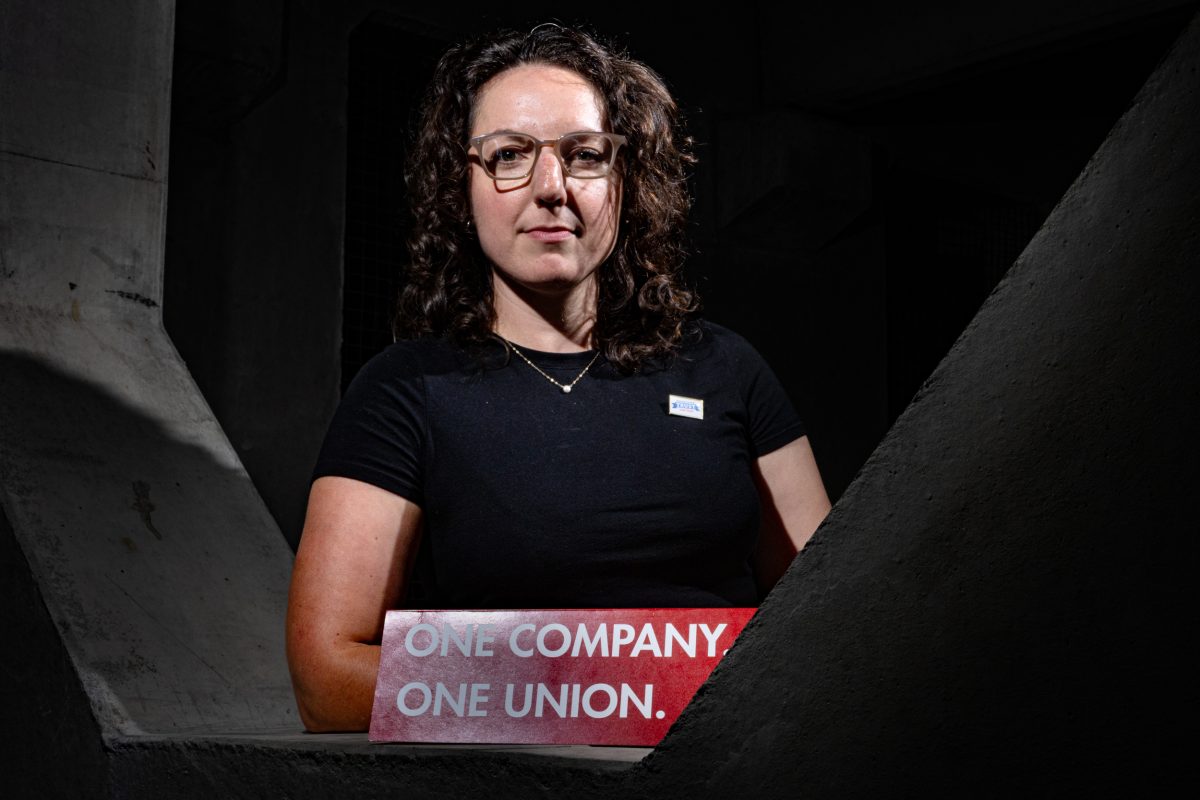
Eric Blanc, author of We Are the Union.
Grassroots worker solidarity grows in Maine
These days, when I desperately need some good news, I turn to an unlikely source: the Chicago-based radio show and podcast This Is Hell!. While listening last summer, a guest’s remark awakened me to the awesome power of psychological warfare waged by everyday folks in furtherance of peace and justice (see “The Tippers: How DIY Psyops Can Save Our World,” Nov. 2024).
This past March I was inspired again, this time by guest Eric Blanc, a journalist and labor organizer who was on to talk about his new book, We Are the Union: How Worker-to-Worker Organizing is Revitalizing Labor and Winning Big.
“The only way we’re going to get … transformative change is through a revived labor movement,” Blanc told host Chuck Mertz. “There’s just no path I can imagine that doesn’t require millions and millions of ordinary working people building power at work. There’s no other mechanism, essentially, to force bosses to listen to you and to build the type of bottom-up people power necessary to force those in power to grant universal health care, to grant Green New Deal — all of these things.
“So the stakes are really high,” Blanc continued. “Not just for the offensive battles we need, all of the changes that we’ve been envisioning for decades, but frankly, just to prevent a complete backslide into a authoritarian hell hole… What Trump is doing right now can only be stopped by a militant labor movement, because the Democrats certainly aren’t coming in, and if we don’t save ourselves, who’s going to?”
What Blanc and others mean by “worker-to-worker” organizing is the spontaneous formation of unions by workers themselves, unprompted by professional organizers seeking to expand an established union’s membership. As Blanc observes in his book, the big unions hadn’t been doing a lot of outreach anyway in the decades before COVID-19, so when the pandemic awakened workers to how essential they are, no one needed a formal invitation to join forces for better conditions, wages and benefits.
All over this country, including Maine, wage laborers gained power by identifying sympathetic coworkers and solidifying majority support before reaching out to established unions for assistance with the bureaucratic nuts and bolts of formal recognition and securing their first contract. Some went through the entire process on their own, guided by the increasing amount of assistance now available through online resources and tools like Zoom and social media.
This grassroots movement for democracy and fairness in the workplace is primarily being advanced by young adults conditioned by the climate crisis to fight for a livable future. It was turbocharged by the Black Lives Matter protests and further fueled by the corporate-supported genocide in Gaza — a testament to its global scope and ambitions.
In Maine, the movement is sweeping through everything: corporate chains and independent businesses, cultural institutions, local governments, the nonprofit sector, the hospitality industry, media and academia. And just like in the old days of Pinkerton thugs breaking up strikes with violence, the bigger the company or institution, the meaner and more criminal the response.
Yet workers are still winning in the end.
Three summers ago, employees at a Chipotle Mexican Grill in the state capital, Augusta, were among the first Chipotle burrito-rollers in the nation to unionize. The corporation responded by closing that location, but was subsequently forced to pay a total of $240,000 to its former employees, grant them all preferential status for rehire at other Maine Chipotles, and post a notice in over three dozen New England locations that it will not illegally close them or otherwise discriminate against pro-union workers anymore.
Baristas at Starbucks in Biddeford and Portland’s Old Port also unionized in 2022. In response, Starbucks closed its Exchange Street location in Portland and has been blocking the Biddeford baristas at every opportunity, but their struggle continues and their spirit has spread — a Starbucks in Waterville unionized six months ago.
Four years ago, we exposed the campaign Maine Medical Center was waging to try to scare nurses away from organizing (“‘Liberal’ Union Buster on the Loose in Portland,” April 2021). The nonprofit hospital Goliath lost that battle, at considerable cost to its reputation as a compassionate institution.
So did the Portland Museum of Art, where workers unionized in 2021 and tried to bring security guards and gallery guides along with them. Museum management responded by firing 14 of its gallery ambassadors, but like the criminal Chipotle corporation, it was subsequently forced by the National Labor Relations Board to pay the axed employees thousands of dollars each in lost pay (one got 30 grand), and the guides and guards voted to join the union last year.
By contrast, indie coffeeshop owner and wholesaler Mary Allen Lindemann voluntarily recognized the union baristas at Coffee By Design formed in late 2023. Vien Dobui and Jessica Sheahan, who own the lauded Portland restaurant Cong Tu Bot, encouraged their staff to unionize that year and promptly partnered with them when they unanimously did so. Stagehands at the State Theatre and Thompson’s Point successfully unionized earlier this year, without significant opposition from management, joining the workers who make shows happen at Cross Insurance Arena and Merrill Auditorium in the International Alliance of Theatrical Stage Employees (IATSE) Local 114, which has a 121-year history here.
This new wave of grassroots worker activism is our best and, as Blanc believes, our only hope to resist and reverse the ravages of the bloodsucking billionaires in control of this country. The hapless Democratic Party is as deep into the bosses’ pockets as the GOP is, so any effort to force them to act on our behalf is energy better spent organizing to improve one’s own workplace and finances. For example, you’ll get health insurance much faster by pressuring your employer to provide it than by waiting for Medicaid for All to pass in Washington.
The Bollard is launching a new series about Maine unions formed by in-house worker activism. Rise of the Locals, spearheaded by renowned Portland photojournalist Troy Bennett, profiles these new unions by explaining why and how they formed, what they plan to accomplish, and the ways they’ve already won.
As revealed in this month’s inaugural feature on journalists at the Bangor Daily News, unionization is not a panacea for workplace problems or even a guarantee of future employment — the BDN cut Troy’s job earlier this year, part of the decimation of Maine media that’s also included deep cuts at the unionized Portland Press Herald. But worker solidarity’s potential to create lasting and meaningful improvements in our daily lives and our world is tremendous.
We are, after all, talking about occupations that comprise about half our waking hours, so it’s not so much a labor movement as a life movement now. For a population like ours, plagued by epidemics of loneliness and hopelessness, unions provide community and common purpose.
Imagine participating in a group decision-making process where you have real influence, one that results in tangible benefits you and your friends can enjoy. Unions revolutionize the workplace by replacing authoritarian top-down management with democratic worker control. Once folks get a taste of what real democracy can do, the political democracy practiced in this nation is exposed as the cruel farce it’s always been. That’s one of the big reasons politicians who fear we, the people try to smash and suppress unions at all costs.
Union solidarity across borders also terrifies tyrants. It undermines their case for war against other workaday folks just trying to make a living and removes their racist rationales for keeping laborers out of the land of opportunity.
Enlightened bosses appreciate unions. They provide structure, stability, accountability and responsibility in a workforce. Giving the people who actually perform the work real say in how it’s done is just good business. It results in happier, more loyal and more productive employees, and saves time and money otherwise spent on hiring and training.
One remark in Blanc’s book especially resonated with me. It’s in a quote from Jon Schleuss, who helped organize the Los Angeles Times in 2018, when he was 31 years old. “When we were in the hardest parts of [the LA Times] campaign, there was a thing we repeated to each other: ‘We have more power than we know,’” he told Blanc. Christopher Burns of the BDN said something similar to Troy, and it’s true.
Workers always have the power to define the terms of their employment, in part because they vastly outnumber the owners and managers who may insist otherwise. And public support for worker struggles is much stronger than any boot-lickin’ affinity with the interests of bosses and Wall Street, regardless of party affiliation. Recall that the wave of successful teacher strikes in 2018 happened in Republican-dominated states like West Virginia, Arizona and Kentucky.
Most crucially, workers are the people actually conducting all the business, so capitalists can only profit with workers’ indulgence, with their willingness to show up and do the job from day to day. Employees can always just unplug the shit and go home, leaving bosses and investors in the lurch. That’s why even talk of unionization scares the shit out of those people and routinely results in raises and other concessions before a union is formed.
Like Troy, I also believe cooperatives are the ideal way to organize an enterprise, and unionization can be a big step in that direction. We all know there’s no room to walk in the other direction — workers today cannot be paid less or forced to labor longer in this wildly unequal economy with no social safety net. From here, we all march forward, or not at all.