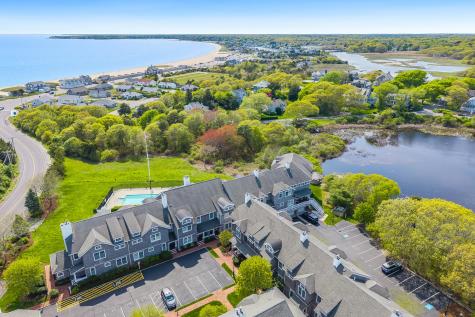
Cape Cod condos pictured in a promotional image.
An op-ed by Gail Goodwin
My partner and I moved to Maine from Cape Cod on Nov. 6, the morning after the election. We dried our tears, disconnected the TV, trailered the kayaks and left with everything we own in a rented Pensketruck with Texas plates.
Let’s get it straight: I am not the young, monied, work-from-home type. I’m an aging fine gardener who sold her small condo to pay off credit card bills and afford a few years of overpriced rent in an old mill.
Other than childhood trips to York Beach, Boothbay Harbor, and late 1990’s summertime lesbian tea dances in Ogunquit, I know very little of Maine. But after living here for a few months, I now know what has been happening for years on the Cape is in full swing in this area.
Some call it gentrification, others revitalization. It’s a little of both, I guess. While there’s an argument that towns like Saco and Biddeford may be better off without acres of empty, decaying mills, the coastline is also disappearing. As has happened everywhere, the fortunate ones are taking over everything beautiful. This has always been true, yet it seems so much more aggressive now.
Which brings me to the other reason I chose Maine: it’s big. During the summer I can escape west or north to find some peace. There is no place to go on a 60-mile-long peninsula, and after the pandemic, Cape Cod got so much smaller.
Those who could bought every piece of available land. Corporations and people from New York, Connecticut, and lifeless Midwest cities built oversized luxury homes blocking once visible coastlines and beaches. And while Cape workers struggle to find housing, for much of the year, many of these trophy homes stand empty. I know, because I planted and maintained their lonely gardens, only occasionally catching a glimpse of their Range Rovers and Mercedes parked in the long seashell driveways.
Short-term rental companies like Airbnb gobbled up the apartments and smaller vacation homes, including many of the year-round rentals so crucial to the Cape’s workforce. There are no affordable apartments on the Cape. A few large, sterile apartment complexes with pools, high rents and stainless-steel appliances have popped up advertising “luxury living.” Most are built in the middle of power-lined industrial parks. Nothing about them says Cape Cod, and no locals live there.
Before choosing where I live now, I toured replicas of once extravagant residential buildings in Portsmouth and Kittery. One had a great view of a Staples parking lot and the other sat about 50 feet from the Maine Turnpike, so I chose the bricks and beams of an old mill.
I really didn’t expect to get a warm welcome here, coming from the land of the “Massholes,” but locals have been incredibly warm and hospitable. I wish I could say I was as nice. When I managed a small garden center and customers would tell me how excited they were to be living on the Cape, I’d whisper under my breath, “Yeah, thanks for coming.” I thought, Who were they to trample on the Cape’s beauty, to try to change our way of life by planting big, thirsty hydrangeas and large, manicured lawns in our dry, sandy soil?
Now it’s me on the other side of the equation, the transplant, the newcomer. And I ask myself, Am I part of the solution or part of the problem? As a consumer, I really try to support local artists and businesses. I haven’t bought and developed any land, and I don’t live in a seasonal mansion. Still, sometimes I think simply my presence makes me part of the problem. I know my ability and willingness to pay what I do for rent helps drive up the cost of housing all around me, most directly impacting those forced to survive on Maine’s $14.65 minimum wage.
The evidence is the high number of homeless people I see here. The Cape likes to hide their homeless. You’re not going to see a shivering man or woman in a black hoodie holding a sign that reads “Anything Can Help, God Bless” in Osterville or Chatham. Poor people were pushed out of there a long time ago.
Here, I’m forced to see them eye-to-eye behind the windshield of my car while stopped at intersections with the longest red lights in the country. Why are they so long? I’m pushed to face my growing uncomfortable sense of indifference, so foreign to this self-proclaimed, lifelong Massachusetts liberal. We all know there are layers of factors causing homelessness, addiction and mental illness being at the core, yet I ask myself, Have I stopped caring or am I simply overwhelmed?
It appears that I escaped the excesses of the Cape only to find myself in the same situation here, just not as far gone. Maybe it’s not too late. Maybe Maine can figure it out. Be careful not to give too much of itself away.