photos/Troy R. Bennett
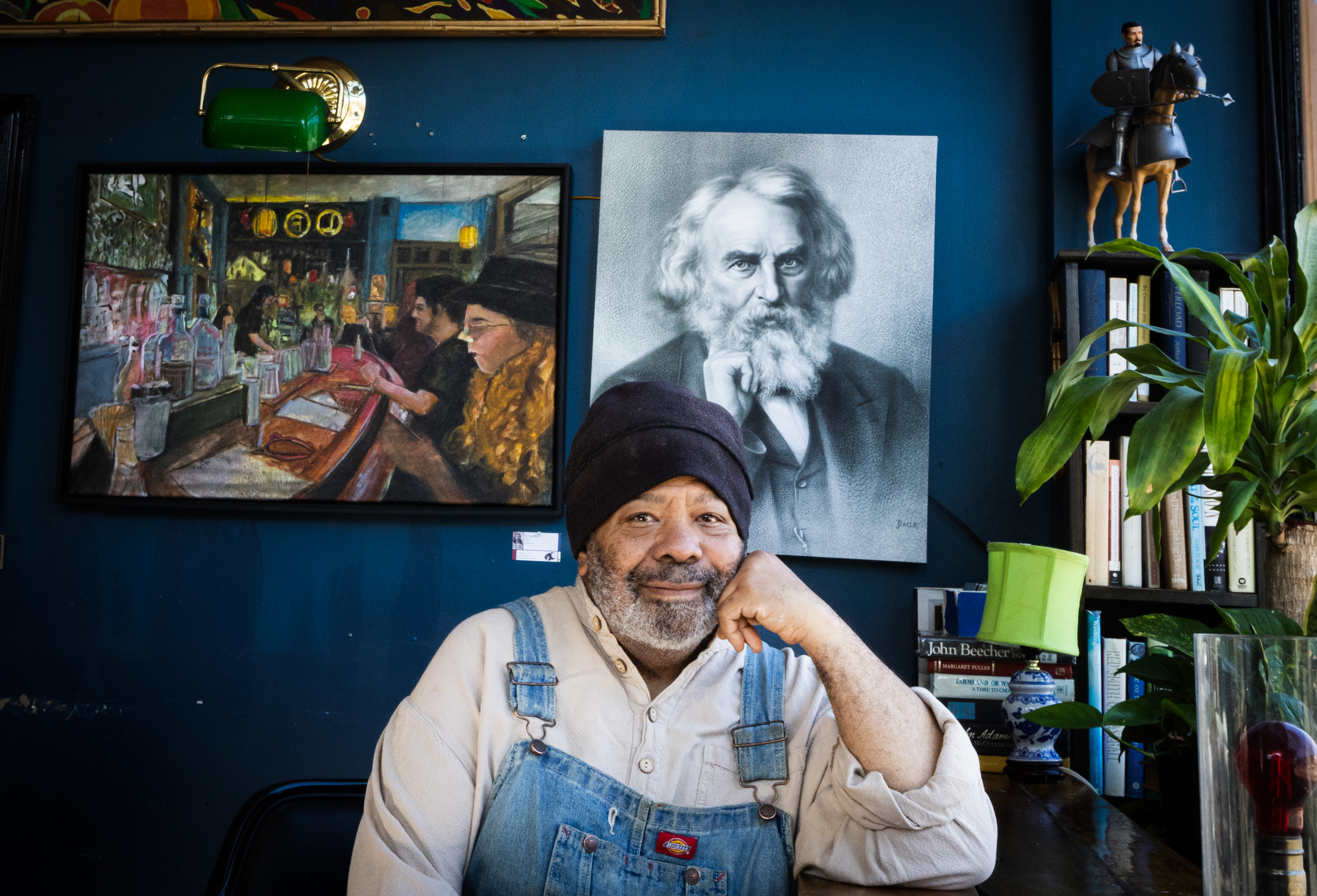
The invisible artistry of Mark Turner, Portland’s kindest cook
A long time ago, in a little Italian village far away from Casco Bay, there lived a boy named Pasquale who was enchanted by the magic of Hollywood movies. He’d sneak away from home or skip school to go to the cinema in Caserta, the capital city. His father, Giuseppe, and several other workmen from the settlement of Garzano lived across the ocean 10 months of every year, building roads in Maine.
In 1940, Italy’s fascist dictator aligned his nation with the Nazis, abruptly stranding Giuseppe inside an enemy country during wartime. Seven years later, it was the pleadings of 17-year-old Pasquale that finally convinced his mother and sister to pack up and move to the land he’d fallen in love with through the big screen.
Pasquale joined the ever-roving Maine road crew during summers and may have remained a laborer had a teacher named Mary Smith not noticed his “talent as a visual artist,” according to his 2019 obituary. She was “instrumental” in his acceptance to the Portland School of Art (now Maine College of Art & Design), and following four years in the Navy as an aerial photographer during the Korean War, Pasquale Tranquillo was hired to teach art at Portland High School in 1960. He taught there for the next 35 years, and his own art was exhibited at galleries in New York and Paris in the early ’60s. Students called him Mr. T.
“He always had a positive, joyful attitude and raised everyone’s spirits,” the obit recalled. “Pasquale’s insatiable curiosity about our world led to endless reading and a constant exploration of new ideas and alternative possibilities. … [He] left people feeling that their world had just been enlarged.”
In the early 1980s, Mark Turner was a teenager in Portland feeling alienated, and not just because he was one of the few Black kids around. His father, an erudite special ed teacher, died when he was five, and about seven years later his mother moved them from Manhattan to Maine, where she and her late husband had honeymooned. To Mark, Portland was a “podunk town,” and he missed his big-city friends.
Like his father, Mark could draw — the skill seemed to come naturally to him — but “when it gets finished in my head, I don’t want to work on it anymore,” he said during an interview last month at Novel, the bookshop, coffee and cocktail bar on Congress Street. His high school art teacher, whom he calls Mr. Tranquillo, threatened to fail him if he didn’t finish at least one painting. This mortified Mark, who liked and admired Mr. T. He struggled to complete it, but persevered and passed the class.
“What are you gonna do with this painting?” Mr. Tranquillo asked him.
“I don’t care,” Mark replied. “I’ll probably throw it away.”
“Can I have it?”
“Sure,” Mark said, cooly but inwardly filing this proud memory away for the rest of his life. “Take it. It’s yours.”
Mr. Tranquillo urged Mark to apply to a prestigious art conservatory in Boston, and his letter of recommendation helped him get accepted, but Mark opted to study education, with minors in history and music, at the University of Maine at Orono. He taught high school history for a year in Ellsworth and also did some teaching in Boston, but came to realize education had been his father’s passion, not his own, so Mark drifted back into the work he’d begun doing at 17: washing dishes, mopping floors and prepping food in restaurant kitchens.
In high school and after college Mark had worked at Sapporo, the pioneering Japanese restaurant that originally opened on Free Street in 1985. His first taste of raw fish was in the giant bowls proprietor Yoshi Hayashi made for staff meals: heaps of sushi on rice with “a fish head they would roast in the char broiler,” Mark recalled.
“Don’t ask,” master chef Yoshi scolded him, “just eat!” He taught the kid dishwasher how to use chopsticks, too.
Mark also worked at Dos Locos, an elevated Mexican restaurant on Exchange Street in the Old Port that later relocated to India Street and hosted jazz bands. Owner Steven Tartarczuk’s 2020 obit notes this karaoke-singing Little League coach and D&D dungeon master had a “calm nature and sense of humor [that] gave people reassurance that things would be okay even during the most stressful events in life.”
Another formative influence was Jim Ledue, the renaissance man and restaurateur credited with introducing many modern culinary ideas to Portland’s dining scene. Mark worked for years at two of Ledue’s places, Alberta’s Cafe and Bella Bella (his third was breakfast mecca The Good Egg).
“As an artist and poet,” Ledue’s 2009 obit reads, “he exhibited paintings and sculptures in his restaurants before it was fashionable, furthered the careers of numerous Portland artists and fed many actors … [He] opened his restaurants to the homeless, traded meals to those who couldn’t afford one, and employed people of diverse backgrounds. He believed in the potential of every life.”
Mark labored his way from the dish pit to garde manger (the chef in charge of cold dishes) to the grill at Alberta’s, and briefly ran the kitchen, “so I worked every station,” he recalled. “When I started there, they changed the menu every day, twice a day, lunch and dinner. … Jim could be difficult to work for, but I respected the hell out of the fact that he was self-taught and … he was an incredible cook. I would see him come in at the wire with two bags full of groceries and just make incredible food.”
Chef Izzy, of Izzy’s Cheesecake fame, who cooks lunch at Commercial Street Pub in the Old Port these days, worked with Mark at the second Alberta’s location, next to Portland Stage Company on Forest Avenue, in the early ’90s. Ledue had hired a Lebanese woman who made a wide assortment of dishes (hummus, baba ghanoush…) that Mark had to assemble as the Lebanese Plate appetizer.
“It was very, very popular,” Izzy recalled, “so on a busy night, he was gettin’ slammed. You’d hear the waitresses, ‘One Leb Plate!’ ‘Leb Plate!’ and he’d be like [low growling sound], but like making fun of [the situation]. Just getting slammed, and the smile on his face. … Always smiling. And his face, when he was smiling…”
Standing in the pub’s little kitchen, Chef Izzy struggled for words to describe the mysterious force of Mark’s smile, but other coworkers have described its effect as instantly calming or causing mild happiness, expressing a wordless assurance that everything is OK. Mark’s been deeply influenced by Buddhism, but he’s not an adherent to any religion. His preternatural tranquility and kindness appear to be innate traits encouraged by the attitudes and actions of the enlightened chefs who showed him the ropes.

Mark’s biggest influence at Alberta’s was Hoke Wilson, who’s been an executive chef for boutique lodging and dining company Hay Creek Hotels since 2011. “I remember I was on the grill the first day he started,” Mark said. “He was going to be the kitchen manager, sous chef, and I thought, Oh, this is going to be a disaster. Like, he’s just kind of moseying around. … I was used to chefs who were a little more frantic, and he’s got jazz on. … We opened, and he just pulled everything together. It was a great night working with him. I was like, This guy is amazing.”
Chef Hoke “never really got flustered no matter how busy we were, and he just had a great sense of humor,” Mark added. “He took the job very seriously, but he didn’t take life very seriously.” Applying an old Southern adage he picked up from his mother, Mark said Hoke “didn’t really take any tea for the fever. … He would go the extra mile to make sure you got what you wanted, but if you’re just being ostentatious and a prima donna, he didn’t really have time for it.”
After Alberta’s, Mark bounced around and landed in the kitchen at Raoul’s Roadside Attraction, the legendary honky tonk on outer Forest Ave. Raoul’s was “probably the funnest job I’ve ever had — the number of great acts I saw there” — like Warren Zevon, whom Mark almost mistakenly ejected from the club before his show, thinking the scruffy weirdo was a customer who’d snuck in early. “At the end, things were kind of out of control,” he said of Raoul’s. “I was probably doing way too much extracurricular stuff. But then again, the universe stepped in and gave me a sign that you need to make a change. So I left there.”
It was 1998, and he’d been cooking at Squire Morgan’s, an Old Port pub, when a friend who worked at Becky’s Diner on Portland’s waterfront called to ask if he’d like to work there. “I was like, ‘You mean, like early in the morning? When the birdies are chirping? Uh, no. Thanks, but no thanks.’ But as soon as I hung up the phone I realized that’s exactly where I need to be if I want to make the kind of changes that I need to make. So I called him right back.”
Now world famous, Becky’s Diner has always been very popular, especially on weekend mornings, when the line out the door is perpetual. Their kitchen is an engine that’s powered generations of locals and visitors of all walks of life, from hungry fisherfolk and lawyers to famous politicians who’ll stop in during election season to press some flesh for the cameras and pretend to be a genuine person. Becky’s is a landmark and a rite of passage for anyone new to town.
And anyone can scramble eggs, drop toast and flip pancakes, right? But could you do a Sunday morning shift at Becky’s, swiftly make every order to perfection, and not suffer at least one panic attack or even raise your voice in distress or frustration?
Let’s say you could. You must be a real pro. Not only are the orders constant, but you’re making breakfast and lunch, including egg dishes and burgers with exponential ingredient and preparation permutations. Impressive!
Now work four consecutive 12-hour shifts there, from 2 a.m. to 2 p.m. or later every Friday through Monday, cooking everything by yourself from 4 a.m., when the front door opens, until help arrives at 6. Heck, pick up an additional shift now and again, too, and do this for a full year. And remember: never lose your cool, even a little. Congratulations, you’re a kitchen rock star!
Now keep doing this every week for five years — wow, you’re like Top Chef Portland!
Ten years — you are an Iron Chef.
Fifteen years — you’re Iron Chef Morimoto.
Twenty years — you’re Mark Turner, a spatula-wielding Jedi whose smile can melt stone.
When Mark shuffled, Yoda-slowly, out of Becky’s kitchen after his last shift in 2018, all the staff and many customers stopped what they were doing and rose to their feet to give him a standing ovation.
It’s “nothing short of amazing to have anybody for twenty years in the restaurant business,” said Becky’s son Zack Rand, who learned to cook in the diner’s kitchen beside Mark and now manages the business, which also underwent a major expansion in the middle of Mark’s tenure. Mark’s grinning visage should be carved into “the Mount Rushmore of Becky’s employees [who] really formed her business and gave her some proper footing in the restaurant culture in Portland.”
“To this day, I don’t know if I have a more dependable person,” Rand continued, recalling that Mark always showed up on time and would stay later or pick up an extra shift if asked. In the kitchen, Mark was “always so friendly, always so positive, always so kind to people. Everybody just loved him for how he treated people with respect and never had a bad word to say to anybody. … I might have seen him really, visibly angry maybe once or twice in those twenty years.”
“Cooking, to me, is very much an artistic endeavor,” Mark said, and given the opportunity, he applies his artist’s eye in the kitchen to make strangers feel appreciated.
“Working at Becky’s was kind of like a sacred trust, because at four in the morning people are coming in and ordering breakfast. Whether they’re getting off work or they’re going to work, I’m contributing to setting the intention for their day,” Mark said. “So if someone came in and ordered a fruit bowl, I would try to make it the most beautiful fruit bowl I could, because how nice is that to start your day when you’re just expecting fruit and granola, but then it comes looking kind of like a sculpture?
“It satisfied my need to make something beautiful, and then to see the impact of that when they look at it and look in the kitchen and would be like” — Mark lifted two enthusiastic thumbs up. “That’s the power of food. It’s such a communal endeavor.”
After Becky’s, Mark cooked for his friend Deb Glanville, a past proprietor of Congress Bar and Grill downtown, and did stints nearby at Hot Suppa and Nosh before finding a new home at LFK, the bar in Longfellow Square, in 2019.*
“If you’re feeling any type of stress yourself, he’ll always make you feel better,” said LFK’s executive chef, Patrick Dean. “People in the front of the house, too. When they come in they can see him in the kitchen, standing there in the back, and immediately they’re like, ‘I feel better. Mark is here.’ And he’s smiling…”
LFK owner John Welliver, son of famed Maine artist Neil Welliver, likens Mark to a different superhero, Nightcrawler, the Marvel Comics character who can teleport. While working in the kitchen with Mark as orders pile up, Welliver said he’ll turn his back or go upstairs briefly, then “I’ll hear this pfffst noise — which is what the character, Kurt Wagner, the Nightcrawler, makes when he teleports — and I’ll come back and Mark will be standing in the corner, and everything is fired.”
To the famously fussy tastemakers at the James Beard Foundation, the Michelin tire company or Food & Wine, a cook like Mark Turner is invisible, a non-entity slaving in the shadow of the next big flash in the pan. But if one’s criteria for distinction are a cook’s skill, speed, artistry, experience, dependability and composure in the kitchen, Mark is clearly among the greatest chefs this foodie city has ever seen, if not the actual G.O.A.T.
Opening his own place never interested Mark. “I’ve run enough kitchens and seen enough restaurateurs get eaten alive by the business that it never seemed like the payoff would be worth the aggravation,” he said. Instead, Mark’s spent his spare time mastering and practicing reflexology (he’s a certified practitioner and had his own clinic in Falmouth years ago), playing music and voraciously consuming all kinds of books and movies (he’s also a certified Star Wars geek).
In homage to Cunningham Books, which previously occupied its space, LFK is decorated with paperbacks and typewriters and paintings — a perfect fit for Mark. Now 57 and feeling some ongoing effects from Covid, Mark works part-time but has felt like part of a family there since his first day. “I’m gonna die here,” he once told Welliver, with an enthusiastic tone that said he’s looking forward to working at LFK until he retires or expires.
About 10 years ago, Mark noticed that his friend and former coworker at Alberta’s, Jim Heffren, was posting little drawings he made every day on social media. “I was just awestruck by that,” Mark said. “I hadn’t drawn in years. But there was something about the curve of his learning, and the joy that was obvious from him just making these images.”
The posts inspired Mark to start drawing again, and drawing upon his longtime love of film, comics and other illustrated books, he created Precinct Thirteen, a gritty graphic novel about a big-city detective in a 1950s metropolis. The main character, detective Lloyd Tagghertz, is still struggling to solve, and find solace after, the murder of his partner when a new case and a new partner pull him back into the shady milieu of characters inhabiting the city’s streets, suites and cells.

In Precinct, the case is “kind of a McGuffin” — a plot that seems central to the story, but becomes increasingly irrelevant. “Really, for me, the book is about how people deal with death and dying when they don’t know how,” said Mark. Tagghertz’ new partner, Brian Benner, is also haunted by the heartache of losing someone close, but neither tough-guy cop can truly express their feelings to the other.
“It’s not drawn in the most pristine fashion,” Mark said during our interview last month. “It’s sort of a slice down the middle between photorealism and hand-drawn. That’s what I was looking for.” The books’ style was particularly influenced by that of cartoonist Lynda Barry.
When Mark discovered Barry’s comics in the pages of Casco Bay Weekly last century, he initially thought, “‘Oh, that’s a shame — she wanted to be a cartoonist but she can’t really draw.’ Following her work through the years, I realized she can. She chose to draw in that fashion to tell the story a certain way. There’s a certain gritty integrity to the characters, even though they’re not drawn anatomically correct.”
Still resistant to finishing a work of art once he sees it completed in his mind, Mark wrote broad outlines of each chapter and composed the story as he went along, panel by panel. His approach is a mix of illustration — pencil and pen with ink wash and charcoal — and collage. “If there’s an art form that I love, it’s book-binding and collage,” he said.
Once drawn, the panels are photocopied in a range of exposures (the best to be determined during assembly) and placed on pages that are photocopied again. Mark then meticulously adds splashes of color — like Tagghertz’ yellow-blonde hair and blue eyes — and hand-binds the pages with thin leather straps between covers he makes with recycled cardboard covered in papier-mâché. He gets all his materials from The Art Mart in downtown Portland and thanks owner Keith Christy and the helpful staff there in the afterword of Book One, which he completed in 2019.

Work on Book Two was complicated by the pandemic, politics, and self-doubt. “I had more crises of confidence about it,” Mark said. “It got into my head: Will people like this? And the whole Black Lives Matter thing was unfolding. I was like, Should I, as a person of color, be writing a graphic novel about police where the two protagonists are both white?”
Mark said he hasn’t experienced much racism in Portland or elsewhere in Maine, with the exception of the day in the late ’90s when he left his VW van at a dealership in Falmouth for repairs and started walking back to Portland. A Falmouth cop tailed him, stopped him, interrogated him, took his ID and pressured Mark to get into the back seat of the cruiser for a courteous ride “home” — that is, just over the Portland city line across the bridge.
“Social commentary isn’t my main focus” with Precinct Thirteen, Mark said, “but it did lead me to be more invested in the character of Moses Watson,” a Black private investigator and/or policeman (the question becomes relevant) introduced in Book Two, a much longer installment finished a couple years ago. Work on Book Three, the final act, is in progress.
“My original intention was not to have it be a published thing,” Mark said. “I was just doing it for myself.” He figured he’d make a copy for Jim Heffren and maybe a few more for friends, but strangers began noticing him working on the first book in coffeeshops and asking if they could buy one. He’s since made about 30 copies of both books that he sells for $20 to a short mailing list of fans. Each one is unique in subtle ways, from their coloring to their covers.
“Art isn’t something that I ever thought of as like a vocation, like a job,” Mark said. “I think if I actually tried to make it into that, I would get very disenchanted with it. I’m just blown away by the fact that people really seem to be enjoying it, that I crafted a story that seems legible, that seems interesting. … I imagine Mr. Tranquillo saying, ‘Well done, Mr. Turner. Well done.’”

*Full disclosure: Bollard advertising director and photographer Kiki Garfield picked up some bartending shifts at LFK a few months after research for this story began.