
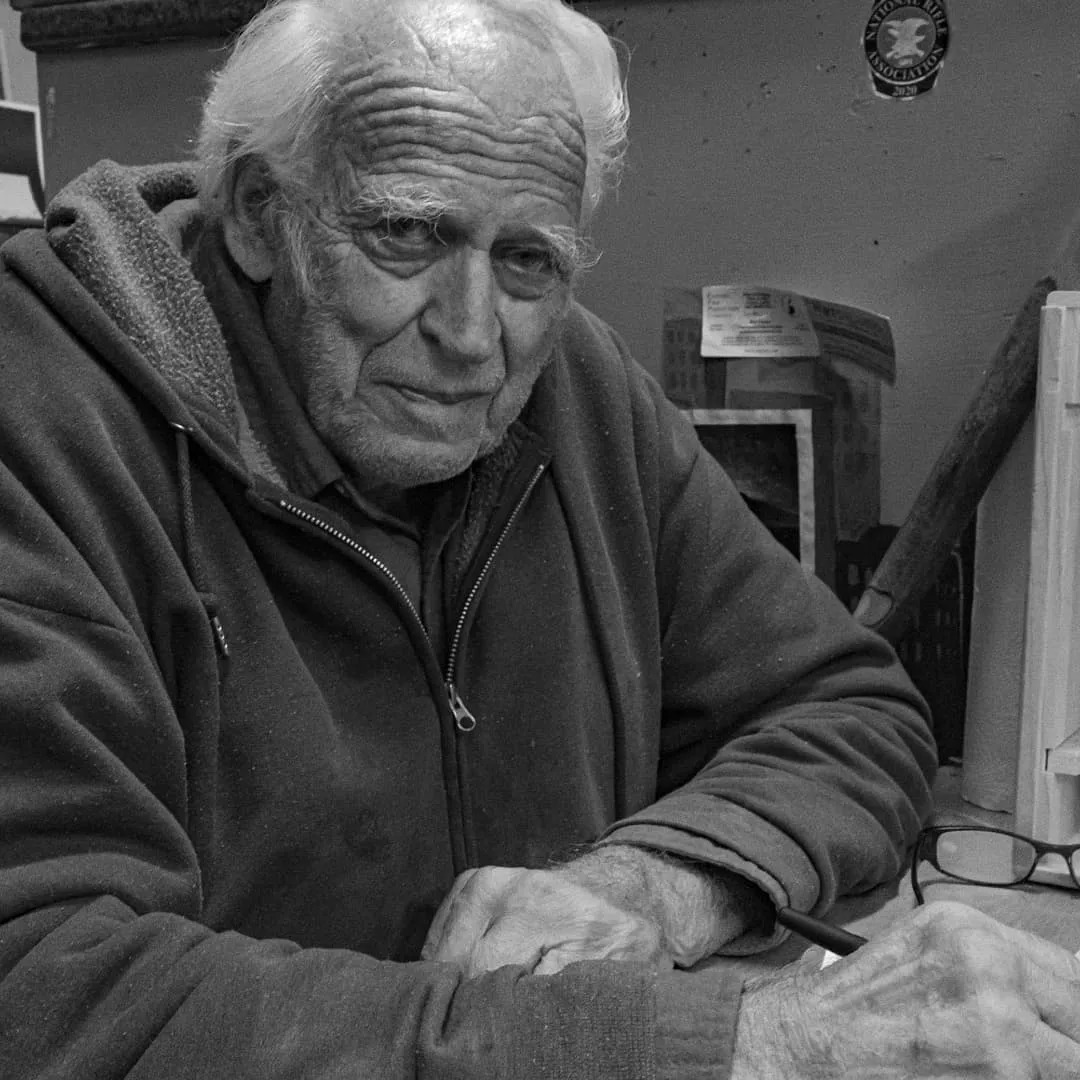
Joe Soley in his Old Port corner store a few years ago. photo/John Duncan
Joe Soley enters the That’s My Dump! Hall of Fame
“The root disease that afflicts the world at the present day is the supremacy of the commercial point of view. … The commercial mind is neither benevolent nor malevolent — as little as science is. It seems at times to be beneficent; at other times it seems to be almost fiendish — as in the case of the atrocities perpetrated on the Congo. It is not fiendish, it is simply ethically neutral or blind.”
— Felix Adler, An Ethical Philosophy of Life, 1918
Ladies and gentlemen, with a mix of sadness and admiration, I hereby induct Joseph L. Soley into the That’s My Dump! Hall of Fame, an imaginary institution founded this year to preserve and honor Joe’s memory and that of other local landlords whose neglect of their properties reaches legendary levels.
Joe was born in New York City in 1931 and raised during the most desperate and destructive years of that century by accomplished and relatively affluent parents; his father was a pulmonary physician and his mother a vice principal and high school English teacher. Joe attended the Ethical Culture Fieldston School, a private “progressive” school with campuses in Manhattan and the Bronx founded in 1878 by humanitarian philosopher and educator Felix Adler. Among Adler’s notable and noble causes was the reform of slum tenement housing, where overcrowding and high rents caused widespread misery during the Gilded Age.
Joe studied biology and medicine at Johns Hopkins University and met and married Barbara Berman — described in his obituary as “the eternal love of his life” — in Baltimore, where the couple settled after Joe got out of the Coast Guard during the Korean War. When Barbara died of cancer in 1967, Joe was left with four boys to raise. The obit notes he began developing apartments and retail space in Baltimore before moving to Camden, where his family had vacationed, in 1976.
Joe established his reputation as a developer and landlord in that coastal tourist town, and it wasn’t a good one. In a 1994 profile for Casco Bay Weekly, titled “My Own Private Portland,” Al Diamon wrote, “Camden officials were reluctant to discuss Soley, but municipal records show a pattern of constant conflicts over everything from building permits to trash disposal to taxes.” Al quoted City of Portland building inspector Sam Hoffses, who said his colleagues in Camden told him “it was the happiest day of their lives when [Soley] moved to Portland” in the mid-1980s.
Joe was drawn to the city’s historic Old Port district, where deindustrialization had left once-bustling brick commercial buildings near the waterfront stranded like empty shells in its wake. Earlier attempts to revitalize the district faltered during the recession at the dawn of the 1990s, and Soley was in a position to take advantage, buying up properties with the zeal of a Monopoly player filthy with funny money. He named his Portland real estate company Monopoly Inc.
As Diamon pointed out 30 years ago, Soley wasn’t a “bottom feeder.” He’d pay top dollar for a building if it fit his vision for the Old Port. He described that vision to Al as follows: “We want to build the activity level all the time. The smells of food, lights, music, all kinds of attractions and shops. I’d like it to be a mini-Harvard Square. I want to see a living city, not a death-dealing suburbia.”
Frank Akers, a friend of Joe’s who was also very active in Old Port real estate, told Diamon in ’94 that “Joe’s money is keeping the Old Port afloat. If it wasn’t for him, we’d have a lot of empty buildings and a lot of bank-foreclosed buildings.”
So yes, for all his many faults, Joe Soley was instrumental in making the Old Port a popular place to dine, drink, shop and live, and he did this while downtown was in a death spiral caused by the gravity of the retail black hole known as the Maine Mall, out in the death-dealing suburb of South Portland. A strong argument can be made that Soley saved Portland from sinking to a depth of cultural and infrastructure decline from which it could not have recovered; or from which the recovery, long delayed, would be characterized by the kind of soulless, disconnected urban renewal projects that dot post-industrial cities nationwide (e.g., the gleaming civic, shopping or arts centers that displace poor neighborhoods and flop a few years after the initial fanfare).
Instead, supported by Soley behind the scene, the Old Port retained and grew upon the spirit of the intrepid entrepreneurs and artists who dared do business down there and who gave the place its fun-loving character with events like the Old Port Festival, which started in 1973. Diamon’s 1994 CBW story included a long list of Joe’s properties at the time and the businesses that occupied them. It’s full of funky shops, art galleries and lots of restaurants and bars, including Joe’s flagship hangout, The Seamen’s Club (later Bull Fenney’s and Henry’s Public House), The Baker’s Table, Three Dollar Dewey’s, Big Easy Blues Club, the Comedy Connection and Cadillac Jack’s.
Joe’s takeover wasn’t always a blessing — he multiplied the rent and forced out at least one Old Port craft shop that I know of in the late ’80s. But as Akers observed, many of these marginal businesses would have been screwed without Joe, evicted by bankers during foreclosure or by a landlord who was strict about rent and rules. This is how Soley’s fortune became their good fortune and, in turn, all of ours.
His wealth was such that he didn’t really need their rent or much care how they paid it. Granny’s Burritos owner Chris Godin (RIP), who leased space from Joe on Fore Street in the ’90s, freaked out when his landlord showed up to collect payment at the end of the month and pulled out a gun. He wasn’t threatening Godin; Joe explained that the tenant he’d just visited had given him the weapon in lieu of rent and he thought it was an interesting piece.
Joe loved to barter and do business off the books, often letting tenants live rent-free in exchange for working for him under the table. Like a good anarchist, Soley’s disrespect for money was paired with utter contempt for government. He blew off every regulation that applied to him and paid fines and taxes at the very last minute to avoid having his business licenses revoked or properties seized by the state.
“If he can get away with it, fine,” Hoffses told Diamon. “If we catch him, that’s fine, too. That seems to be his attitude.”
Granted, sometimes it helps if the landlord gives a damn about your workplace or apartment having, say, heat, or hot water, or a fire escape, or a place to put trash. Joe was unbothered by those details, and if tenants were willing to take their chances or fix his properties themselves, they generally got along fine.
For example, about 15 years ago, my partner, Kiki Garfield, lived at 11 Exchange Street, a rundown building in the heart of the Old Port with almost a dozen mostly small, but architecturally interesting, apartments. Rent was $450 — by last year, it had risen to maybe $600.

One of Joe’s most notorious dumps, its hallways were often clogged with sleeping party guests of the struggling musicians and service-industry workers who lived there. Sprinklers and fire exits were not in evidence — had Kiki needed to escape a blaze outside her door, the only option would have been to try to grab a tree branch during the three-story drop from window to alleyway. The smoke detectors in the hallways worked all too well, and wafts from cigarettes, joints and who-knows-what-else sent fire trucks racing down Exchange almost every other night.
The fridge in Kiki’s unit was busted, so they gave her another one. It was full of maggots. She and a friend sanitized the appliance and it worked fine. Kiki bought materials to replace the peeling flooring and patch and paint hole-punctured drywall that revealed anarchy symbols sprayed on the exposed brick. She saved the receipts. The disagreeable property manager had no interest in these improvements, so Kiki invited Joe to take a look. He was trilled, raved that she’d restored the place to its former glory, and gave her several months free rent in exchange for the materials and labor.

Confronting or complaining to Joe — or, god forbid, getting the government involved — incited his terrible wrath. A full accounting of all these disputes would strain the Internet’s capacity, so I’ll pick one favorite from Al’s reporting:
“In 1992, some tenants in offices above the Seamen’s Club complained there were no fire exists on the upper floors,” Diamon wrote. “Soley responded that there was an exit — located inside a locked office. He offered to give all the tenants keys. When he was informed this still violated the fire code, Soley conveyed his displeasure to the building inspector: “WE HAVE GONE WAY OVERBOARD TO SATISFY EVENTY TENANT’S WHIM … ANYTHING, INDEED, THAT UPSETS THIS PRESENT SCARY TENANT BASE WOULD INDEED PUT US IN DIRE JEAPORDY [sic] OF OUR INCREDIBLY THIN PRESENT AND BARE EXISTENCE.”
Our incredibly thin present and bare existence. What a line! Conveyed, as was Joe’s habit when upbraiding bureaucrats, in all caps, it’s pure bullshit given his vast riches, yet also poetic and an apt description of daily life in the Old Port back then (and now).
In Book Three of Kenny Wayne Beek’s memoir of his homeless years in Portland last decade, Transience (serialized here in The Bollard), he describes a dingy subterranean hideaway in the Old Port where he and his associates once crashed. They called it “the Dungeon,” and they arrived there one freezing night to find a crudely written sign warning “the Homeless and the Hoboes” to stay out. They entered anyway, and overslept. Kenny awoke in a panic to the sound of someone descending the steps. His story continues…
“It was the owner of the property, the landlord, the man with the Power,” Kenny wrote. “I jumped up and took command of the platoon. ‘Wake up!’ I ordered. ‘Everybody up! Gather your things. And don’t forget to pick up any trash. It should look like you were never here when we leave.’
“It was not at all certain that we would be leaving. Technically, I think we may have broken and entered this man’s property, and were presently criminally trespassing.
“‘I’m sorry we’re in your space, sir,’ I said. ‘We had nowhere else to go and it was cold. And thank you for not being angry with us…’
“The lord didn’t speak. He just nodded and walked past us, to one of the three doors down there that was always locked at night. … I got a peek inside. It was a little office, with a desk and a desktop computer.
“As we were gathering our meager belongings and preparing to vacate the premises, the door opened. The lord’s eyes caught mine and we each gazed for a moment through the windows of the other’s soul. He reached out his hand. ‘Here,’ he said, handing me a ten dollar bill. ‘Why don’t you get your friends a coffee or something.’
“As money goes, it wasn’t much, but in other respects, it was a lot. It meant, first of all, that we weren’t going to jail. It also said he was sympathetic to our struggle. And, to me, it said that when he’d looked into the window of my soul, he saw a human animal, not just a beast.”
That “lord,” of course, was Joe.

It’s tempting to crucify Soley for his habitual disobedience of perfectly reasonable health and safety regulations, and for his mercurial temper and disrespect of some tenants, neighbors and contractors over the decades. Don Russell, a local who tangled with Joe in his later years over the condition of rental properties Soley owned in Cape Elizabeth, called him a “bully” for whom business was “just a game.”
Russell shared another story from about 15 years ago, conveyed to him by a trusted source, about a contractor who barged into a meeting Soley was having in his office and demanded long-overdue payment for services rendered. Joe crudely rebuffed the guy, whereupon the workman, who was about Joe’s age and size, knocked him to the floor. Joe got up and, with a chuckle, wrote a check.
I won’t defend Joe’s Trumpian imperiousness, but neither can I take the city’s side. For people made desperate by this century’s calamities, city government is primarily something to fear, its policies and police employed to exclude, harass, fine, arrest and demonize them in myriad ways. By contrast, Joe offered easy shelter and odd jobs, a shred of respect, or at least an hour’s escape from one’s worries. The hand-painted circular sign outside his corner store bluntly beckoned: “BEER LOTTO WINE CIgS.” And unlike city officials, Joe was accessible. Chances were good he’d be in there, opening and ignoring mail at his table office or holding court behind the counter, always hunched forward, in rumpled afterthought clothes, curious eyes peering beneath wildly unkempt brows.
When Joe died last December, at the age of 93, some scolds jumped online to hold a virtual grave rave, but those who’d dealt with him at street level were generally more sympathetic.
“It’s funny,” said grandson Josh Soley, whose real estate company, CORE, is managing all of Joe’s properties now. Reading comments on social media, Josh noticed, “Everybody who knew Joe was like, ‘I was a seventeen-year-old boy and I got kicked out of my home and Joe took me in. He didn’t care that I was seventeen.’
“I’m not sure it was legal for Joe to do that,” Josh added with a laugh. “Joe cared about ethics, he didn’t care about laws, and he took in people who needed the help.”
“He looked at your fingernails,” his grandson continued. “If you have dirt under your fingernails, he’d rent you the space, because he said, This is a hardworking guy. And he didn’t care about rent. I mean, there was one guy on Reddit who was like, ‘Joe gave me free rent for a year.’ A year of free rent!”
Before he passed, 11 Exchange was full of people in drug- and alcohol-recovery programs. It’s doubtful any of them had a lease or paid rent regularly, and they were all evicted not long after Joe was interred at Mt. Sinai Cemetery.
“I do know about Joe’s reputation,” Josh Soley said. “We are making life-safety updates to the building [at 11 Exchange]. We have to, right? I mean, Joe might have given all of these guys dirt-cheap rent because he didn’t want to improve the properties, but I need to make sure that now we have control of these properties, we’re making sure they’re safe, they’re habitable.”
“I have to make sure there’s no environmental hazards,” Josh continued. “I have to make sure the bricks are not falling off the buildings. There’s quite a list. I wanna make sure icicles aren’t coming off buildings. So we’re taking down all these things that Joe obviously managed very, very differently, that we are gonna have to clean up today.”
Some pieces of Soley’s sprawling real estate empire in Maine and other states are being sold. “I’ve got a Walgreens in Westbrook that I’m selling,” said Josh. “I’ve got a Walgreens in Waterville that I’m selling. But we’re making a strong effort as a family to retain the Old Port holdings and to make sure that those are kept [in] better condition and kept in the family. There was a level of sentimentality in those properties with Joe.”
“Joe was, as you know, a lover of the arts and of beautiful things,” Josh told me during an interview via Zoom this February. “He prided himself on having many beautiful wives, he prided himself on having many beautiful properties, he prided himself on having many beautiful pieces of art. He really loved beauty, and I think that he was more drawn to the properties because of how attractive they were, rather than being drawn to real estate as an industry. … He never received any training on how you’re supposed to operate real estate, but he loved it, and that’s why he bought it.”
Extremely affordable housing developer. Patron of the arts — both directly, as an art buyer and donor to museums and theater companies, and indirectly, as the lenient landlord of countless creatives and indie venues like the Movies on Exchange. Savior of the Old Port. Friend of the downtrodden. Foe of the officious. Scoundrel. Bully. Monopolist. But not actually the inspiration for The Simpsons’ Mr. Burns.
Those are the honorifics and descriptions I’d include in Joe Soley’s epitaph, to which we’ll now add this distinction: That’s My Dump! Inaugural Hall of Fame Inductee. Congratulations, Joe, wherever you are beyond this thin and present existence!
Subscribe to The Bollard at bollardhead.substack.com to support our journalism and get extras like all six books of Transience in handy and weatherproof PDF format.



One thought on ““OUR INCREDIBLY THIN PRESENT AND BARE EXISTENCE””
Comments are closed.