
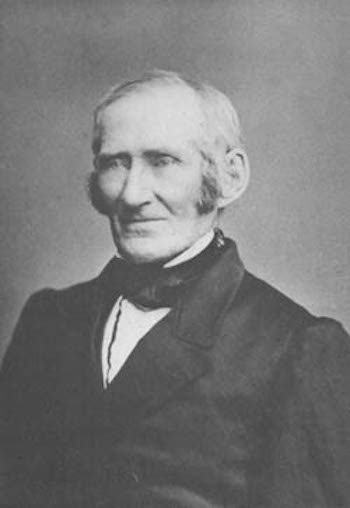
Journalist and abolitionist David Lee Child.
Birth of the First Interracial Academy in New England
In 1834, a group of prominent men from Maine, New Hampshire and Massachusetts hatched an ambitious and extremely controversial plan to build the first interracial, co-ed college preparatory school in New England. After years of failed attempts to launch separate Black academies in other states, all derailed by furious local opposition, the men had settled on a proposal to build an integrated school. By the summer of that year, they had raised the money and won the political support necessary to launch Noyes Academy in Canaan, N.H., about 30 miles east of Dartmouth College.
Moved by an intense moral and religious feeling, the abolitionists believed all men are created equal in the eyes of God. By building a school for white, Black, and female students, they believed they were putting Biblical teachings and the spirit of the nation’s founding documents into practice. Since nearby Dartmouth had accepted a very small number of Black students going back to the 1770s, the founders thought Noyes would serve as a preparatory school for that prestigious college.
On July 4, 1834, the school’s founders applied for, and were granted, an official charter by the New Hampshire Legislature. They proposed to open the school exactly one year later, Independence Day, 1835, “upon the principles of the Declaration of Independence.”
The well-respected founders knew they were putting their reputations on the line with such a radical proposal. Eighty-year-old farmer and Revolutionary War veteran Samuel Noyes, the academy’s namesake, was from one of the first white families that settled Canaan. Canaan businessman Nathaniel Currier and farmer George Walworth were involved in state and local politics as lawmakers.
Fourth founder George Kimball was an Underground Railroad conductor and Harvard-trained attorney who previously practiced in Warren and Union, Maine. According to historian William Allen Wallace, Kimball was a “gentleman of refinement and intelligence, companionable and of amiable disposition, a good storyteller and a writer of fair ability,” despite his “indolent” younger years. The school was to be built on land purchased next to the Congregational Church where the four men worshipped.
The Noyes Academy’s board of trustees included abolitionist writer David Lee Child, husband of famed anti-slavery author and one-time Mainer Lydia Maria Child; Massachusetts Anti-Slavery Society co-founder Samuel Sewell; abolitionist newspaper editor Nathaniel Peabody Rogers; town magistrate Dr. Timothy Tilton; and Portland pastor William C. Munroe, its only Black member.
When the trustees publicly announced the formation of the school on Sept 11, 1834, they drew upon Enlightenment principles and Biblical scripture to make their case:
“We profess to be republicans, not Jacobins nor agrarians; we think with a great and liberal Englishman, that political equality means ‘not a right to an equal part, but an equal right to a part,’ not a right to take from others, but an equal right with others to make for ourselves. We profess to be Christians, and we look with humble reliance for the blessing of him with whom “there is neither Greek nor Jew, Barbarian nor Sythian, bond nor free, but Christ is all in all.”
Despite growing abolitionist fervor in the region, Canaan was sharply split on the slavery question, as was the rest of the country, Wallace wrote in his 1910 history of the town. Opponents launched a campaign to halt the school.
On Aug. 15, 1834, a town meeting was held to debate the controversial proposal. Leading the opposition was Elijah Blaisdell, a former selectman and state lawmaker who, history records, was a miserable old cuss not well liked by many people. For example, in 1826, Elijah decided to campaign for a seat in the New Hampshire Legislature to succeed his Federalist father, Judge Daniel Blaisdell. The elder Blaisdell was appalled when he learned from a local drunk that his son had just been nominated to run during a “sly caucus” at the local tavern.
“WHAT!” the judge bellowed. “Lige Blaisdell for rep! Impossible! But who’s done it? He ain’t fit for it, more’n my old hoss, and I tell you he shan’t have it.”
With that, according to Wallace, the judge mounted said old horse and rode to the general store, where he announced to a crowd of customers, “Men, this will never do; because I was fit to hold office, it don’t follow that all the Blaisdells are fit for it, and I ought to be pretty well acquainted with them all. And then the way this nomination was made is unfair. A man that plays tricks even in politics, is unworthy of your votes.”
Soon after, Judge Blaisdell held a rival caucus at a store where the rum flowed freely, and one of Elijah’s spies was discovered and nearly lynched from a beam before being thrown into the cold night with only the rum to keep him warm.
Voters elected the younger Blaisdell anyway, and much to his father’s dismay, Elijah switched parties and became a Democrat when Andrew Jackson was elected president in 1828.
The Noyes Academy’s founders had no love for Elijah either. As the journalist and trustee Rogers warned Kimball when the founder moved to Canaan to practice law, “You have no bitter enemies except poor Elijah, and his enmity is as good as a [milk] cow to you in Canaan.”
In 1833, Elijah Blaisdell had moved with his family to Lebanon, 14 miles away, but when he caught wind of the academy plan, he returned to Canaan vowing to drive “the n——s out of our beautiful town.”
According to a diary entry that Wallace cited recounting the Aug. 15 town meeting, Kimball spoke with “considerable warmth and energy on the wrongs of slavery” and Rogers “spoke cheeringly of the future” of the school. Blaisdell, the diary notes, “with his usual malignant disposition, bitterly opposed the object of the meeting, as subversive of the cause of good morale.” However, the account continued, Blaisdell did “not win confidence in his assertions for his bitterness.”
Canaan residents were very supportive, in general, of building a school, because the children of the town would benefit, but Blaisdell knew support for integration was soft. While only about a quarter of the town was in Blaisdell’s camp, Wallace estimated, Canaan was never very welcoming of African Americans. As in most New England towns, the few Black churchgoers who lived there were segregated into the “Negro Pen” in the northwest corner of the church gallery, as far from the altar of God as possible.
At another town meeting, on Sept. 3, Blaisdell’s side showed up in force and passed a series of resolutions declaring their opposition to the academy. One resolution lamented the “hard fate of the African race,” but stated, “we are not prepared to sever the happy union of these states and imbue our hands in the blood of our brethren for the purpose of having Black Presidents, Black Governors, Black Representatives, Black Judges, nor for the purpose of gratifying the religious zeal of any class of discontented citizens.”
The anti-integration side expressed horror that the school would allow Black and white students to board together on campus, and would “compel their own children” to “associate with them.” The men pledged to “use all lawful means” to defeat the plan, but one attendee privately wrote later that they could sense a mob spirit in the air. According to Wallace, “Mr. Blaisdell took hold of the growing sentiment of opposition, petted it, rubbed it the wrong way of the fur, to irritate it.”
Nearly a third of the town’s registered voters supported the anti-integration resolutions, but the abolitionists would not be deterred. They began raising more money and hiring staff for the school that fall.
The following spring, as Noyes Academy prepared to receive students, Blaisdell and his cronies spread rumors that Canaan would soon be overrun with Southern Black “vagabonds, beggars, and paupers,” and crude shanties would pop up all over town. In April, a young Black woman who’s remained unnamed, and Thomas Paul, who become a progressive Baptist minister, were the first Black students to arrive. More Black students showed up in the following months, boarding with the families of founders Kimball and Currier. The hysterical rumors were proven untrue by the presence of only 14 Black students and 28 white students enrolled at Noyes.
One supporter of the school snidely remarked in a letter that the “whole slave population of the South” coming to Noyes Academy “shocks the sensibilities of the toothless, eyeless, senseless part of the community. The old, superannuated dotards sigh at the coming events, and wish they had never been born. Because, forsooth, a black man has come among us.”
What frightened Blaisdell and other male bigots the most was the prospect of lusty young Black men intermingling with the Yankee daughters of New Hampshire. Those fears were repeatedly stoked in the pages of the Federalist-leaning Concord Patriot. The editor of the paper expressed shock that Black students were invited to Kimball’s home for tea and sweets, where they were waited on by a white female servant.
“Since the establishment of the school, it has been no uncommon spectacle to witness colored gentlemen walking arm in arm with what ought to be respectable white females,” the Patriot blustered. “And that respectable people opposed to the school, as well as others, have been invited to parties where the colored portion of the school were also invited guests.”
As Noyes Academy students and the school’s abolitionist backers gathered to celebrate its official launch on the Fourth of July, there was a feeling of euphoria, a sense that they were making history in the fight for freedom and equality.
Just down the road, a crowd of 70 white men assembled with torches, axes and clubs, intent on making their own history.
Andy O’Brien is a writer and communications director for the Maine AFL-CIO. You can reach him at andy@maineworkingclasshistory.com.


One thought on “Radical Mainers”
Comments are closed.