Cops’ silence masks three decades of failed “gang” policy
Sometime before 8 a.m. on Saturday, Aug. 3, Bill Holmes, having recently awoken from a coma, shuffled, shoeless, out of a Portland hospital room with a hat atop his freshly fractured skull and hijacked a city bus to take him to breakfast. It wasn’t hard to do. Holmes, the most notorious “gang leader” in Portland since the Clinton Era, raised a hand beneath his hospital blanket to mimic a pistol and the driver, who knew Holmes from the neighborhood bars, chuckled and welcomed him aboard the empty Metro, sans fare.
The restaurant owner suggested Holmes take a break from the place for awhile. His presence was making staff nervous. There was good reason to believe armed and angry outlaw bikers were after Holmes, due to his involvement in the events of the previous Tuesday evening, which culminated in a hail of gunfire, multiple serious injuries and a woman’s death in the Meineke parking lot at Morrill’s Corner.
Law enforcement also apparently had strong reasons to believe Holmes had a bull’s eye on his back. Officers had been guarding his hospital room and, officially, Holmes wasn’t even there — visitors needed his patient pseudonym and a password to see him that week, sources say. Yet they allowed him to walk out and wander the sunny streets of downtown Portland in his socks, still dazed from heavy medication, like the proverbial duck in a barrel.
As this issue of The Bollard went to press, over two dozen days since that July 30 murder, Holmes was also — officially, at least — not at the scene that night, according to Portland police, who have refused to even name the injured victims. They did reveal the identity of the deceased: Susan McHugh, 54, of Gray, a promoter of hardcore punk and metal shows who was beloved by denizens of that scene. And press reports have subsequently sussed out that her husband, Troy McHugh, a friend of Holmes’, was seriously injured (there’s a GoFundMe campaign to aid his recovery). After initially reporting, erroneously, that McHugh’s son was treated at a local hospital that night, The Bollard identified the third injured man as New Hampshire-based military veteran and outlaw biker Kris Haken, who was released from the hospital later that night.
The cops have jailed a suspect in McHugh’s murder: Aaron Karp, 47, who worked at Almost Famous Tattoo & Piercings across the street from the muffler shop. Karp turned himself in to police at their Middle Street headquarters on Aug. 8 after learning there was a warrant for his arrest. On his Facebook page, Karp proudly identifies as a member of the Outlaws motorcycle club, a fact the Portland Press Herald reported the next day, but police have made no comment about the connection.
Portland Police Chief Mark Dubois “acknowledged the public frustration about the lack of information,” the newspaper reported Aug. 9, and told the Herald, “our top priority in every case is to make sure the individuals responsible are brought to justice. At times, this includes not providing details to the public that some may [see as] benign, but in the reality of the case, are very much not benign.”
So it appears we have an example here of competing realities. There’s the “reality of the case,” a crime seemingly so dangerous that even the victims must remain confidential. And then there’s the daily reality of people living and working amid what appears to be a budding outlaw-biker-gang war involving beatdowns at bars, hammer-wielding attackers and a shootout that could easily have become a Lewiston-level massacre.
Here in that reality, the people our armed gang of patch-wearing thugs are sworn to protect and serve are scared for their lives. For much of August, many regulars avoided neighborhood bars and grills where bikers or Holmes might show up. Be careful wearing, say, a black-and-white ballcap, went the word around town, as rumors blossomed like black mold in the information void, ratcheting up the very tension that makes a retaliatory attack more likely.
Holmes was personally banned from over half a dozen establishments in two cities and lost his job as a tattoo artist at a shop in Scarborough — all based on rumors of what happened that fateful night. Holmes declined to comment, but The Bollard’s investigation, based on off-record interviews with over three dozen sources, reveals the broad outlines of what went down.

Earlier on the evening of July 30, Holmes was at Brookside, the restaurant and bar in Westbrook not far from the Portland city line on Route 302. Sources say members of Higher Calling, a Christian-based motorcycle club affiliated with the Outlaws, were also at Brookside that night, and Holmes took offense to them wearing club patches there.
Brookside, which opened in 2020 next to Corsetti’s pizzeria and deli, had some problems with rowdy bikers early on, but patrons say those issues have long since been resolved. A visit last month revealed a friendly and remarkably diverse crowd enjoying trivia night — no bouncer required, though signs on the doors now more clearly state that club “colors” and other identifying gear are not permitted inside.
Steven Cope, a Portland attorney whose son, Adam Cope, co-owns Brookside and Corsetti’s, responded to The Bollard’s inquiry about the incident that followed.
“There was an altercation that occurred on July 30,” attorney Cope wrote via e-mail, “though from the restaurant’s perspective, it happened in the rear of the restaurant in the outdoor self service area, lasted only a few (5 or less) minutes and by the time it was brought to the attention of the manager, all involved had left the premises. The altercation did not involve any Brookside personnel and Brookside management was not aware of any details until a little later in the evening when the police initiated contact and pursued their investigation.”
“One of the persons apparently involved in the incident was an acquaintance of Adam’s,” Steven Cope wrote, “but none of the persons apparently involved in the incident has ever been employed, engaged or requested by Brookside, directly or indirectly, expressly or impliedly, to provide any security service or assistance at any time including but not limited to July 30.”
Sources say Holmes badly beat a Higher Calling member behind Brookside that evening and ripped the patch from his jacket — a deeply offensive insult in biker-club culture. Enraged, members of Higher Calling and Outlaws roared into Portland on motorcycles in pursuit of Holmes and confronted him in the Meineke lot, where he was with Troy McHugh and Susan McHugh’s son, Travis Frechette.
The Bollard obtained video of the attack that shows a group of about 10 people walking across Forest Avenue from the direction of Almost Famous and confronting a handful of figures standing behind cars parked at the muffler shop. It reveals two or more members of the group that crossed the street confronting two of those figures, one of whom falls to the ground after what appears to be a close-range gunshot and remains there. The second figure falls with the first and it set upon by a man who kicks and swings what’s believed to be a hammer at the prone figure before walking off.
As the second figure rises and begins staggering away, another attacker appears to limp forward, jerk and fall on the sidewalk as if struck from behind, but quickly stands and raises a handgun, discharging six shots. The second figure falls again, and a third figure can be seen ducking for cover between cars in the Meineke lot. At the end of the blurry, dark footage, the shooter appears to pick something up from the sidewalk, then walks back across the avenue.
In a separate surveillance video from a nearby location that Portland police released to the TV news, 18 shots can be heard and people can be seen “scurrying for cover,” WMTW reported. Sources say that if large vehicles subsequently found riddled with bullets had not been parked in front of the plate glass windows of Samuel’s Bar & Grill across from Meineke, the casualty count could have been much higher.
Holmes’ skull was fractured by either a glancing bullet, a hammer blow, or both. Troy McHugh suffered a serious gunshot wound, sources say, and police ruled his wife’s death a homicide by firearm. It’s possible one of the attackers was also struck by gunfire and fled the scene, based on other off-record accounts and the footage, but only three injuries and one death were reported by police.
You don’t have watch Sons of Anarchy to see where this is going or to know the only way this plot can be peacefully resolved. Holmes, who was a member of the Outlaws two decades or so ago, before they amicably parted ways, needs to make things right with the club’s leadership. Sources say Holmes, now a father of four pushing 50, assured his family he’ll return to the peaceful path and refrain from the violent retribution everyone expects him to exact, based on his legendary history.
But sources who know Holmes also say Portland police have made no effort to reach out to him in hopes of securing a ceasefire or truce while their secret investigation continues. Higher Calling did not respond to a request for comment regarding any outreach cops have made to their club since the shooting.
Members of the Outlaws and other supporters have been rallying behind Karp, who’s caged in the Cumberland County Jail without bail. A GiveSendGo crowd-fundraising page says this “friend, brother, and family man is fighting the State for his life … This is about right vs wrong and protecting someone falsely accused.” At press time, the campaign had raised almost $10,000 of its $200,000 goal to help cover Karp’s attorney fees.
Chief Dubois already effectively answered the central question here: How did this happen? Recall that his department’s “top priority in every case is to make sure the individuals responsible are brought to justice” [emphasis added]. The Portland Police Department has prioritized convictions and caging over public safety, generally, and the wellbeing of victims and rehabilitation of perpetrators, more specifically, for as long as anyone can remember. Had the top cops around here — including current Portland Mayor Mark Dion — been more invested in helping Holmes leave gang life when he was still an impressionable teen, instead of repeatedly prosecuting him, caging him and demonizing the kid in the press, the killing at Morrill’s Corner never would have happened.

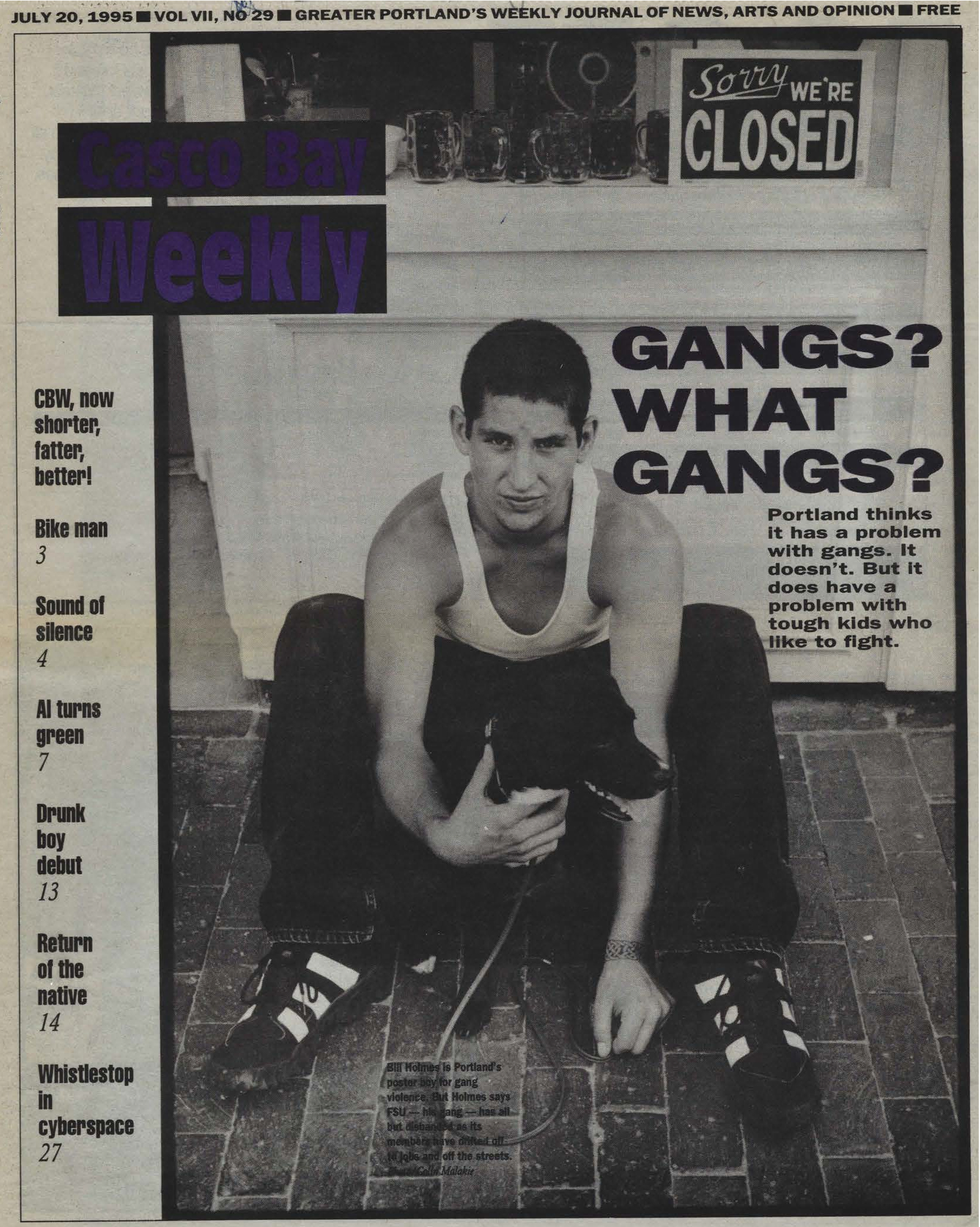
In a cover story for Casco Bay Weekly published in July of 1995 and headlined, “Gangs … What Gangs?” Christopher “Crash” Barry (a former Bollard contributor) wrote that Holmes, then 19, had “been in and out of jail and the Maine Youth Center [now Long Creek Youth Development Center, Maine’s brutal and understaffed children’s prison] since he was 16.” That summer, he was facing two felony charges for aggravated assault stemming from a brawl at an Old Port drinking party during which police alleged Holmes bit off part of a man’s ear (Holmes claimed it was self-defense).
“Holmes is a mother’s worst nightmare,” Barry wrote, noting that in addition to the cover of CBW that week, his scowling mug had been splashed on page one of the Press Herald’s Local section, and Maine and national media were identifying the teen as the leader of FSU (a.k.a. Fuck Shit Up), a gang that grew out of the hardcore music scene in Massachusetts, where they’d police the mosh pit against racist skinheads and other troublemakers.
At its height in the early ’90s, FSU had about 15 members, plus some hangers-on, Holmes told CBW in the summer of ’95, but by that year it had dwindled to only one, Holmes himself, as “members have taken jobs and drifted off the streets,” Barry wrote. That’s the usual way youth leave gangs — they just grow out of them, recognizing the lifestyle is generally incompatible with legal employment or stable family life.
Informed of this good news, Mayor Dion, then the Portland force’s deputy chief, said Holmes was lying. He told Barry, “gang members often declare their gangs dead to take some of the heat off,” the reporter paraphrased. Police told CBW the ragtag groups of troubled teens, most from impoverished single-parent or dysfunctional households, “are a source of much of the city’s violence” and a relatively new threat.
Dion weighed in with words that now sound prophetic. “What the community needs to understand is that years ago we had juvenile delinquents acting alone or with a friend,” he told CBW. “Now we have a group dynamic. Yes, we’re sounding the alarm. If we don’t, we’ll only be able to react when it’s a real crisis.”
The Bollard asked the Portland Police Department about its current approach to “gangs”: whether it’s primarily confrontational or more nuanced, involving respectful communication or even mutual acceptance in the service of public safety — an approach that’s markedly reduced violence in other cities.
Public Information Officer Brad Nadeau responded with a portion of a statement previously released by Major Bob Martin in which Martin tried to explain the department’s lack of disclosure regarding the July 30 shootout. “While we understand that people have questions and may be concerned for their own safety,” it read, in part, “the PD has a track record of communicating as quickly as possible as we can [sic], and we are confident that the public expects us to relay information only when it does not jeopardize the outcome of the investigation.”
“We will have no further comment at this time,” Nadaeu’s Aug. 22 e-mail concluded.
Mayor Dion, a former Cumberland County Sheriff and state lawmaker who’s also a lawyer for cannabis interests, did not respond to The Bollard’s questions about how law enforcement should best respond to “gangs,” and whether he saw any missed opportunities to steer Holmes onto the right track over the past three decades.

Sure enough, it took years, but FSU did grow again after Holmes’ CBW feature story, and eventually went from policing to organizing and promoting hardcore shows here and elsewhere in the region — a positive contribution to the community. If this “gang” has seriously crossed the law around here anytime this century, it hasn’t made the papers. Likewise, the Outlaws and Iron Horsemen, two motorcycle clubs whose clashes caused a stir in Maine last century, are said to have reached a handshake truce, and neither club has been linked to any newsworthy malfeasance in recent memory.
Then, as now, nearly all the (relatively rare) violence perpetrated by outlaw bikers, FSU, and long-forgotten menaces like the West End Wrecking Crew, Portland Area Skinheads (PASH), Time Posse (Munjoy Hill) and “Yellow Jackets” (Parkside, possibly) is committed against or among one another. Holmes, for example, definitely shot a Portland man: himself, in the upper thigh, after drunkenly shoving a handgun into his jeans pocket during a brawl — a near self-castration that reportedly turned him off firearms forever.
Reading the yellowed CBW clips, one sees a frustrated dropout trying to stay sober and find a job, a task made nearly impossible by his cop-fed media notoriety. Was Holmes one of those fearless “super predators” the Clintons were warning us about while they pushed through their infamous “Crime Bill”? This teenage Bill was facing years in prison and a lifelong felon tag. “I’ve never been this scared in my life,” he told Barry. Which sounds ironic, since authorities like Dion were saying at the time that we all should be afraid of him.
Again, sure enough, Holmes did end up in prison, but not for those drunken scraps in the Old Port. He graduated into the drug trade and did federal time, during which it’s rumored he had to cozy up to white supremacists to stay alive, but he didn’t bring that hateful ideology back into society. Since his release in the spring of 2012, the heavily inked Holmes seemed to be putting himself on the right track, finding success as a tattoo artist and a stable domestic relationship in Yarmouth. He’d pop into neighborhood pubs with his adorable little dog, Bob, unleashed, and was welcomed like a normal citizen, despite some lingering obnoxious behavior (by Bill; Bob’s a prince, and is said to be fine).
The local community, especially the neighborhood bar and tattoo crowds and owners, have done the most to suppress “gang” violence around here by doing simple little things like posting “no club colors” signs, or buying a felon a beer, or just not freaking out when a leather-clad, bearded biker steps through the saloon door. A small but compelling body of research indicates motorcycle “gang” problems significantly decline when cops stop treating club members like de facto criminals — and once that happens, more of the public will do the same.
In Norway’s capital city, police pursued a “harm reduction” strategy based on mutual respect and dialogue that “appears to have clearly reduced violent conflicts between outlaw motorcycle gangs in Oslo [and] helped to prevent the establishment of other outlaw gangs in the capital,” Tore Bjørgo wrote in the academic journal Trends in Organized Crime in 2017. Bjørgo also notes the success of the “Exit for bikers and gang members” program in Denmark, which helps those who wish to leave outlaw organizations find new jobs, housing, or even a new life.
In Ecuador, where bloody street violence was once endemic, the government legalized a number of gangs in 2007 and homicide rates subsequently plummeted, researchers David C. Brotherton and Rafael Gude note in a 2018 paper for the Inter-American Development Bank, “Social Inclusion from Below.” The legally recognized gangs worked with government agencies on economic and cultural initiatives for their communities, and with rival gangs. None of the once-outlaw groups wanted to lose the benefits legalization conferred, so street violence between them largely stopped.
It seems Higher Calling has had a very positive relationship with community leaders, local businesses and charities. In early August, Ian Tovell, Development and Marketing Director for Ronald McDonald House Charities of Maine, posted a picture on Facebook with HC members holding a giant check for $11,400. “For many years now, HCMMC has supported [RMHC] through Cayden’s Ride and by donating much-needed wish list items. This year, they have blown us away by DOUBLING their previous donation amounts through creative and fun fundraising ideas.” Last summer, Sanford’s community paper reported that Mayor Becky Brink met with members of Higher Calling and the “Club is open to suggestions from the Council for future fundraising efforts.”
“Praise be to the LORD my Rock, who trains my hands for war, my fingers for battle,” reads the psalm atop the group’s Facebook page. On its website, the club promotes “Charity,” “Loyalty” and “Respect,” with the latter defined as “showing all people the love of Christ through what we do and how we treat them. Each person brings value to the world and to God’s kingdom. We all have purpose, and we should treat all people mindfully and with great respect because God has deemed them of value.”
Social media and the Internet have helped bring outlaw clubs out of the shadows, and this is undoubtedly a positive development, helping to humanize a subculture that’s been smeared by authorities and the press for 75 years. But it’s not always helpful, and often reflects the adversarial relationships police here have done little or nothing to mend. “All cops are Cunts,” Karp, the imprisoned Outlaw, wrote on Facebook last March. “Talk Shit/Get Hit” reads a meme he posted there.
“People tend to think I will forget the shit they said,” reads another meme Karp posted to Facebook a year ago. “But there is no expiration date for disrespect.”