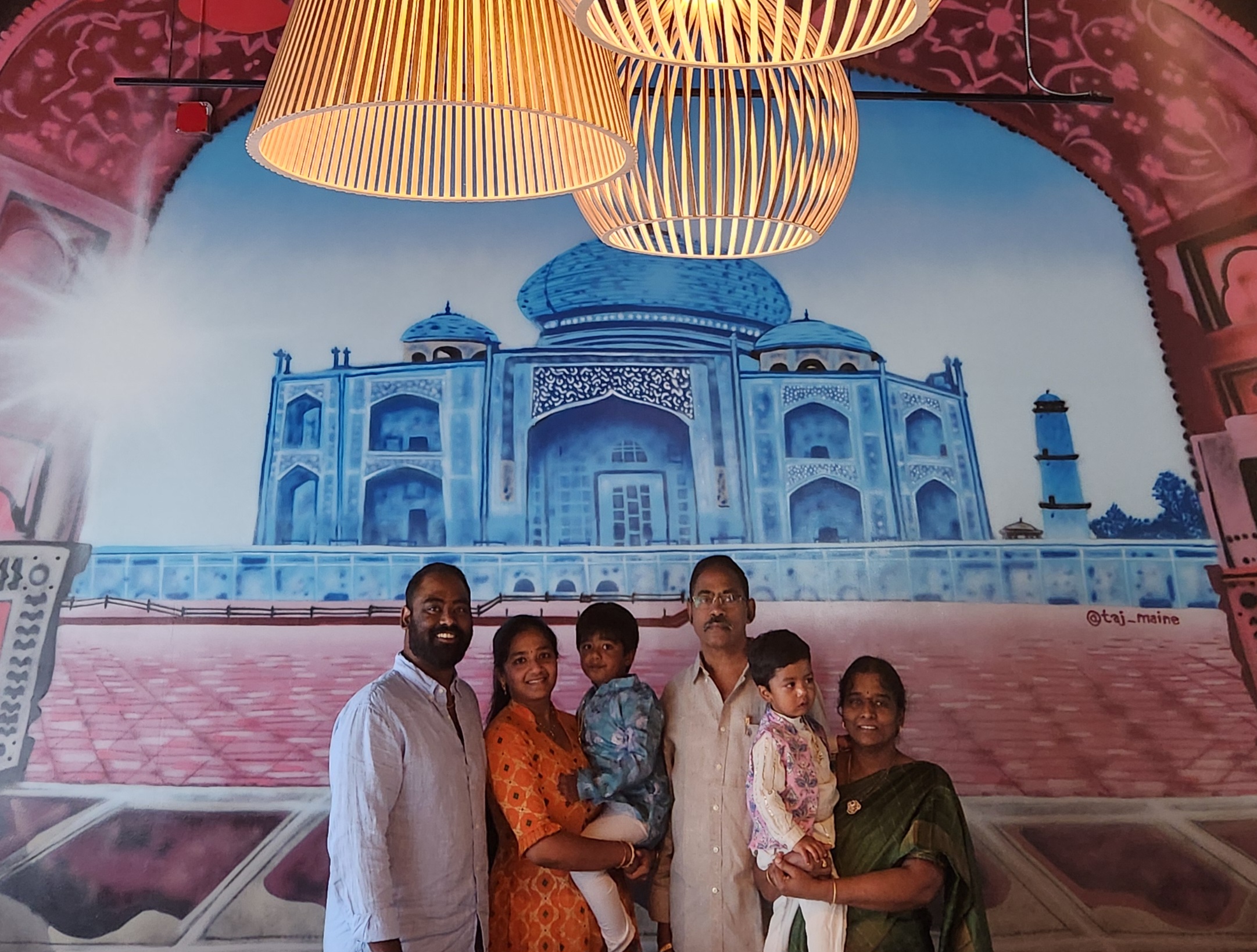
The Reddy Guntaka family (from left): Sai, Charitha, Geetansh, Sudarsana, Sidhansh and Hemalatha. photos/Kiki Garfield
How the Guntaka family makes the tastiest Indian food in Maine
In the spring of 2013, while researching what turned out to be the first of two exposés about the malevolence of celebrity chef Harding Lee Smith [“Satan’s Sous Chef,” July 2013], I’d bring up his name at bars and restaurants all around Portland. It was downright unnerving how, nearly everywhere, there was somebody — the bartender, a fellow customer, some dude in the kitchen — who had a horror story about Chef Harding.
This summer I did a similar thing, telling people I was working on a story about Taj, the Indian restaurant in South Portland near the Maine Mall. And once again, I got an earful.
One guy told me it took well over two hours to get food from Taj during the most recent pandemic.
“The dining room is like a cafeteria,” said a shop owner who prefers not to eat inside the place.
“Where they’re located, it looks like a chain restaurant,” observed Arlyn Vaughan, a chef at Coals pizzeria in Bayside. “It looks like an Olive Garden.”
Strong words, and he dished out more. “Their garlic naan is average,” said Vaughan, who cooked for two years at the long-defunct British-Indian eatery Haggarty’s in Portland. And every night he goes to Taj for takeout, there’s a homeless person loitering outside.
Here’s where I add that the first guy remembered that long wait only because Taj owner Sai Reddy Guntaka texted him later that same night to personally apologize for the delay. The shop owner who thinks the dining room has a cafeteria atmosphere loves Taj’s food and gets takeout all the time.
As does Vaughan, because average naan or not, he still thinks Taj has the best traditional Indian food around — especially his go-to, lamb vindaloo, a dish he said is hard to consistently find elsewhere. “I will give them all my money at least twice a week,” he said with a chuckle.
“Their food is so good,” Vaughan added, “and the fact that there’s a guy who’s struggling sitting outside that waits, and they give him something at the end of the night, makes it a little bit better.”
Sai’s mother, Hemalatha Reddy Guntaka, runs the kitchen, and sure enough, Chef Hemalatha can be very demanding. For example, Sai wanted waitstaff to serve water to every customer in glasses, but his mother put the kibosh on that quick and insisted on bottled water.

Why? Because the burden of handling all those water glasses would be too much for their beloved dishwashers. Whom they pay almost $30 an hour. How un-Harding of her.
By now you’ve caught on that Taj is an absolute jewel. Someone did have something to say about the place everywhere I went, and no one had a harsher comment than “average naan.” Instead, I got remarks like this, sent via e-mail from an ad client: “Also a big fan of Taj, so good.” “We absolutely love their food,” wrote another client last month, “in fact, ordering some now…”
Taj’s small, squarish, well-lit dining room is entirely open, cafeteria-style, but that too is a minor quibble — and one about to be irrelevant. On Aug. 6, Taj reopens in a gorgeous new space over three times larger than their original location and maybe 100 yards behind it — in the retail strip between The Point mega-church and the movie theater off Clarks Pond Parkway (also slated for reincarnation soon).
For the Guntakas, the new place is a dream coming true. “My whole family’s ten years’ of hard work is in this project,” Sai said last month in the new space, while power tools buzzed in the background. “Mom, dad, mine, my wife’s, everybody’s. So we are scared [it won’t succeed].”
But they aren’t making this leap without faith. The new restaurant and bar’s interior design, as well as the date of its grand opening, were divinely guided by their Hindu beliefs. And in a modern twist, even the location was seemingly preordained by all-seeing heavenly entities.
Is karma at play here? Possibly. But the path of Taj’s success is clearly paved with hard work, dedication to craft, and kindness.
The Guntaka family moved here from Texas in the spring of 2012. Hemalatha and Sai’s father, Sudarsana, had been working at Indian restaurants in Dallas and Austin for several years when they decided to start saving money for their own place … somewhere, anywhere. Sudarsana worked his network of friends and relatives, and a cousin who worked at Wright Express in South Portland (soon to be renamed WEX) told him about an Indian restaurant for sale near his office.
“We didn’t have a lot of money at that point,” said Sai, who’d recently graduated from high school. “We just decided, ‘Alright, we’ll give you whatever we got. Just give it to us,’” they told the previous owners. “And then they did.”
The building the family took over is owned by notorious Old Port mega-landlord Joe Soley. Other than cleaning and stocking the restaurant, the Guntakas kept it pretty much as it was when they bought it. Hemalatha handled the kitchen; Sudarsana manned front of the house and also did some cooking. They hired a dishwasher, a prep cook, and a baker for the tandoor oven. A new mother came in to help in the mornings for lunch service; Sai and his younger brother, Praveen Kumar, who was then still in high school, worked the dinner shifts and everything before and after.
Sai was also taking classes at Southern Maine Community College. Shortly before Taj’s opening day (June 12, 2012), he designed a small promotional flyer on his computer using Microsoft PowerPoint, printed out and hand-cut at least a couple thousand of ’em, and hit the road.
“I walked,” he recalled — “every single house in Scarborough, and I put the flyer on their door, like every single house in the Scarborough area by Scarborough High School. I walked, because I didn’t have a car at that point. And then I went to Hannaford, put one on every windshield. I did it myself, because we couldn’t afford any marketing.”
“And first it was great — good turnout,” Sai continued. “And then second day, we had ten people. We’re like, Shit.
“I was only eighteen, so I didn’t really have that stress, thinking about business,” he said. “My mom and dad were the ones that were thinking more. My mom was crying. She was like, ‘What do we do? What’s going on?’ Those [first] six, seven months, they were just kind of stressed.”
Business gradually grew, but late one night in November of that year they got terrible news. Sai’s uncle, Srinivas Reddy Guntaka, who’d been instrumental in bringing the family to the United States from India, passed away unexpectedly in Texas after minor surgery. The cash-strapped Guntakas bought same-day tickets and flew down; meanwhile, their new restaurant sat closed for about two weeks, its meager momentum spent.
When they returned, Hemalatha was dispirited. “I don’t know if I can cook anymore,” Sai recalled her saying. “I don’t know if I can get back into the work.”
“And then we did,” Sai matter-of-factly told me. “I mean, that’s life, so we did. We have to, we have no other choice. [My parents] don’t have anything else to do, and then we have the space invested.”
Gradually, customers returned and business picked up again. In 2015, the Guntakas were able to hire more kitchen help, a man Hemalatha had worked with at an Indian restaurant in Texas. Sai flew down to convince him to move to Maine. He still works at Taj, and recently became a father. In 2018, Hemalatha’s brother and his wife joined the team from the subcontinent.
About half the staff at Taj are family. Among the others are two African brothers who recently got their work permits. “We love ’em. We take care of them,” Sai said. “We pay about twenty-eight bucks an hour to them” — to wash dishes, pans, cutlery and glasses, but not too many glasses, thanks to Chef Hemalatha.
It was also in 2018 that Sai joined the family business full-time. After earning two advanced degrees, including a master’s in computer science from the University of Southern Maine, he’d taken a job at Maine Medical Center as a systems analyst, mostly for the health insurance benefits. He lasted about a year and a half.
“I couldn’t sit at a desk all day,” Sai said. “It was not for me, because I was working along with people all these years.”
When the world shut down a year or so later, Sai’s computer savvy came in handy as takeout ordering shifted online. But wary of scaring off customers by posting long estimated wait times, Sai made the mistake of low-balling it.
“We were putting only thirty minutes [wait time] and then, boom, fifty orders at a time,” he recalled. “Like everything at once. We were like, crap.” Thirty minutes turned into two hours or more for some customers. “And then everybody was so angry,” Sai said. “We were delivering each order to the cars outside. I got scared. I said, ‘Crap. What if everybody’s angry?’
“So I went online,” he continued. “I can see the orders that day from online. I opened up my computer that night at 11 p.m. I typed in … ‘Hey, this is Sai from Taj, I’m the owner of Taj. I apologize for the long wait you had tonight. I am so sorry. We did not expect that many orders. I hope you accept my apology. I know that it’s very frustrating.’ And then I copied each number, I typed it in, and then I typed in their name personally. … I know each customer. I didn’t send the same message to everybody, because I know who waited when, because I was there every day.
“Most people replied being like, ‘Don’t worry. Thanks for the message,’” Sai said. He directed staff to post more accurate estimates, regardless of how long. “Thankfully, thank God, people were so understanding.”
Sure, there’s that. And there’s the inarguable fact that Taj’s food is worth a two-hour wait.
Start with the spices, the defining, foundational ingredients of this cuisine. For the first few years, the Guntakas bought them from sources in the States or, indirectly, Canada, like most restaurants do. But eventually, Sai said, “We’re like, ‘What is this?’ We’re also eating it. It’s all chemicals. We said, ‘Let’s just go to India.’”
“My mom and dad, they go to India three, four times a year,” said Sai. “They handpick the spices themselves. They import ’em. They bring them with their baggages sometimes, they declare it at customs. … And then sometimes we just ship them directly through FedEx or DHL. We don’t buy any spices here, at all. Because everything here, all the spices here … it’s kind of chemicals. It’s not natural. They’ve had a lot of pesticides and all that.”
Everything on the menu, which encompasses Northern and Southern Indian dishes as well as Indo-Chinese offerings, is made fresh in-house, every day. The kitchen crew cooks all the stocks and sauces twice a day, for lunch and again for dinner service. No rice cookers here for the basmati (also imported from India, naturally). Chef Hemalatha’s masala is made with Indian spices she carried here over her shoulder.
Any leftover food is delivered by Sai and his staff to local homeless shelters each night, or handed to any hungry soul who shows up around closing time. “My mom and dad, they feel like food brings people together, and nobody should go hungry,” Sai said. “If we can afford to feed people, we will. … Whatever I could do, I will do it. Whatever they can do, they will do it.”
The Guntakas plan to keep leasing their original space, and the idea at present is to make it an Indian café, serving authentic Chai teas and the like mornings and early afternoons, under the direction of Sai’s wife, Charitha. “We’re not doing that to bring up a lot of money,” Sai said. “I’m kind of attached to that building, because we are where we are today because of that space, so I don’t want to lose that space. My wife wants get involved in feeding homeless people from that location, for lunch. At dinner, we’re gonna be feeding from here.”
Taj’s original location is only 1,300 square feet. The new space is 4,700. The kitchen is palatial, designed to maximize both the productivity and the comfort of the cooks and preppers and scrubbers. In the buffet room, a huge mural by local graffiti artist Mike Rich catches the light of numerous hanging fixtures. The plan is for Rich to also do a big mural out back, where there’ll eventually be patio seating.
The dining room is no one’s idea of a cafeteria. Walnut and dusky emerald tile surround the warmly lit, tin-ceilinged space. Smoked and speckled glass behind the bar reflects a radiant wall piece by Portland’s “Neon” Dave Johansen. Nearly all the suppliers and contractors on Taj’s project are independent Maine companies, like the architecture and construction firm Woodhull, whose enthusiasm for this job was stoked by its team’s enthusiasm for Taj’s food.
The new restaurant’s software system is not, strictly speaking, local. It’s from Toast, a company headquartered in Boston, whose CEO is (you guessed it) another happy Taj customer. And the new tandoor oven crossed the Atlantic from the U.K.

Sai is especially excited about the bar, a feature the old Taj never had. He’s brought on Jim Baldi, a longtime bartender at The Bar of Chocolate Café in the Old Port, to craft cocktails inspired by the subcontinent’s spices and other flavors. The espresso martini there will be made with beans imported and roasted for Taj by Tandem Coffee Roasters. Oxbow Brewing Co. makes Taj’s signature Sai Lager.
All the point-of-sale screens face north or northeast. Sai deferred to Charitha to explain why, and she began, “Most of the Hindus believe that…” and then uttered a noun (perhaps a proper one) beyond this reporter’s ability to transcribe, awaiting Sai’s translation.
“Devils,” Sai said.
“Not ‘devils’! No!” Charitha exclaimed with a laugh, then explained that the Hindu god most commonly known as Yama “is the one who takes our life, who takes our soul when you’re dead. So he stays in the south, and all the [other] gods stay in the east and north, the northeast corner.” Awakening facing north or northeast — or pointing POS screens in that direction — is believed to encourage good fortune.
Sai’s initial plan was to open the new place July 6. But the gods had other plans. Or, as Sai put it, “then my mom got back from India.”
“‘It’s not a good day. It’s not a good month,’” Sai said his parents told him. “‘We cannot do anything new … we cannot open a business.’ Because they have a [religious] calendar that they look at.”
Sai was pissed. “I was so excited to have this thing open up, come to life,” he said. Plus he’d been telling everyone, including lots of customers, that July 6 was the big day. “I finally agreed,” said Sai, “and then we saw the calendar, we called the priest: ‘When’s a good day?’ He told us August 6th, that week is good, we can open.
“But I’m glad,” Sai added, “because [the project] took a little bit longer too, so I guess everything happens for a reason.”
That does appears to be the case here. Consider this: every time a new customer put Taj’s original address (200 Gorham Rd.) into their navigation software, the GPS brought them to 333 Clarks Pond Parkway, the new place’s address. “The past ten years, every day, I’m on the phone, being like, ‘Oh, we’re not there. … Come here. Come to this small road’” linking the two shopping-center parking lots.
“I guess,” Sai concluded, “it’s just meant to be.”