photos/Zack Barowitz
For a short time back in the 1990s, I dated a woman who worked as a domestic policy advisor for Hillary Clinton. I was, naturally, very curious about what the First Lady ate for lunch, but she refused to tell me — claiming, with tetchy exasperation, ignorance. But I knew she knew, so I pressed her until one day she finally blurted out, “Gourmet sandwiches!”
That seemed plausible. Gourmet sandwiches were a thing back in the ’90s, and seemed in character with the sophisticated yet practical conception of Hillary at the time.
We don’t hear the adjective gourmet much anymore (craft and artisinal are more common), but it’s a useful concept to explore. In the Clinton Era, a gourmet sandwich might’ve had grilled chicken (in contrast to the lumpenproletariat practice of frying), pesto, fresh mozzarella, sundried tomatoes, prosciutto and other ingredients that are now considered pretty standard sandwich fare. But it’s perfectly possible to spend a lot of money on fancy ingredients and produce a sandwich no better than something slapped together for a kid’s lunchbox. That’s because — contrary to the neoliberal, individualist, Clintonian world order — the ingredients themselves are less important than the ways they work together.
So, yes, it takes a village to make a great sandwich — in this case, a village in Vietnam. It was during the Clinton Era that I first started seeing bánh mì(then simply called “Vietnamese sandwiches”) for sale at small markets in Asian neighborhoods in New York. The sandwich created a sensation not only for its unconventional ingredients, but due to its harmonious balance of flavors and textures (sweet, sour, piquant, umami, aromatic; soft, chewy, crunchy), and of food cultures (French and Vietnamese).
Fifteen years ago, I wrote a feature story for this publication about Kim’s Sandwich & Café, on St. John Street in Portland, and owner Kim Tran’s “French sandwiches,” which sold for [trigger warning] $2.95 [see “Off the Eatin’ Path,” March 2008]. Kim’s wasn’t the first bánh mì in Portland, but her fresh ingredients and authentic presentation set the standard, and prices for the sandwich have been rising ever since. I’ve recently seen them on menus for as much as $17.
Kim’s closed years ago, but you can still get good ones at Sun Vietnamese Restaurant or Veranda Market, both in Woodfords Corner, for around eight dollars. Yet let’s face it: you’re holding a free magazine in your hands. Chances are, you’d like to save a buck or two by making it yourself.
At the dawn of the Obama Era, I observed that bánh mì “have been known to include everything from scrambled eggs to sardines … meatball and shredded tofu,” but the most popular combination was the classic cold-cut version, bánh mì dac biet, which typically includes pork roll, head cheese, ham, pâté, and sliced sausages. That’s still the case around here.
Beyond some basic pickling knowledge and knife skills, you don’t need any expertise to make great bánh mì. You just need to stick to the proper elements that, combined in the right order, make sandwich magic: bread, herbs, fresh and pickled vegetables, and proteins. As noted, there’s ample opportunity to use your imagination when it comes to the protein. Here, I offer three variations: cold cut (dac biet), lobster (you heard it here first!), and vegetarian (using pressed five-spice tofu).
Banh me!
It’s pretty important to use the bánh brought up twice weekly from Boston and sold in packs of six in stores like Serey Pheap, Haknuman Meanchey and Veranda Asian Market. Yes, you can use a French baguette, but that’s kinda like eating a hot dog on a bagel (not bad, but far from the best). An Italian roll from Botto’s Bakery in East Deering also might work in a pinch. If you can’t find the right bread, or you’re gluten-free, the ingredients can go into fresh spring rolls or a bowl with rice noodles (I’ve had good luck with Three Ladies Brand rice stick vermicelli).
It’s also important to first bake the bánh again, unsliced, for three or four minutes (at about 375), so the crust is firm, but don’t let it brown further. Bánh contain rice flour, which makes them airy. They should feel like a hollowed-out eggshell. Let them cool before slicing so the mayonnaise (I use Kewpie) doesn’t melt.
Herbs and veg, fresh and pickled
Preparing the pickled carrot and daikon is the most labor-intensive step. Cut the veggies a little longer and thicker than a julienne and soak/store in a solution of salt, sugar, water and vinegar for a few hours, until they’re pliable. The goal is a slightly sour flavor with balanced saltiness and sweetness. You can also purchase pints of brined carrot and daikon at Veranda Market for about $6 that’ll make a dozen or so bánh mì.
Fresh veggies include cucumber and scallion (white onion’s OK) cut into long, narrow strips, and diced hot peppers — typically jalapeno, but the little Thai peppers have more oomph.
Cilantro is the most commonly used herb in bánh mì, but you’ll discover a great variety of other options at shops like Veranda and Serey Pheap, such as rice patty herb (ngo om), green-and-purple Vietnamese perilla (tía tô), and fish mint (diếp cá), so named for its taste. Culantro, or Sawtooth Herb (ngò gai), is always a safe bet; it tastes similar to cilantro, only hardier, earthier, and with more crunch.
Proteins, animal and otherwise
You’ll need to go a Southeast Asian grocery store to get the Vietnamese cold cuts. Serey Pheap sells the realVietnamese pâté gan gà, which comes in frozen tubes. Once thawed, it’s soft and squishy, with the texture and consistency of warm polenta. Apply it to the banh before the mayonnaise.
A plausible dac biet has several kinds of Vietnamese “deli” meats, such as cha lua (finely ground pork loin flavored with fish sauce and steamed in a banana leaf), head cheese and roast pork (you can substitute baked ham or turkey in an emergency), plus thin slices of cold sausage, like Tay Ho Food Company’s cured pork hock links.
Head cheese is the most challenging ingredient both to find and to get comfortable with. It’s a terrine, or meat jelly, made from the boiled head of an animal, usually a pig. Flesh from the snout, ears, cheeks and mouth is reintroduced to the strained broth and set into a gelatin that can be cut into slabs or slices. Medeo European Food and Deli will put it on the meat slicer, but Bogusha’s Polish Restaurant & Deli will not (“Cut it yourself — people are so lazy these days!”).
I found a frozen package of Vietnamese head cheese (gio thu) at Lo’s Seafood & Oriental Market in Portsmouth that was just snout and aspic. If you really can’t deal with head cheese, find a suitably fatty salami at a deli like Micucci’s, on India Street. But I strongly suggest you explore the freezers in Asian markets. You’ll discover a new world of sausages and sliced meats, as well as affordable shrimp, and the condiment aisle has fun sauces to accompany them.
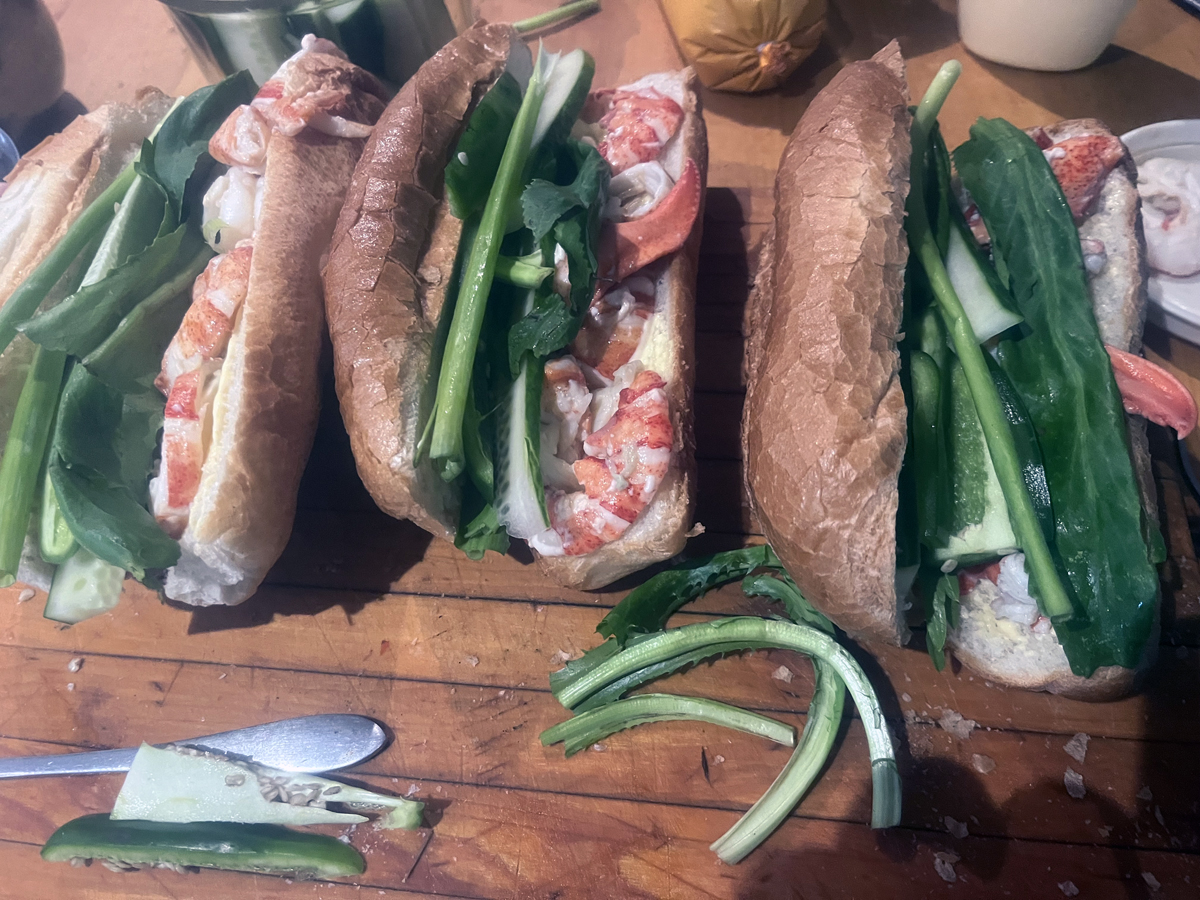
For my lobster version, the claw and tail meat needs a little boost to groove with the other ingredients. Favorite flavorways of mine include a mixture of fish sauce, lemongrass and hot oil; an Asian barbeque sauce; a sprinkling of nori or kelp; or even a light coating of black bean sauce. I advise buying pre-cooked lobster, since you’ll be eating it cold, anyway. A single one-pound lobster will supply about three bánh mì.
For my vegetarian version, I think pressed five-spiced tofu (available at Hong Kong Market) is as good as any of the multitude of options. It has the texture of a hot dog and about as much flavor. Slice it, top it with barbeque sauce, and grill it in a toaster oven for three minutes (or pan fry it and let the sauce carmelize in the pan). Serve warm, and Biden to it as soon as possible!

SOURCING THE INGREDIENTS
Bogusha’s Polish Restaurant & Deli
825 Stevens Ave., Portland
878-9618
Haknuman Meanchey
803 Forest Ave., Portland
347-5029
Hong Kong Market
945 Congress St., Portland
772-8688; hongkongmarketmaine.com
Lo’s Seafood and Oriental Market
1976 Woodbury Ave, Portsmouth, NH
603-431-0022; losseafood.com
Medeo European Food and Deli
529 Main St., Westbrook
854-4020
Serey Pheap Market
229 St John St., Portland
747-5506
Sun Vietnamese Restaurant
699 Forest Ave., Portland
613-9036; sunvietnameserestaurant.com
Veranda Asian Market
695 Forest Ave., Portland
874-8001